On this page
How to identify it
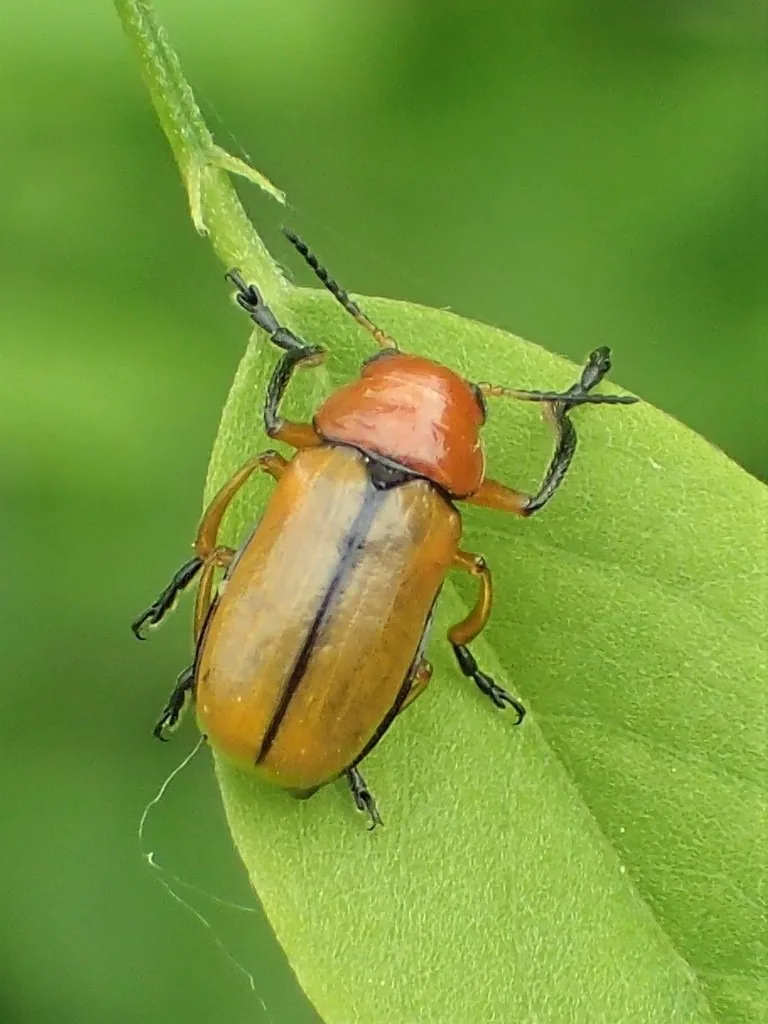
- Adults are about 3/8 inch long (7 to 9 mm in an Iowa study) and brown to reddish brown.[1][2]
- A dark line runs down the inner and outer edges of each wing cover, so the beetle shows a black stripe down the middle of its back and one along each side.[1]
- The larvae are case-bearers: each wears a pouch made of its droppings and bits of leaves.[1]
Where it lives
It is found throughout North America east of the Rocky Mountains, from the Great Plains eastward.[2][1]
Biology and life cycle
Host plants vary by region. In North Carolina most records are from persimmon; elsewhere in the Southeast it has been found on azalea, oak, willow and wisteria; and on Great Plains prairie it seems to feed only on leadplant (Amorpha canescens).[1][2]
In Iowa, adults are out from mid-June to late July, feeding on the developing leaves and immature flower spikes of leadplant, and mating on the plants. They are gone by the time the flowers open.[2]
Females lay eggs inside cases made of fecal material, on the ground or on leaves, and ants may carry the egg cases off.[2][1]
The larvae feed on leaves while living in their cases.[1]
In Iowa there is one generation a year.[2]
It moves very little: in the Iowa study no marked beetle traveled even 1 kilometer, and numbers at a site peaked and dropped off within about 15 days, although the species may be present for about six weeks across the region.[2][1]
Damage and signs
Health risk
It is a leaf-feeding beetle; NC State and the Iowa study describe no risk to people.[1][2]
Control
Pesticides
NC State says bifenthrin, permethrin or another pyrethroid labeled for landscapes should control it if needed. Pyrethroids also repel insects, so a treated tree becomes unattractive to other beetles and bees, and they are toxic to fish: keep them away from pools, ponds and streams.[1]
Common questions
- What is the small striped beetle on my persimmon tree?
- It may be the clay-colored leaf beetle, also called the persimmon leaf beetle: about 3/8 inch long, brown to reddish brown, with a black stripe down the back and one on each side. In North Carolina most records come from persimmon.[1]
- What are the little brown cases stuck to the leaves?
- Clay-colored leaf beetle larvae live inside cases made of their droppings and leaf bits, and the eggs are laid in fecal cases on leaves or on the ground.[1][2]
Sources
- NC State Extension, “Claycolored Leaf Beetle (J. Baker; reviewed 2025).” content.ces.ncsu.edu/clay-colored-leaf-beetle (accessed 2026-11-08)
- Ecological Entomology (Royal Entomological Society / Wiley), “Dispersal ability and host-plant characteristics influence spatial population structure of monophagous beetles (M. J. St Pierre, S. D. Hendrix and C. K. Lewis), Ecological Entomology 30: 105-115 (2005).” doi.org/10.1111/j.0307-6946.2005.00659.x (accessed 2026-11-08). Read via Wiley full-text passages (abstract, Methods, Discussion).
- iNaturalist, “Anomoea laticlavia taxon page (order and family).” www.inaturalist.org/taxa/213717 (accessed 2026-11-08)