On this page
How to identify it
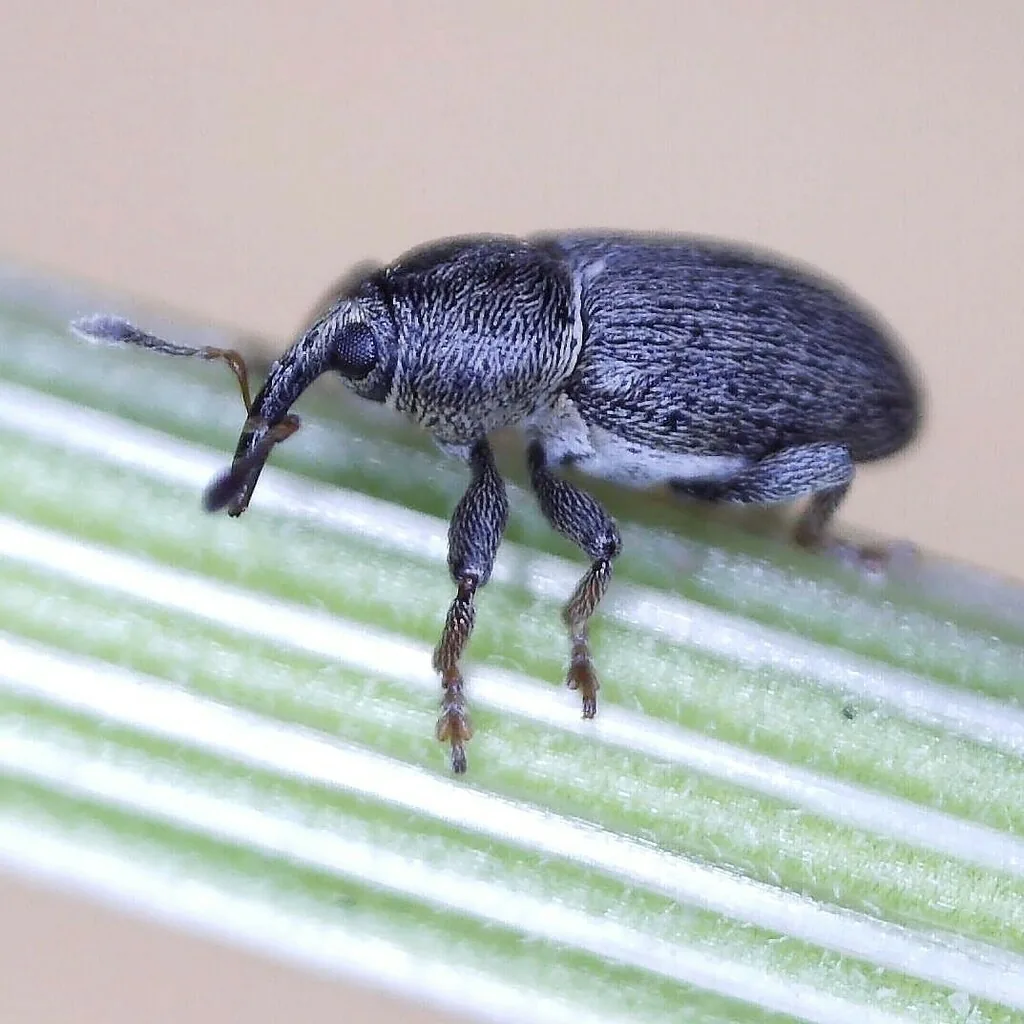
- A small gray weevil about 0.1 inch long, found on clover flower heads during bloom.[1]
- The damage is inside the pod: larvae feed within developing seeds and destroy two to four seeds in each pod they infest. Larval counts, extracted from flower heads with a Berlese funnel or a grower-built funnel, are the measure that correlates with seed-yield loss.[1][2]
Look-alikes
| Look-alike | How to tell them apart |
|---|---|
| Lesser clover leaf weevil and clover leaf weevil (Hypera) | Other weevils the handbook lists as separate pests of clover grown for seed; the clover seed weevil is the one whose larvae are inside the pods.[1] |
| Clover root curculio | Another weevil in the handbook's clover seed section, treated as a separate pest.[1] |
Where it lives
A serious pest of white clover grown for seed in western Oregon's Willamette Valley, where it needs routine control; the Oregon resistance study used a susceptible Canadian field population for comparison.[1][3]
Biology and life cycle
Adults feed during bloom and larvae feed within the pods and destroy the seeds. A second generation of weevils appears in fields near harvest, but these neither harm seeds nor lay eggs and need no control.[1]
Hosts are alsike, white, arrowleaf and ladino clover; red clover is not attacked.[1]
Damage and signs
- Larval feeding destroys two to four seeds per pod and can seriously infest white clover seed crops; in Oregon State trials larval abundance was correlated with reduced seed yield, though differences among insecticide treatments did not translate into measurable yield differences in large plots.[1][2]
Health risk
A seed-crop pest only; the sources describe no effect on people.[1]
Control
Prevention
Scout flower heads for larvae. Oregon State set a conservative economic threshold of three or more larvae per 30 inflorescences to justify a diamide spray, and found a standard Berlese funnel and a grower's do-it-yourself funnel gave similar larval counts.[2]
Red clover is not a host. Second-generation weevils present in the field near harvest neither harm seeds nor lay eggs and do not warrant treatment.[1]
Pesticides
Time any application after pollination, when the first blooms turn brown and the bees have left the field. In trials, isocycloseram reduced adults when applied just before bloom and cyantraniliprole reduced larvae when applied at full bloom. Bifenthrin, though still labeled, gave negligible suppression of adults or larvae, and the handbook warns that continued use will likely increase weevil numbers by harming predators; malathion showed limited efficacy and Oregon populations have low to high resistance to it as well. Rotate modes of action rather than repeating pyrethroids.[1][2][3]
Common questions
- My bifenthrin spray did nothing to the weevils in my white clover. Why?
- Oregon populations are highly resistant: resistance ratios of roughly 180 to 730 to bifenthrin, with more than 2.7 times the labeled rate needed to kill half the weevils in topical tests, through detoxifying enzymes. Repeating the spray is more likely to raise the population by killing predators.[3][1]
- When is the right time to treat?
- After pollination, when the first blooms turn brown and bees have moved out; research timing was just before bloom for adults with isocycloseram and full bloom for larvae with cyantraniliprole, triggered by a count of three or more larvae per 30 flower heads.[1][2]
- Does it attack red clover?
- No. It infests alsike, white, arrowleaf and ladino clover but not red clover.[1]
Sources
- Pacific Northwest Pest Management Handbooks (Oregon State University, Washington State University and University of Idaho), “Clover seed-Clover seed weevil (PNW Insect Management Handbook).” pnwhandbooks.org/insect/legume-grass-field-seed/clover-grown-seed/clover-seed-clover-seed-weevil (accessed 2026-11-10)
- Journal of Economic Entomology (Entomological Society of America), “Tiwari, Kaur, Anderson, Tanner, Lightle, Willette, Donovan and Dorman (Oregon State University). Evaluating foliar insecticides and economic thresholds for Tychius picirostris (Coleoptera: Curculionidae) in white clover seed crops. Journal of Economic Entomology 117 (2024), PMID 39001690.” pubmed.ncbi.nlm.nih.gov/39001690/ (accessed 2026-11-10)
- Journal of Economic Entomology (Entomological Society of America), “Tiwari and colleagues (Oregon State University). Field-evolved pyrethroid resistance in Tychius picirostris (Coleoptera: Curculionidae) populations in Oregon white clover seed crops. Journal of Economic Entomology 117 (2024), PMID 38284646.” pubmed.ncbi.nlm.nih.gov/38284646/ (accessed 2026-11-10)
- iNaturalist, “Tychius picirostris taxon page (order and family).” www.inaturalist.org/taxa/233118 (accessed 2026-11-10)