On this page
How to identify it
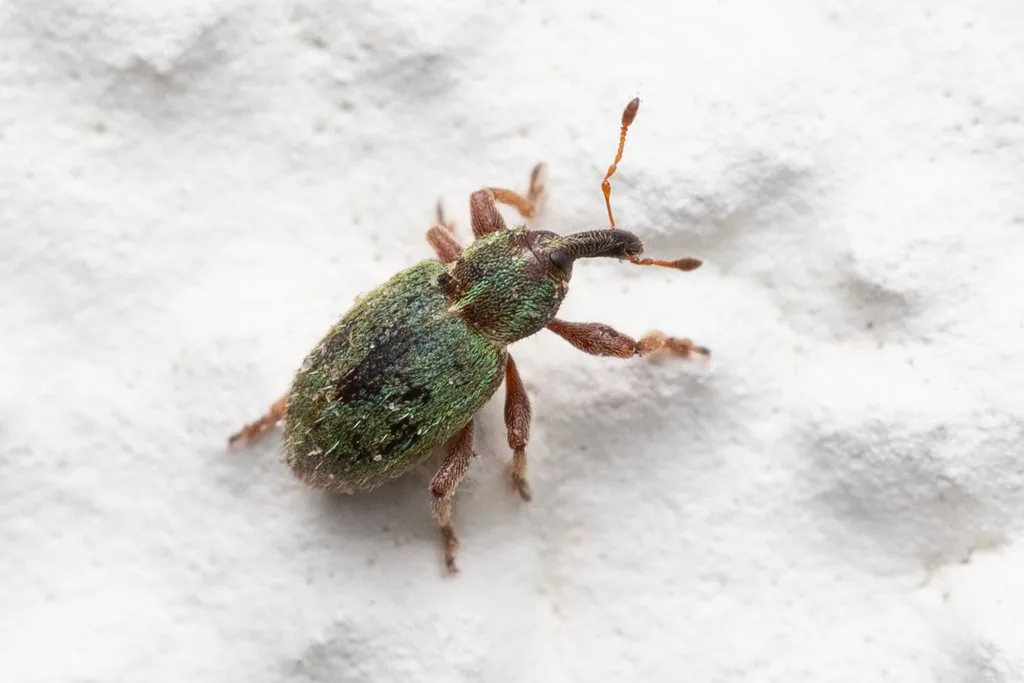
- Adults are green or brown weevils. The handbook treats this as a separate pest from the clover leaf weevil, clover root curculio, clover root borer and clover seed weevil that share the same crop.[1]
- iNaturalist lists Hypera nigrirostris under the common name black-beaked green weevil.[4]
- The damage pattern identifies it. Larvae feed under the basal leaf sheath, tunnel in the stem, and feed on the florets in developing flowers, so in Saskatchewan sampling they were found on stipules, buds and flowerheads rather than on open foliage.[1][3]
- Larvae pass through four instars, and pupae are found on the shoots and in plant debris.[3]
Look-alikes
| Look-alike | How to tell them apart |
|---|---|
| Clover leaf weevil | The other leaf-feeding clover weevil listed in the same handbook section; the lesser clover leaf weevil is the one whose larvae tunnel in stems and feed in the flowerheads.[1] |
| Clover root curculio | Another clover weevil in the same crop, treated as a separate pest; its larvae attack roots rather than buds and flowers.[1] |
| Clover seed weevil (Tychius picirostris) | Also a bloom-time pest of clover grown for seed, but its larvae develop inside the pods destroying seeds, and it is mainly a pest of white clover.[1] |
Where it lives
A pest of clover grown for seed in the Pacific Northwest, where the regional handbook carries management guidance for it, and a key pest of red clover seed crops in Western Canada, where the thresholds research was done on farms in Saskatchewan.[1][2]
Biology and life cycle
In Saskatchewan red clover fields, adults overwinter in the clover and begin feeding, mating and laying eggs in late April and early May. Eggs are placed under the surface tissue of stipules, shoots and leaves from early May to mid-July.[3]
Larvae were collected from early June until mid-August and were found on stipules, buds and flowerheads; pupae turned up on shoots and in debris from late June into August. New-season adults appeared first in mid-July, and the sharp rises in adult density tracked their emergence.[3]
Eggs and larvae are clumped rather than spread evenly through a field, with the clumping easing as the larvae develop, which matters when designing a sampling plan.[3]
Damage and signs
- Larvae feed under the basal leaf sheath, tunnel in the stem and eat the florets of developing flowers. The crop affected is mainly red and alsike clover.[1]
- In red clover grown for seed, larval feeding can reduce seed yields by as much as 50 percent, and on-farm trials found yield loss strongly associated with increasing larval density.[2]
Health risk
A field-crop pest; the sources describe damage to clover only.[1]
Control
Prevention
Sample for larvae rather than spraying on a calendar. University of Saskatchewan researchers built the first data-driven economic injury levels and practical thresholds for this weevil in North American red clover seed systems, with the thresholds shifting as seed prices change. Before that work there were no thresholds, so prophylactic treatments were the norm, raising costs, the risk of insecticide resistance and the risk to pollinators the seed crop depends on.[2]
Because pollinators are essential to red clover seed production and bloom coincides with larval feeding, timing matters as much as product choice: the label restrictions on blooming crops and bee activity are the practical constraint on treating this pest.[1][2]
Pesticides
The regional handbook lists bifenthrin and chlorantraniliprole for this pest in clover grown for seed. Bifenthrin must not be applied to a blooming crop or allowed to drift while bees are actively visiting bloom, is limited to three applications a crop year with at least 21 days between them, and treated clover may not be grazed or cut for hay or forage; its use on clover seed is under Oregon and Idaho special local need labels. Chlorantraniliprole has a zero-day preharvest interval and a four-hour restricted entry interval and is limited to four applications a calendar year. Follow the label in hand, since rates and restrictions change.[1]
Common questions
- How much yield is at stake?
- In red clover grown for seed, larval feeding has been shown capable of cutting seed yields by up to 50 percent, with losses rising as larval density rises.[2]
- When are the larvae present?
- In Saskatchewan sampling, from early June until mid-August, on stipules, buds and flowerheads, with eggs laid from early May to mid-July and new adults appearing from mid-July.[3]
- Can I spray during bloom?
- Not with bifenthrin: its label prohibits application to a blooming crop or drift while bees are actively visiting. That restriction, plus the crop's dependence on pollinators, is why threshold-based decisions matter here.[1][2]
Sources
- Pacific Northwest Pest Management Handbooks (Oregon State University, Washington State University and University of Idaho), “Clover seed-Lesser clover leaf weevil (PNW Insect Management Handbook).” pnwhandbooks.org/insect/legume-grass-field-seed/clover-grown-seed/clover-seed-lesser-clover-leaf-weevil (accessed 2026-11-10)
- Journal of Economic Entomology (Entomological Society of America), “Irvine and Prager (University of Saskatchewan). Economic thresholds for Hypera nigrirostris (Coleoptera: Curculionidae) in red clover seed production from on-farm trials. Journal of Economic Entomology 119 (2026) 229-236, PMID 41165615.” pubmed.ncbi.nlm.nih.gov/41165615/ (accessed 2026-11-10)
- The Canadian Entomologist (Entomological Society of Canada, Cambridge University Press), “Weiss and Gillott (University of Saskatchewan). The biology of the lesser clover leaf weevil, Hypera nigrirostris (Fabr.) (Coleoptera: Curculionidae), on red clover, Trifolium pratense L., in Saskatchewan. The Canadian Entomologist.” www.cambridge.org/core/journals/canadian-entomologist/article/biology-of-the-lesser-clover-leaf-weevil-hypera-nigrirostris-fabr-coleoptera-curculionidae-on-red-clover-trifolium-pratense-l-in-saskatchewan/4EC37DD3294B023FF11AFC42E493D6AD (accessed 2026-11-10)
- iNaturalist, “Hypera nigrirostris taxon page (order and family).” www.inaturalist.org/taxa/221981 (accessed 2026-11-10)