On this page
How to identify it
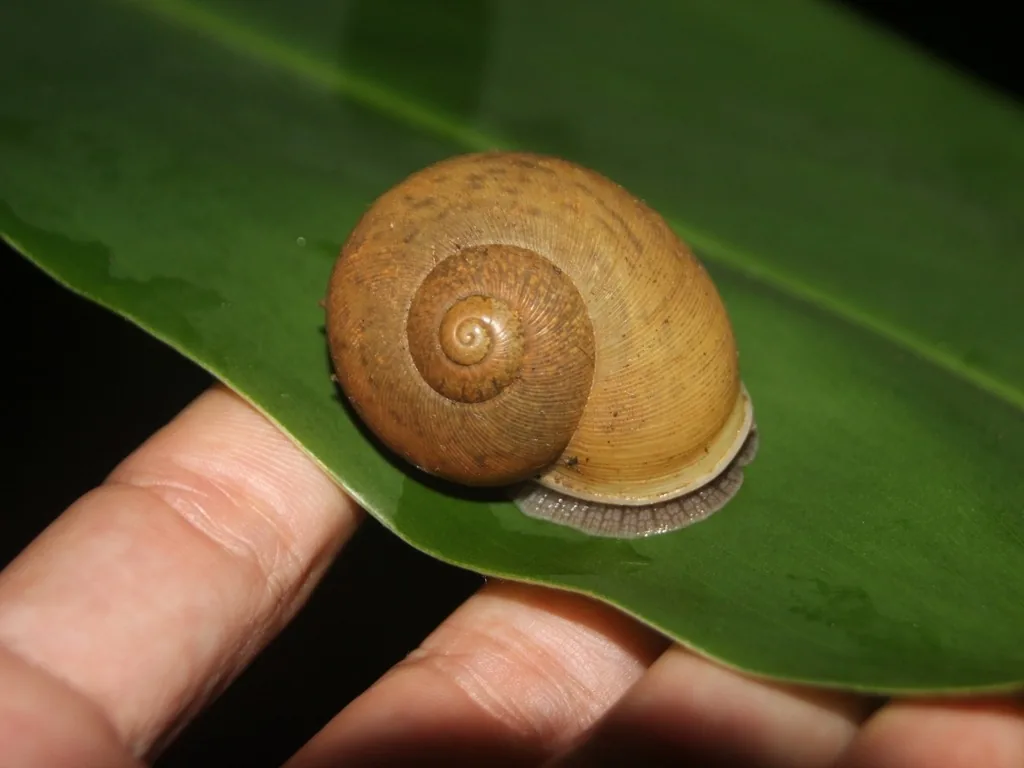
- Adults are 25 to 30 mm (about 1 inch) wide and about 20 mm (3/4 inch) high, with 4 to 5 whorls; the shell is brown or yellowish brown, sometimes with brown streaks radiating from the center.[1][3]
- The lip of the shell opening is typically white, in sharp contrast with the brown shell, and the shell is heavily ribbed.[3]
- The shell's shape changes as the snail matures, so young snails look different from adults.[1]
Look-alikes
| Look-alike | How to tell them apart |
|---|---|
| A larger related Zachrysia snail | UF/IFAS describes a related snail that closely resembles the Cuban brown snail but is larger, 41 to 45 mm (about 1 2/3 to 1 3/4 inches) across.[1] |
Where it lives
Native to Cuba and established in south Florida; Plant Pono reports it has become widespread in Florida and California, and Hawaii detected it on Oahu in September 2020.[1][3][2]
Biology and life cycle
It feeds at night and burrows into the soil during the day.[2][3]
The snails also climb trees.[3]
Damage and signs
- It attacks tropical fruit and citrus, most ornamental plants and vegetable plants; ornamental hosts include bougainvillea, crepe myrtle, hibiscus, ti plant, impatiens, orchids, bromeliads, ornamental asparagus, begonia, cactus and aroids.[1][3]
- In Hawaii it has been found feeding on garden vegetables and herbaceous greens.[2]
- Because Florida-grown ornamentals are shipped to other states, the snail can travel with nursery plants.[3]
Health risk
None of the sources lists a health risk, though Hawaii's agriculture department asks people to wear gloves when collecting the snails.[2][3]
Control
Prevention
Consider where nursery plants come from and check them before buying, since the snail moves with ornamental plants.[3]
In Hawaii, report suspected snails to the state's pest hotline (643-PEST) with a clear photo that includes a coin for scale.[2][3]
Sanitation
Limit the places snails can hide around plantings.[3]
Pesticides
Slug and snail baits containing a molluscicide kill the snails; follow the label.[2]
Common questions
- What is the brown snail eating my hibiscus at night?
- In Florida, a brown snail about an inch across with a white-lipped opening, feeding on ornamentals at night, may be the Cuban brown snail.[1][3]
- What should I do if I find one in Hawaii?
- Take a clear photo with a coin for scale, collect the snail with gloves into a sealed container, and report it to the Hawaii Department of Agriculture.[2][3]
Sources
- UF/IFAS Extension (EDIS), “Terrestrial Snails (Phylum Mollusca, Class Gastropoda) Affecting Plants in Florida (IN893).” ask.ifas.ufl.edu/publication/IN893 (accessed 2026-10-17)
- Hawaii Department of Agriculture, Plant Pest Control Branch, “New Pest Advisory 21-02: Cuban Brown Snail (J. R. Ocenar and J. N. Matsunaga, June 2021).” dab.hawaii.gov/pi/files/2021/06/21-02-Cuban-brown-snail.pdf (accessed 2026-10-17)
- Plant Pono (Hawaii Invasive Species Council), “Cuban Brown Snail (pest fact sheet).” plantpono.org/wp-content/uploads/cuban-brown-snail-fact-sheet.pdf (accessed 2026-10-17)
- iNaturalist, “Zachrysia provisoria taxon page (order and family).” www.inaturalist.org/taxa/233921 (accessed 2026-10-06)