On this page
How to identify it
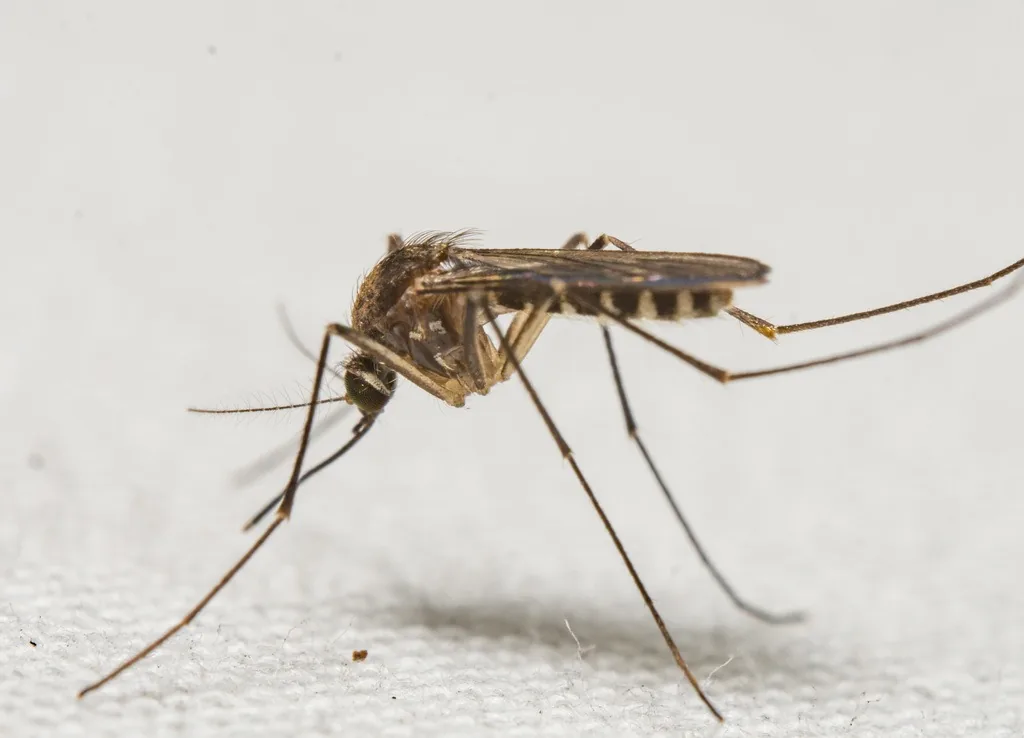
- The proboscis is dark, and the back of the head is covered with broad, pale scales that lie flat.[2]
- The top of the thorax is an even golden-brown with no line of bristles down the middle.[2]
- The abdomen is dark brown, with narrow pale bands at the front of each segment and patches at the base of each side.[2]
- The legs are mostly dark and often have a metallic sheen, and the wing veins carry narrow dark scales.[2]
- CDC's training guide describes it as a rather small, dark mosquito whose females are almost indistinguishable from two close southeastern relatives, Culex peccator and Culex pilosus.[10]
Look-alikes
| Look-alike | How to tell them apart |
|---|---|
| Northern house mosquito | Has a line of bristles down the middle of the thorax, only narrow scales on top of the head and dingy white abdominal bands that curve inward along the rear edge.[2] |
| Culex peccator and Culex pilosus | Two close relatives in the same subgroup that also live in the Southeast. CDC's training guide says the females are almost indistinguishable from Culex erraticus, which is the most common of the three.[10] |
Where it lives
Culex erraticus lives mainly in the southeastern United States. Rutgers researchers described New Jersey as near the northern edge of its range, and Connecticut's only records are four females caught in a light trap in September and one overwintering female found in November 1999, all in Fairfield County; a 2026 checklist added it to Maine as a new state record. Researchers have also studied it in natural areas across Illinois and in north central Florida. GBIF holds about 53,000 US records since 1990 from 14 states, most from Florida, Virginia, Maryland and Indiana.[1][2][15][7][6][17]
Biology and life cycle
Mated females spend the winter in natural and man-made shelters. In north central Florida, it was the most abundant mosquito found inside gopher tortoise burrows, and its numbers there rose in the winter months, a sign that it uses the burrows to overwinter.[1][2][6]
Larvae develop in lakes, ponds and slow-moving stretches of streams with abundant vegetation such as duckweed, often alongside Anopheles larvae, and it has been reported breeding in great numbers in Arkansas rice fields. The species has several generations a year.[2][10]
In Cape May County, New Jersey, larvae turned up in July in two man-made ponds with almost no emergent plants. They were sheltering in dense willow root mats that reached into the water, alongside larvae of the common malaria mosquito, and the roots appeared to protect them from the ponds' many fish.[1]
Unlike other Culex in New Jersey, adults don't appear in resting-box collections until late July, then peak in August and September. In early spring the willow root mats were under at least a foot of water from snowmelt and rain, and Rutgers researchers suggest that the lack of breeding sites explains the late peak.[1]
Females feed on a wide range of animals. At a site in Alabama's Tuskegee National Forest where eastern equine encephalitis virus had been found in seven mosquito species, it supplied 1,099 of the 1,374 blood meals collected over six years, most often from yellow-crowned night herons, great blue herons and white-tailed deer.[4]
In Alabama it switches each year from feeding mainly on birds to feeding on mammals. The switch comes later after harsher winters, which researchers link to birds nesting later after cold winters, since the mosquitoes target birds during the nesting season.[5]
In Illinois, about 73 percent of its blood meals came from mammals, mainly white-tailed deer and people, with the rest from birds, reptiles and a few amphibians. In Florida gopher tortoise burrows it fed mostly on the tortoises.[7][6]
In the Florida Everglades it fed on mammals, birds and reptiles, particularly American alligators, and water and wading birds were its main bird hosts.[16]
Damage and signs
- The Connecticut guide lists birds as its preferred host and says it occasionally bites people, especially outdoors at dawn and dusk. In the Illinois study, people were one of the two main mammal hosts, and bites on people increased at sites farther from the forest edge.[2][7]
- CDC's training guide calls the adults persistent and painful biters that bite mainly in the evening.[10]
Health risk
Culex erraticus is the most common mosquito at many southeastern sites where eastern equine encephalitis virus circulates and is often infected. In a laboratory test with field-caught females fed on infected chicks, 89 percent of those that survived two weeks were infected and 84 percent had a disseminated, body-wide infection, though virus levels were generally low. At an Alabama site its estimated capacity to transmit the virus was 44 percent that of Culiseta melanura, the accepted vector in the wildlife cycle, so it may play a role where it is abundant and Culiseta melanura is rare. CDC's surveillance guidelines list it among the primary bridge vectors of the virus in the Southeast, and it has been found naturally infected with West Nile virus, including at Louisiana alligator farms.[3][6][11][13]
Control
Prevention
Host-seeking Culex are most active in the early morning and evening, and this species bites people especially outdoors around dawn and dusk. Near ponds and slow streams, cut back time outside at those hours or cover up and use an EPA-registered repellent, following its label.[8][2][9][12]
In a field test in Arkansas rice country, some spatial repellent devices cut catches of Culex erraticus and other mosquitoes at stand-in human sites, by up to 84 percent depending on the device and the species.[14]
Biological control
Mosquito-eating fish have limits against this species. In the New Jersey ponds, willow root mats appeared to shield the larvae from abundant fish, and UC IPM notes that mosquitofish work best in man-made ponds that don't connect to natural waters and don't hold dense stands of emergent plants.[1][8]
Where sources disagree
Host preference: the Connecticut guide lists birds as its preferred host and CDC's training guide says it is said to prefer the blood of fowls, but about 73 percent of its blood meals in Illinois came from mammals, and in the Everglades it fed heavily on alligators as well as birds and mammals.[2][10][7][16]
Northern limit: Rutgers researchers described New Jersey as near the northern edge of its range in 1989, while a 2026 checklist added it to Maine as a new state record.[1][15]
Common questions
- Does Culex erraticus bite people?
- Sometimes. The Connecticut guide lists birds as its preferred host and says it occasionally bites people, especially outdoors at dawn and dusk. In an Illinois study, though, most blood meals came from mammals, and people and white-tailed deer were the main mammal hosts.[2][7]
- Why does it show up so late in the summer in New Jersey?
- Its breeding sites in Cape May County, willow root mats in ponds, were under at least a foot of water in early spring, and researchers suggest that this lack of habitat explains why adults don't appear until late July and peak in August and September.[1]
- Can it spread eastern equine encephalitis?
- CDC's guidelines list it among the primary bridge vectors in the Southeast, the mosquitoes that carry the virus from birds to mammals. It is common and often infected at southeastern sites where the virus circulates, and it became infected readily in laboratory tests.[11][6][3]
Sources
- Rutgers Center for Vector Biology (reprint), “The larval habitat of Culex erraticus in southern New Jersey (J.R. McNelly and W.J. Crans), Proceedings of the 76th Annual Meeting of the New Jersey Mosquito Control Association, 1989, pp. 63-64.” vectorbio.rutgers.edu/outreach/species/sp17.htm (accessed 2026-11-11)
- Connecticut Agricultural Experiment Station, “Identification Guide to the Mosquitoes of Connecticut, Bulletin No. 966 (Andreadis, Thomas and Shepard, 2005).” portal.ct.gov/-/media/caes/documents/publications/bulletins/b966b996pdf.pdf (accessed 2026-11-11)
- Journal of Medical Entomology, “Vector Competence and Capacity of Culex erraticus (Diptera: Culicidae) for Eastern Equine Encephalitis Virus in the Southeastern United States (Bingham, Burkett-Cadena, Hassan and Unnasch), Journal of Medical Entomology 53(2):473-476 (2016), abstract.” pubmed.ncbi.nlm.nih.gov/26659606/ (accessed 2026-11-11)
- Vector-Borne and Zoonotic Diseases, “Temporal analysis of feeding patterns of Culex erraticus in central Alabama (Oliveira and others), Vector-Borne and Zoonotic Diseases 11(4):413-421 (2011), abstract.” pubmed.ncbi.nlm.nih.gov/21395423/ (accessed 2026-11-11)
- Biology Letters, “Winter severity predicts the timing of host shifts in the mosquito Culex erraticus (Burkett-Cadena, Hassan, Eubanks, Cupp and Unnasch), Biology Letters 8(4):567-569 (2012), abstract.” pubmed.ncbi.nlm.nih.gov/22399787/ (accessed 2026-11-11)
- Journal of Medical Entomology, “Culex erraticus (Diptera: Culicidae) utilizes gopher tortoise burrows for overwintering in North Central Florida (McNamara and others), Journal of Medical Entomology 61(2):454-464 (2024), abstract.” pubmed.ncbi.nlm.nih.gov/38217415/ (accessed 2026-11-11)
- Journal of Medical Entomology, “Forest proximity shapes host-feeding patterns of Culex erraticus, a potential vector of eastern equine encephalitis virus, in Illinois (Yan and others), Journal of Medical Entomology 63(4):tjag128 (2026), abstract.” pubmed.ncbi.nlm.nih.gov/42554736/ (accessed 2026-11-11)
- University of California Statewide IPM Program, “Pest Notes: Mosquitoes, Publication 7451 (revised April 2020).” ipm.ucanr.edu/legacy_assets/PDF/PESTNOTES/pnmosquitoes.pdf (accessed 2026-11-11)
- City of Jacksonville Mosquito Control (Florida), “Avoiding Mosquitoes.” www.jacksonville.gov/departments/neighborhoods/mosquito-control/avoiding-mosquitoes (accessed 2026-11-11)
- U.S. Public Health Service, Communicable Disease Center (now CDC), via CDC Stacks, “Mosquitoes of Public Health Importance and Their Control (Training Guide, Insect Control Series; Pratt, Barnes and Littig, 1963).” stacks.cdc.gov/view/cdc/7613/cdc_7613_DS1.pdf (accessed 2026-11-11)
- U.S. Centers for Disease Control and Prevention, “Guidelines for Eastern Equine Encephalitis Virus Surveillance and Control.” www.cdc.gov/eastern-equine-encephalitis/php/surveillance-and-control-guidelines/index.html (accessed 2026-11-11)
- U.S. Centers for Disease Control and Prevention, “Preventing Mosquito Bites.” www.cdc.gov/mosquitoes/prevention/index.html (accessed 2026-11-11)
- Journal of Medical Entomology, via PubMed, “Detection of West Nile virus RNA in mosquitoes and identification of mosquito blood meals collected at alligator farms in Louisiana (Unlu et al. 2010).” pubmed.ncbi.nlm.nih.gov/20695278/ (accessed 2026-11-11)
- Journal of the American Mosquito Control Association, via PubMed, “Field evaluation of four spatial repellent devices against Arkansas rice-land mosquitoes (Dame et al. 2014).” pubmed.ncbi.nlm.nih.gov/24772674/ (accessed 2026-11-11)
- Journal of the American Mosquito Control Association, via PubMed, “An updated checklist of mosquito species in Maine with new state records (Schneider 2026).” pubmed.ncbi.nlm.nih.gov/42031369/ (accessed 2026-11-11)
- Vector-Borne and Zoonotic Diseases, via PubMed, “Host-feeding behavior of mosquitoes in the Florida Everglades (Anderson et al. 2024, Connecticut Agricultural Experiment Station).” pubmed.ncbi.nlm.nih.gov/38648543/ (accessed 2026-11-11)
- Global Biodiversity Information Facility (GBIF), “Culex erraticus: US occurrence records since 1990 by state (GBIF occurrence search API).” api.gbif.org/v1/occurrence/search?taxonKey=1653523&country=US&hasGeospatialIssue=false&occurrenceStatus=PRESENT&year=1990%2C2026&facet=stateProvince&facetLimit=400&limit=0 (accessed 2026-11-11)
- iNaturalist, “Culex erraticus taxon page (order and family).” www.inaturalist.org/taxa/259089 (accessed 2026-11-11)