On this page
How to identify it
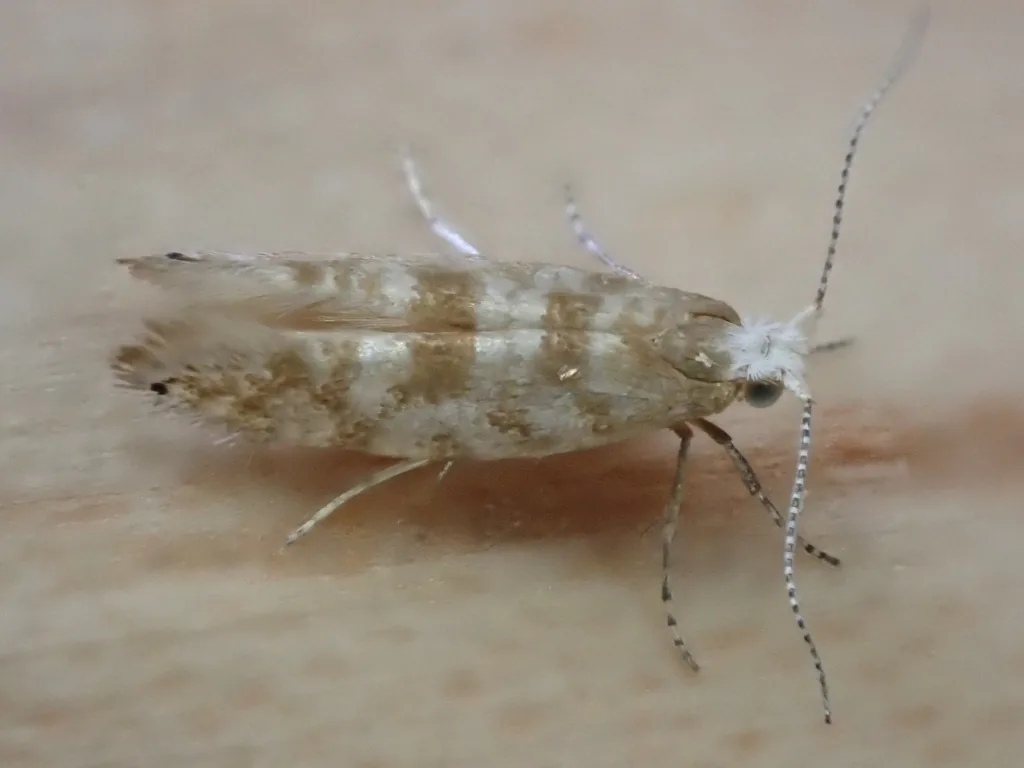
- The adult is a tiny moth that looks silvery to the naked eye; up close it is mottled brown or tan and whitish, with a wingspan of about 1/3 inch.[3][1]
- The larva is a small caterpillar, up to about 1/4 inch (6 millimeters) long, pale yellowish green, sometimes pinkish, with a darker head and a darker shield on the segment behind it. It lives inside the shoot tips.[3][4]
- When the larvae finish feeding they spin white, papery cocoons, about 1/5 inch long, between the twiglets or among the foliage.[3][4][2]
- Infested tips have dark exit holes, turn yellow in early winter and brown by late winter or early spring, and once empty the dead, hollowed twigs break off easily.[1][3][4]
Look-alikes
| Look-alike | How to tell them apart |
|---|---|
| Didymascella leaf blight | The dark exit holes left by the larvae can look like the symptoms of this fungal disease. Older moth larvae hollow out whole shoot tips, and the dead, hollow twigs break off easily.[2][4] |
| Other Argyresthia tip moths | Nine Argyresthia species attack different conifers in the Pacific Northwest. If control fails, have the insect identified to be sure which species you have.[1] |
Where it lives
It lives in western North America, from south coastal British Columbia south to California, where it is found mostly in coastal areas. It has also become established in Britain.[4][3]
Biology and life cycle
Hosts include arborvitae (especially eastern arborvitae, Thuja occidentalis), cypresses such as Leyland, Lawson and Monterey cypress, certain junipers and coast redwood.[3][4][1]
There is one generation a year. Adults are out in spring or early summer, depending on the region: mostly March to May in Southern California, April and May in Northern California, May to June in the Pacific Northwest, and June in British Columbia.[3][2][4]
Females lay flattened, oval eggs one at a time on green twig tips; in British Columbia a female lays up to 33 eggs.[3][4]
The young larvae first mine individual scale leaves, which usually goes unnoticed. They spend the winter as larvae, feeding on warm days, and in early spring bore into the shoots near the tip, each larva hollowing out four to six shoots. The larval stage lasts about ten months.[4][2]
In spring the grown larvae leave their mines and spin cocoons, and adults emerge after a few weeks.[4][2]
Damage and signs
- Damage is usually limited to scattered twig tips, but in a heavy infestation most of the plant can look brown and scorched, and repeated infestations cause dieback.[3][1][4]
- The browning shows from late winter until new growth hides it in late spring or summer. Even severe infestations do not kill plants, and junipers can recover from heavy feeding, though discolored nursery stock is unsellable.[3][4][2]
Health risk
These sources treat it only as a plant pest and do not describe any harm to people.[3][4]
Control
Prevention
Where it has been a problem, plant less susceptible hosts instead of eastern arborvitae. Resistant cultivars are available; UC IPM lists western redcedar (Thuja plicata) and the junipers 'Kaizuka', Sargent juniper 'Glauca' and Rocky Mountain juniper 'Erecta Glauca' among the least susceptible.[3][2]
Keep them out
In nurseries, growing hosts under well-kept screens or in hoop houses keeps out the egg-laying moths, which fly mostly at night. Motion-activated security lights attract fewer moths than lights left on all night.[3]
Pesticides
Bacillus thuringiensis (Bt) is highly effective against newly hatched larvae before they bore into the foliage. Because eggs hatch over a period of time, UC IPM suggests several Bt sprays about a week apart in late winter through spring. Bt and certain spinosad formulations are acceptable for organic growers.[3]
For nursery production, UC IPM also describes a single thorough spray of a broad-spectrum, persistent insecticide when a noticeable number of moths are present between March and May.[3]
Checking for cypress tip moth
Beginning in mid- to late winter, look on the foliage tips for small whitish cocoons. When cocoons appear, shake the branches hard and watch for tiny silvery moths flying out.[3]
You may also see larvae dropping from the plant on silk threads. A sticky plate hung horizontally under the plant catches larvae as they leave the tips.[2]
Common questions
- Why are the tips of my arborvitae hedge turning brown in late winter?
- Cypress tip moth is a common cause. Its larvae hollow out the shoot tips over winter, and the foliage does not discolor until late winter, when the dead tips turn brown and snap off easily.[1][4]
- Will cypress tip moth kill my hedge?
- No. Even severe infestations do not kill plants, and new growth in spring and summer restores the green color, though repeated heavy infestations can cause dieback.[3][1]
Sources
- Pacific Northwest Pest Management Handbooks (Oregon State, Washington State and University of Idaho Extension), “Arborvitae (Thuja)-Cypress tip moth (Pacific Northwest Insect Management Handbook).” pnwhandbooks.org/insect/hort/landscape/hosts-pests-landscape-plants/arborvitae-thuja-cypress-tip-moth (accessed 2026-11-09)
- Pacific Northwest Pest Management Handbooks (Oregon State, Washington State and University of Idaho Extension), “Juniper (Juniperus)-Cypress tip moth (Pacific Northwest Insect Management Handbook).” pnwhandbooks.org/insect/hort/landscape/hosts-pests-landscape-plants/juniper-juniperus-cypress-tip-moth (accessed 2026-11-09)
- University of California Statewide IPM Program, “Cypress Tipminer (Floriculture and Ornamental Nurseries Pest Management Guidelines).” ipm.ucanr.edu/agriculture/floriculture/cypress-tipminer (accessed 2026-11-09)
- Natural Resources Canada, Canadian Forest Service, “Cypress tip moth (Trees, insects and diseases of Canada's forests).” tidcf.nrcan.gc.ca/en/insects/factsheet/12106 (accessed 2026-11-09)
- iNaturalist, “Argyresthia cupressella taxon page (order and family).” www.inaturalist.org/taxa/345291 (accessed 2026-11-09)