On this page
How to identify it
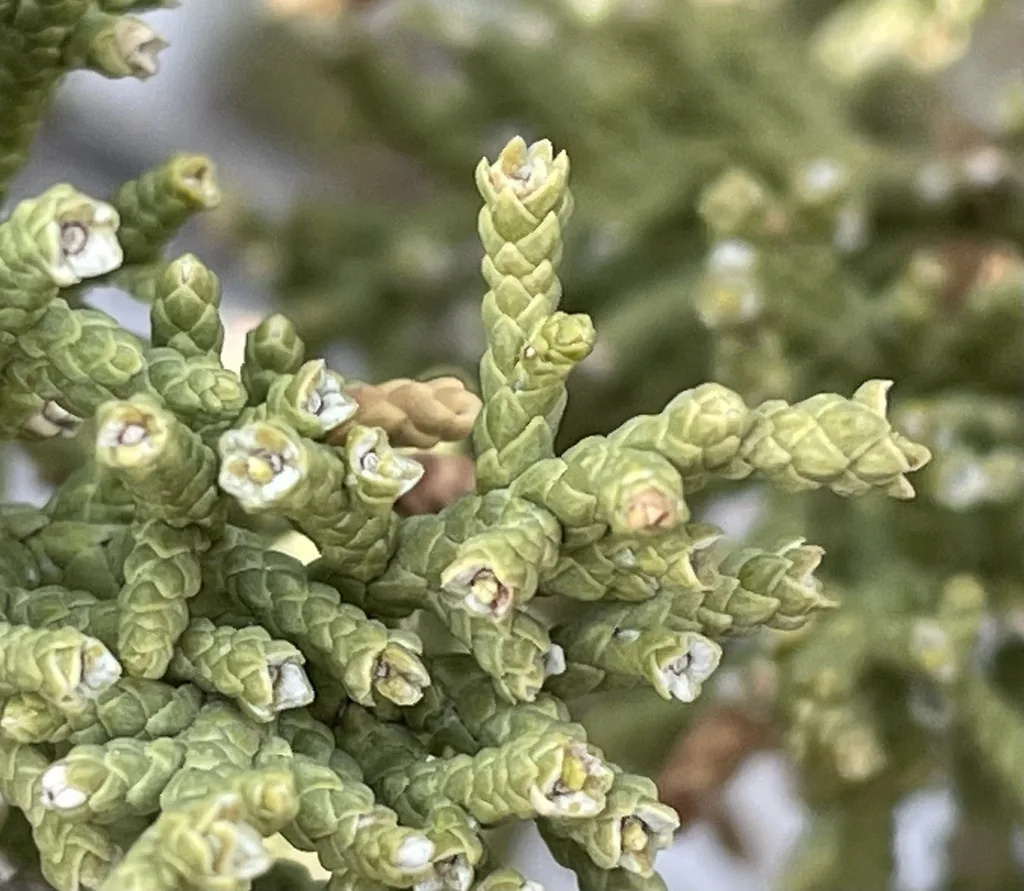
- The galls are the field mark: swollen juniper shoot tips, green while the larvae are inside and brown to reddish afterward, which the Forest Service describes as reddish, conical galls at the ends of the shoots.[1][2]
- Mining and exit holes can be found at the junction between living and dead tissue or at the base of the swollen portion of the tip.[1]
- The adult is a tiny yellow fly only about 0.06 inch long that looks like a miniature mosquito; the larva is a maggot with no legs and no distinct head.[1]
Look-alikes
| Look-alike | How to tell them apart |
|---|---|
| Phomopsis tip blight | Fungal tip blight also browns and kills juniper shoot tips; the midge's tips are swollen into small galls and show exit holes where live and dead tissue meet.[1] |
| Juniper webworm | A yellowish to brownish caterpillar that first mines inside the leaves and then feeds in small colonies in nests of webbed foliage; the tip midge leaves no webbing, only swollen, browning tips.[3][1] |
| Cypress tip moth | A silver-tan moth about 0.3 inch long whose green larvae tunnel in the growing points of one- and two-year-old shoot tips without forming a swollen gall.[4][1] |
Where it lives
Recorded on junipers in Colorado, Utah and British Columbia by the Forest Service, and treated as a landscape and nursery pest of juniper in the Pacific Northwest.[2][1]
Biology and life cycle
The larvae feed within the shoot tips, which respond by swelling into tiny green galls; the galls turn brown, sometimes reddish, and the tips die back after the larvae have left.[1]
The Forest Service describes the galls as apical and conical and lists the midge among the gall-forming cecidomyiid midges of western trees and shrubs.[2]
Damage and signs
- Infested tips swell, then brown and die back, producing scattered dead tips over the plant that can be mistaken for fungal tip blight.[1]
Health risk
Neither source mentions any effect on people; the juniper tip midge is a plant pest only.[1][2]
Control
Traps and physical control
Remove the green galls and damaged tips while the larvae are still inside them, before the galls brown and the midges emerge.[1]
Pesticides
The Pacific Northwest handbook refers readers to its landscape chemical-control table and its general gallmaker section rather than naming a specific product for this midge.[1]
Common questions
- Why are the tips of my juniper swelling and turning brown?
- Swollen tips that are green at first and then brown or reddish, with tiny exit holes at the base of the swelling, are galls of the juniper tip midge; plain browning without swelling is more likely Phomopsis tip blight.[1]
- How do I get rid of juniper tip midge?
- Prune off the green galls and damaged tips while the maggots are still inside, which removes the next generation with them.[1]
- Where does the juniper tip midge occur?
- The Forest Service records it on junipers in Colorado, Utah and British Columbia, and the Pacific Northwest handbook treats it as a juniper pest in the Northwest.[2][1]
Sources
- Pacific Northwest Pest Management Handbooks (Oregon State University, Washington State University and University of Idaho), “Juniper (Juniperus)-Juniper tip midge, Hosts and Pests of Landscape Plants, Pacific Northwest Insect Management Handbook.” pnwhandbooks.org/insect/hort/landscape/hosts-pests-landscape-plants/juniper-juniperus-juniper-tip-midge (accessed 2026-11-10)
- USDA Forest Service, “Western Forest Insects, Miscellaneous Publication 1339 (R. L. Furniss and V. M. Carolin, November 1977; scanned copy).” archive.org/details/CAT78702369 (accessed 2026-11-10)
- Pacific Northwest Pest Management Handbooks (Oregon State University, Washington State University and University of Idaho), “Juniper (Juniperus)-Juniper webworm, Hosts and Pests of Landscape Plants, Pacific Northwest Insect Management Handbook.” pnwhandbooks.org/insect/hort/landscape/hosts-pests-landscape-plants/juniper-juniperus-juniper-webworm (accessed 2026-11-10)
- Pacific Northwest Pest Management Handbooks (Oregon State University, Washington State University and University of Idaho), “Juniper (Juniperus)-Cypress tip moth, Hosts and Pests of Landscape Plants, Pacific Northwest Insect Management Handbook.” pnwhandbooks.org/insect/hort/landscape/hosts-pests-landscape-plants/juniper-juniperus-cypress-tip-moth (accessed 2026-11-10)
- iNaturalist, “Oligotrophus betheli taxon page (order and family).” www.inaturalist.org/taxa/702435 (accessed 2026-11-10)