On this page
How to identify it
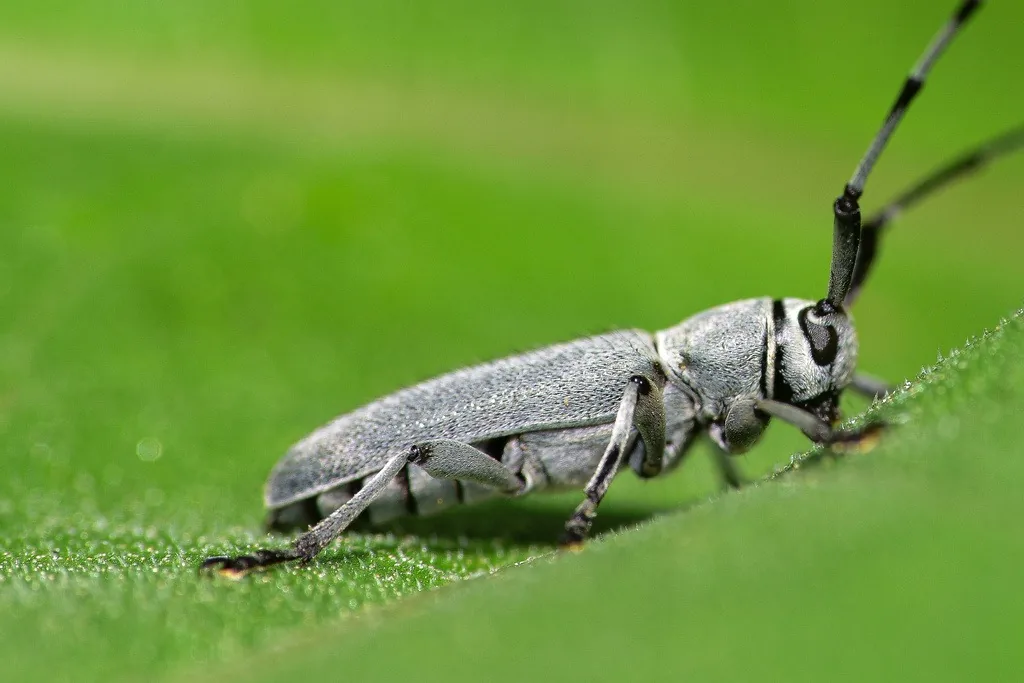
- Adults are gray, somewhat flattened long-horned beetles about 3/8 inch long, with slender antennae banded in dark rings and longer than the body.[1][3]
- Larvae are creamy white to yellow with an orange-red to dark brown head and an accordion-like, segmented body, reaching 1/2 to 5/8 inch; they are found only inside leaf stalks and stems.[1][2]
- Signs in the field include a small chewed hole in a leaf stalk or stem, wilted leaf stalks, tunneled pith when you split a stem, and stems girdled from the inside a few inches above the soil.[1][4]
Where it lives
It is native to North America east of the Rocky Mountains and now infests soybeans across the main U.S. production areas, from Missouri and Tennessee to the Carolinas and the Dakotas.[4][1][2][3]
Biology and life cycle
It overwinters as a mature larva in a sealed chamber at the base of the stem. Adults begin emerging in June or early July, emergence stretches over several weeks, and they are most common in July and August.[1][2][3]
Females chew a small hole in a leaf stalk or stem and usually lay a single egg there; eggs hatch in 6 to 10 days and the larva tunnels into the main stem to feed on the pith.[1]
Several larvae may enter one plant, but only one survives to maturity because the larvae are cannibalistic.[3][4]
In late summer the larva moves to the base of the plant and girdles the stem from the inside, usually about 2 inches above the soil. There is one generation a year.[1][4]
Damage and signs
- Tunneling in the pith causes little direct yield loss; most loss comes from girdled plants lodging before or during harvest.[1][2][4]
- SDSU reports yield losses of 7 to 12 percent in heavily infested soybean fields, and in some no-till areas 80 percent or more of the plants in a field can be infested.[3][4]
- The timing and amount of girdling are unpredictable, and heavily infested fields don't always lodge much.[4]
Health risk
It feeds only on plants; Missouri, NC State and SDSU Extension mention no risk to people.[1][2][3]
Control
Prevention
Control cocklebur, giant ragweed and other weed hosts in and around fields, rotate away from soybeans, and avoid planting next to fields that were heavily infested the year before.[1][2]
Sanitation
Fall tillage that buries infested stubble at least 2 to 3 inches deep increases winter deaths of the larvae.[1]
Traps and physical control
Split stems before maturity to check for tunneling and live larvae, and harvest heavily infested fields first, as early as possible, to limit lodging losses.[1][3][4]
Pesticides
Sprays are not recommended: adults emerge over several weeks, so timing is nearly impossible, and UT calls insecticide treatment not cost effective. There is no treatment threshold.[1][3][4]
Common questions
- Why are my soybean plants snapping off near the ground before harvest?
- One possible cause is the Dectes stem borer: its larva girdles the stem from the inside a couple of inches above the soil before overwintering, so the plant breaks or lodges.[1][4]
- Can I spray for Dectes stem borer?
- Not effectively. Adult emergence is spread over several weeks, so sprays miss most beetles; extension services recommend weed control, rotation and early harvest instead.[1][3][4]
Sources
- University of Missouri Extension, “Biology and Management of Dectes Stem Borer (G7152).” extension.missouri.edu/publications/g7152 (accessed 2026-10-19)
- NC State Extension, “Dectes Stem Borer in Soybean.” content.ces.ncsu.edu/publication/dectes-stem-borer-in-soybean (accessed 2026-10-19)
- South Dakota State University Extension, “Dectes Stem Borer in Soybean.” extension.sdstate.edu/dectes-stem-borer-soybean (accessed 2026-10-19)
- University of Tennessee Institute of Agriculture, UT Crops, “Dectes Stem Borer (Soybean Insect Guide).” guide.utcrops.com/soybean/soybean-insect-guide/dectes-stem-borer/ (accessed 2026-10-19)
- iNaturalist, “Dectes texanus taxon page (order and family).” www.inaturalist.org/taxa/306570 (accessed 2026-10-06)