On this page
How to identify it
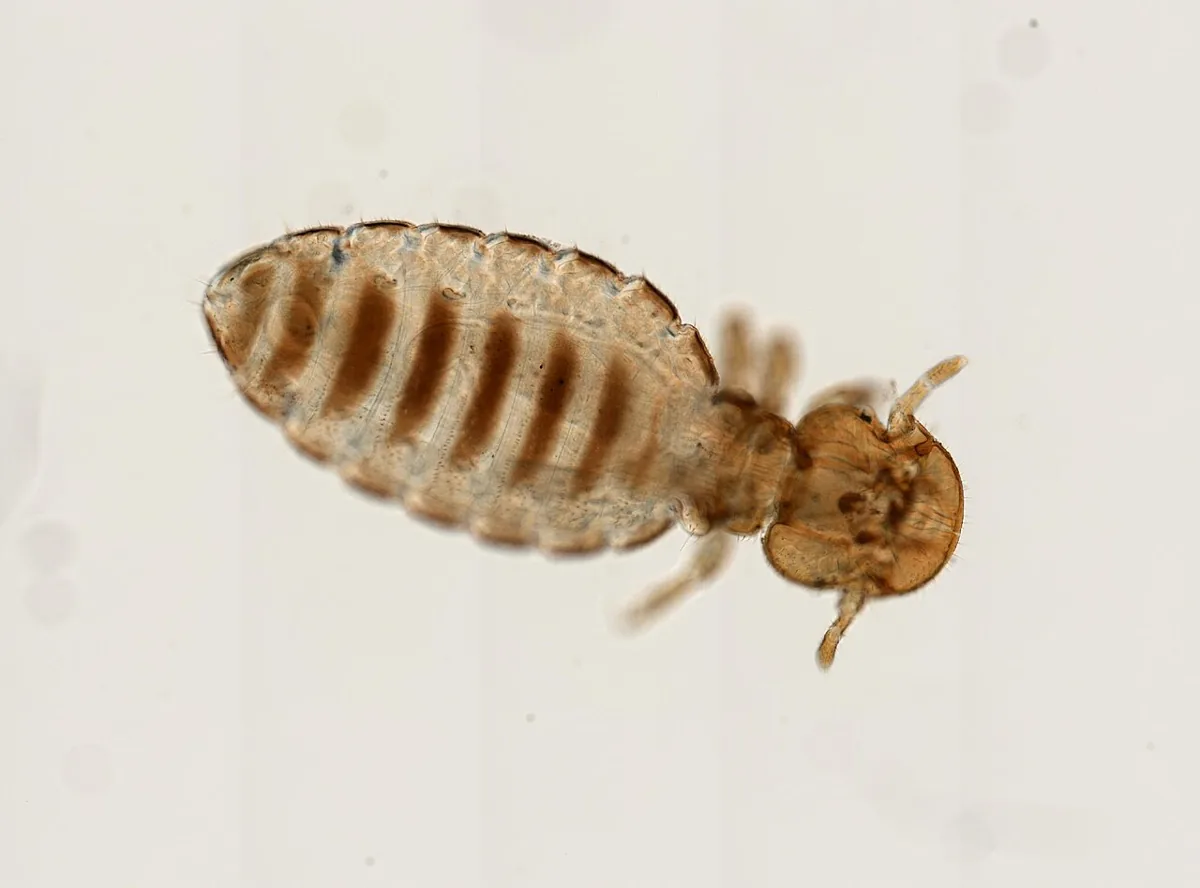
- Adult lice are a few millimeters long, flattened from top to bottom, six-legged and wingless.[1]
- Seen from above, a sucking louse has a pointed head narrower than its thorax, while a chewing louse has a blunt, rounded head wider than its thorax. In the dog sucking louse the front pair of legs is shorter than the other two.[1]
- Females lay their eggs, called nits, attached to the hairs.[1][2]
- Adult lice and nits can be seen in the coat, sometimes with the help of a comb, and are confirmed by looking at them under a microscope. Pet lice can be told from human lice because they lack eyes and have a different body shape.[1]
Look-alikes
| Look-alike | How to tell them apart |
|---|---|
| Human lice, including crab lice | Human lice, the human crab (pubic) louse among them, occasionally turn up briefly on dogs and cats, but pets are not a reservoir or source of human lice. Pet lice lack eyes and have a different body shape.[1] |
Where it lives
Lice occur on dogs, and to a lesser extent on cats, around the world. The dog chewing louse is found globally and has also been reported on wild canids and other wild carnivores. Owned dogs are rarely infested; it is more common on stray dogs, and reported infestation rates range from 0.2% to 10.6% depending on the country and type of dog. In western Canada, lice may be becoming more common on dogs and wild canids, while the cat louse is uncommon there and turns up mostly on farm cats.[1][2]
Biology and life cycle
The whole life cycle takes place on the animal. A nymph develops in each nit, hatches and molts twice to become an adult, with no pupal stage, and the cycle can be completed in a few weeks.[1]
Sucking lice survive off the host for a few days at most, while chewing lice may survive for several weeks in the environment.[1]
Lice spread by direct contact between animals and through objects such as bedding and grooming equipment, and any life stage can pass them on. Some animals carry lice without showing signs.[1]
Chewing lice feed on skin debris and hair and move around more than sucking lice.[1]
The animals hit hardest tend to be young, stressed animals kept in crowded conditions, or older animals with other diseases or neglect. Lice are a particular problem in young puppies and kittens, and sometimes whole litters are affected.[1]
Damage and signs
- Many infested dogs and cats show no obvious effects, and small numbers of lice generally cause no signs. Heavy infestations cause hair loss, itching and scaling.[1][2]
- Sucking lice on dogs typically cause hair loss and skin inflammation on the head and front of the back, areas the dog has trouble grooming. Chewing lice cause itching of varying severity, and the animal's scratching and rubbing add to the hair loss and skin damage.[1]
- Heavy sucking-louse infestations can cause enough blood loss to weaken a dog.[1]
- Like fleas, the dog chewing louse can serve as an intermediate host of the flea tapeworm, Dipylidium caninum, which can also infect people; how much lice contribute to spreading it is not known.[1][2]
Health risk
Pet lice are more or less host-specific. The dog chewing louse poses no risk of spreading to people, and pets are not a reservoir or source of human lice. The indirect concern is the flea tapeworm, which the dog chewing louse can carry and which can infect people.[1][2]
Control
Prevention
Address underlying problems with nutrition, health and management, since lice hit young, stressed, crowded animals and neglected or sick older animals hardest.[1]
Sanitation
Clean bedding, grooming tools and pet clothing thoroughly, ideally by washing and drying them on hot cycles.[1]
Traps and physical control
Clipping long-haired animals helps, and a comb can help find lice and nits in the coat.[1]
Pesticides
Treat every animal of the same species that has been in contact with the infested one. Insecticides such as pyrethrins, pyrethroids and imidacloprid, sold as shampoos, sprays, dusts and spot-ons, may be used on dogs as the label directs but are generally unsafe for cats. Because nits may survive treatment, a repeat treatment in 1 to 2 weeks is often needed.[1]
Many products labeled for flea and tick control are proving useful against lice, including selamectin and isoxazolines, often as a single dose; treatments that work through the bloodstream may work better on sucking lice than on chewing lice. Check the minimum age on any product before using it on puppies or kittens.[1]
Studies have found propoxur, fipronil, imidacloprid, selamectin and pyrethroids effective against the dog chewing louse after a single topical application as collars, spot-ons or sprays. In a 2021 field study in Romania, no live lice were found on any of the dogs given a single oral dose of the isoxazoline afoxolaner, or on dogs given a fipronil and (S)-methoprene product, two weeks and one month after treatment.[2]
Common questions
- Can I get lice from my dog or cat?
- No. Pet lice are more or less host-specific, the dog chewing louse poses no risk of spreading to people, and pets are not a reservoir or source of human lice.[1][2]
- Can I use my dog's lice shampoo on my cat?
- Not without checking the label. Pyrethrin, pyrethroid and imidacloprid products may be used on dogs as labeled but are generally unsafe for cats, and every product has minimum age limits.[1]
- How long can pet lice live off the animal?
- Sucking lice survive off the host for a few days at most, but chewing lice can live several weeks in the environment. WCVM's advice is to treat all in-contact animals of the same species and to wash and dry bedding, grooming tools and pet clothing on hot cycles.[1]
Sources
- University of Saskatchewan, Western College of Veterinary Medicine, “Lice Dogs and Cats: chewing (Mallophaga), and sucking (Anoplura) (Learn About Parasites, March 2021).” wcvm.usask.ca/learnaboutparasites/parasites/lice-chewing-mallophaga,-and-sucking-anoplura.php (accessed 2026-11-08)
- Parasites & Vectors (BioMed Central), “Efficacy of afoxolaner against natural infestations with Trichodectes canis in dogs under field conditions (A. D. Mihalca and colleagues, 2022).” parasitesandvectors.biomedcentral.com/articles/10.1186/s13071-022-05428-y (accessed 2026-11-08)
- iNaturalist, “Trichodectes canis taxon page (order and family).” www.inaturalist.org/taxa/380650 (accessed 2026-11-08)
- iNaturalist, “Linognathus setosus taxon page (order and family).” www.inaturalist.org/taxa/391723 (accessed 2026-11-08)