On this page
How to identify it
- Grown caterpillars are smooth, twiglike inchworms about 2 inches long; in outbreaks most are dull slate black with a rusty head, while some are green, yellow or mottled.[1][2]
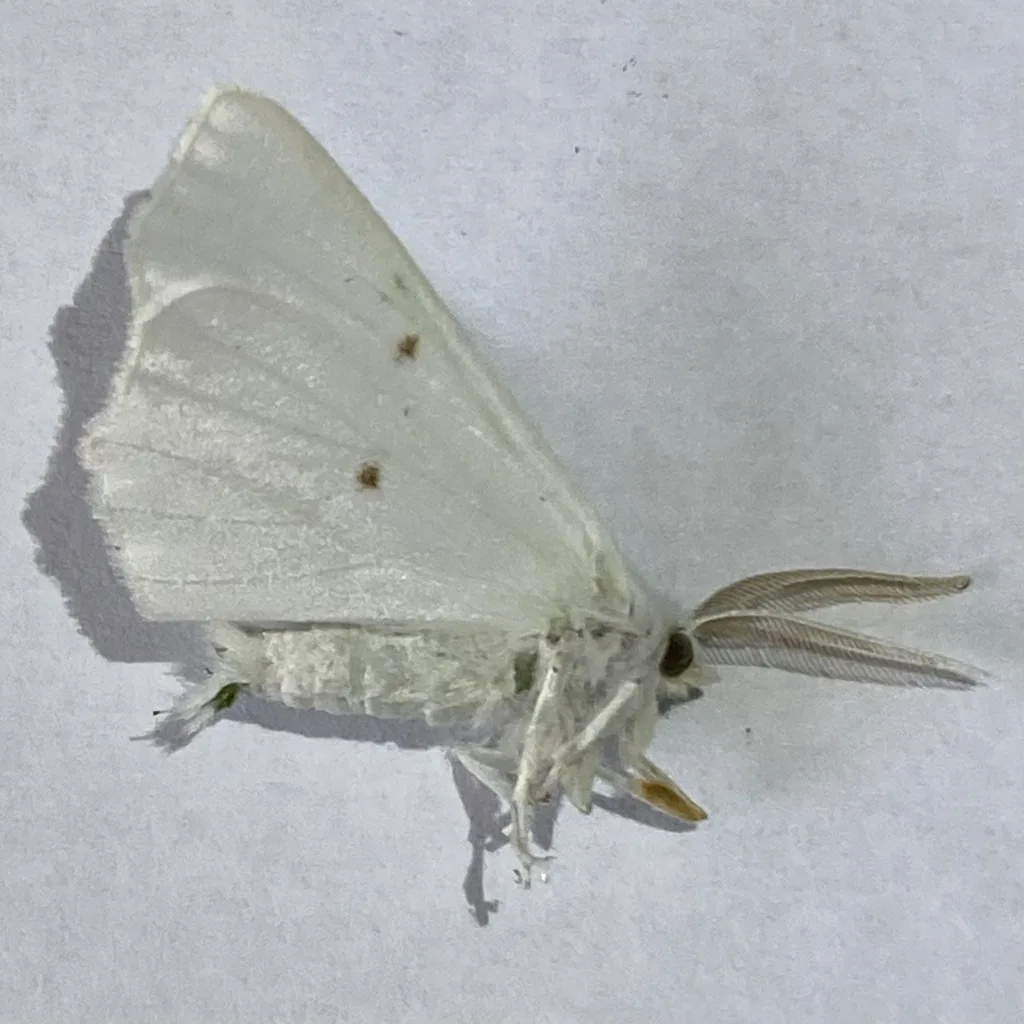
- Adults are pure white moths with a 1 to 1.5 inch wingspan; males have feathery antennae.[1][2]
- Egg masses of up to 250 eggs on the undersides of branches start bright green and turn dull gray or bronze by winter.[1][2]
Where it lives
Throughout most of the eastern United States and southeastern Canada, recorded from Nova Scotia to mid-Florida and west to Texas and Saskatchewan.[1][2]
Biology and life cycle
Eggs overwinter and hatch in spring, from late April in the southern Appalachians to mid-May or June in the Northeast; tiny caterpillars can drift on silk threads.[2]
Caterpillars feed for about a month, then pupate in loose, netlike cocoons on partly eaten leaves; moths appear in late July or August.[1][2]
Near heavy infestations, swarms of male moths drawn to town lights can look like midsummer snow.[2]
Damage and signs
- Favorite hosts are ash, hickory and walnut; beech, cherry, elm, maple, oak, willow and many others are also eaten, while yellow-poplar is rarely touched.[2]
- Young caterpillars chew holes from the underside of leaves; older ones eat all but the midrib and stem, and outbreaks can strip whole trees.[1][2]
- Stripped trees usually leaf out again, but two or more summers of defoliation lead to limb dieback and death, especially in oaks then attacked by the twolined chestnut borer.[2]
Health risk
Control
Traps and physical control
Prune off and destroy egg masses on small twigs and branches before they hatch.[1]
Biological control
Tiny egg parasitoid wasps can destroy more than 80 percent of eggs during an outbreak; birds, spiders, ground beetles and parasitic flies also attack it.[1][2]
Common questions
- What are the black inchworms stripping my trees?
- In late spring and early summer, often elm spanworms; despite the name they feed on many hardwoods.[1][2]
- Why are white moths swarming my porch light in summer?
- Near outbreaks, elm spanworm moths, mostly males, can gather at lights in huge numbers.[1][2]
Sources
- UMass Extension Landscape, Nursery and Urban Forestry Program (Landscape Insect & Mite Guide), “Ennomos subsignaria (Elm Spanworm).” www.umass.edu/agriculture-food-environment/landscape/publications-resources/insect-mite-guide/ennomos-subsignaria (accessed 2026-10-16)
- USDA Forest Service (Forest Insect & Disease Leaflets), “Elm Spanworm (Forest Pest Leaflet 81, revised March 1971).” www.fs.usda.gov/foresthealth/docs/fidls/FIDL-81-ElmSpanworm.pdf (accessed 2026-10-16)
- iNaturalist, “Ennomos subsignaria taxon page (order and family).” www.inaturalist.org/taxa/119939 (accessed 2026-10-06)