On this page
How to identify it
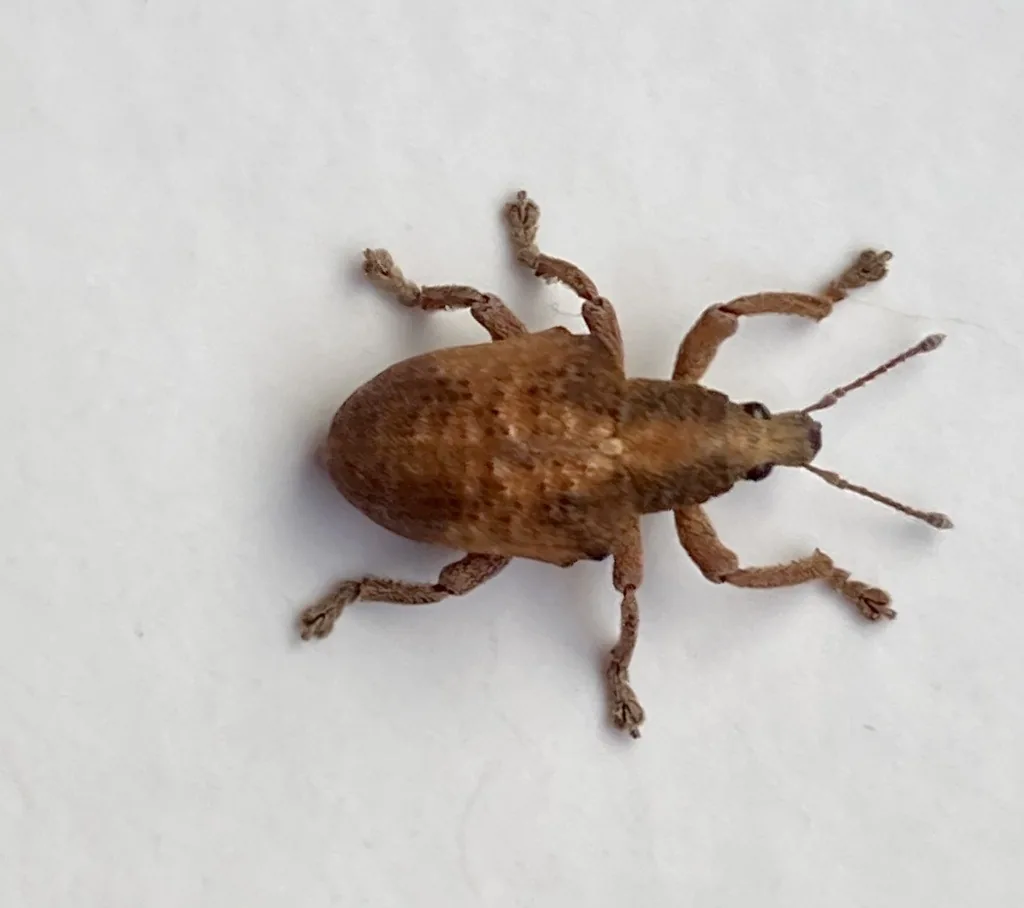
- Adults are brown and gray, often reddish, weevils about 1/3 inch (7.5 to 8.5 mm) long with a long, tapered snout. From the side the body looks dome-shaped. A dark X-shaped mark on the wing covers is not always visible.[1][2]
- Larvae are white but look yellowish green because of a sticky coating, with many small black spots and a black stripe along each side. They reach about 2/5 inch and often trail strings of droppings that can stick to the body.[1][2]
- Eggs are laid in a small, boxlike, blackish to dark brown case about 1/8 inch (3 mm) long, holding rows of yellowish eggs. Eggs turn black when parasitized.[1]
- Adults notch leaf edges; young larvae scrape pale trails across the leaf surface, and older larvae chew holes right through. Infested foliage looks ragged and scalloped.[1]
Look-alikes
| Look-alike | How to tell them apart |
|---|---|
| Eucalyptus tortoise beetles | Eucalyptus tortoise beetles are two Australian leaf beetles that also chew semicircular holes and notches along eucalyptus leaf edges in California. The snout beetle is a weevil, with a long tapered snout and a dome-shaped body seen from the side, and lays its eggs in small boxlike cases.[4][1] |
Where it lives
Native to Australia, where it is a complex of at least eight look-alike species. Members of the complex have spread to New Zealand, South America, California, Hawaii and western Europe.[2][3]
Biology and life cycle
Adults feed for about a month before laying eggs, and each female can lay several hundred. Eggs hatch in about a week, and larvae pass through four stages while feeding on the leaves.[1]
Mature larvae drop to the ground and pupate in the topsoil; in warm weather adults emerge about a month later. Egg to adult takes 2 to 3 months during the growing season.[1]
Adults fly well and live for several months. They spend the winter clinging to eucalyptus twigs or hiding under loose bark. California has about three generations a year; worldwide the number ranges from one to four, depending on climate and natural enemies.[1][2]
Damage and signs
Health risk
The sources describe it only as a leaf feeder on eucalyptus; they mention no harm to people.[1][2]
Control
Prevention
No control action is needed. Avoid broad-spectrum, persistent insecticides on eucalyptus, because they can kill natural enemies that keep this and other eucalyptus pests in check.[1]
Biological control
It is completely controlled by Anaphes nitens, a black wasp about 1/25 inch long that lays its eggs inside the beetle's eggs. The same wasp has greatly reduced damage in every country where the beetle has spread.[1][2]
Common questions
- Should I spray my eucalyptus for snout beetles?
- No. UC IPM says no control action is warranted because the egg parasite controls the beetle completely, and broad-spectrum insecticides can harm the natural enemies of other eucalyptus pests.[1]
- What are the small black boxes stuck to my eucalyptus leaves?
- They may be eucalyptus snout beetle egg cases. Healthy eggs inside are yellowish; eggs that have turned black were parasitized by the wasp that controls this beetle.[1]
Sources
- University of California Statewide IPM Program, “Eucalyptus Snout Beetle (Home and Landscape).” ipm.ucanr.edu/home-and-landscape/eucalyptus-snout-beetle/ (accessed 2026-11-09)
- EFSA Journal (European Food Safety Authority), “Pest categorisation of the Gonipterus scutellatus species complex (EFSA Panel on Plant Health 2018, EFSA Journal 16:5107).” pmc.ncbi.nlm.nih.gov/articles/PMC7009585/ (accessed 2026-11-09)
- Bulletin of Entomological Research, “Insect pests of eucalypts in California: implications of managing invasive species (Paine and Millar 2002, Bulletin of Entomological Research 92:147-152), abstract.” pubmed.ncbi.nlm.nih.gov/12020373/ (accessed 2026-11-09)
- University of California Statewide IPM Program, “Pest Notes: Eucalyptus Tortoise Beetles.” ipm.ucanr.edu/home-and-landscape/eucalyptus-tortoise-beetles/ (accessed 2026-11-09)
- iNaturalist, “Gonipterus taxon page (order and family).” www.inaturalist.org/taxa/199384 (accessed 2026-11-09)