On this page
How to identify it
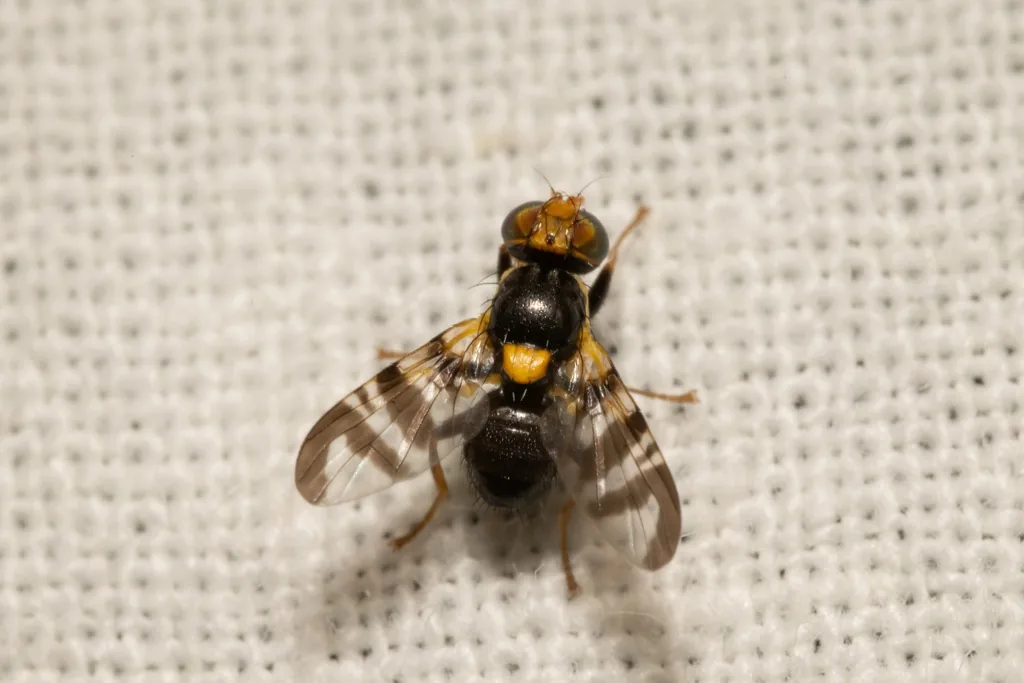
- Adults are small flies, about 3/16 inch long for females and 1/8 inch for males, with a tan head, a black body and a distinctive yellow spot on the thorax.[1][2]
- The clear wings carry four large blue-black bands and one small band. Wing pattern is the way to tell this species from the native cherry fruit flies.[1][2]
- The maggots are white and about 1/4 inch long and live inside the fruit; the pupae, which overwinter in the soil, are small, light yellow-brown to straw-colored cases that resemble a grain of wheat.[1][2]
- Adults are often seen on sunlit parts of cherry trees and honeysuckle bushes, because females prefer to lay eggs in fruit in the sun.[1][2]
Look-alikes
| Look-alike | How to tell them apart |
|---|---|
| Cherry fruit fly (Rhagoletis cingulata) | A native relative with clear wings marked by dark bands and a characteristic dark spot at the wing tip; males have three white crossbands on the abdomen and females four. The European species has four large bands and one small one on each wing.[2][1] |
| Black cherry fruit fly (Rhagoletis fausta) | A native species with an entirely black abdomen and darker, wider wing bands that include a doughnut-hole marking near the back edge of the wing.[2] |
Where it lives
Native to Europe and parts of Asia. In North America it was found in southern Ontario in 2016 and in western New York in 2017, most likely arriving with infested fruit.[2][3]
Biology and life cycle
There is one generation a year. Adults emerge from the soil in late spring, and the European species may appear one to two weeks earlier than the native cherry fruit flies, which emerge from late May or early June into early July.[2]
New adults feed on honeydew from aphids and other insects, mature in about a week, and mate on the fruit. Females insert eggs one at a time just under the skin, usually one per cherry.[2][1]
Hosts include sweet, tart, all saints, mahaleb and black cherry, plus honeysuckle fruit, including the invasive honeysuckles Lonicera tatarica and L. morrowii.[1][2]
Full-grown larvae bore out of ripe fruit and drop to the ground, forming puparia mostly in the top 2 inches of soil. They spend about ten months there, and some stay two or more years before emerging.[2][1]
Adults usually travel less than about 100 meters unless hosts are scarce.[2]
Damage and signs
- The egg puncture is small and easy to miss. As the larva grows, the flesh around it turns brown and soft, the pulp separates from the pit, and infested cherries may shrivel, develop soft spots and rot, with small exit holes where larvae left.[1][2]
- Wormy fruit may look sound and doesn't drop early, so cut suspect cherries open to find the larvae. Brown rot can start in infested fruit and spread to other cherries.[1][2]
- In Europe it is a serious pest that can infest an entire sweet or tart cherry crop, and infested cherries can't be sold for fresh or processed use. The USDA National Agricultural Library calls it a highly destructive pest of cherries.[1][3]
Health risk
A pest of cherry fruit. Cornell IPM and the USDA National Agricultural Library mention no risk to people or pets.[1][3]
Control
Sanitation
Remove sources of infestation. Cherry fruit flies build up in unsprayed, abandoned cherry trees and wild Prunus, and the European species also in honeysuckle, then move into orchards; removing these hosts considerably reduces the threat.[2]
Traps and physical control
Monitor with baited fluorescent-yellow sticky boards or vane traps, which catch all three cherry fruit flies; identify them by their wing patterns.[2]
Pesticides
Commercial cherries must be free of maggots, so growers time insecticide sprays from first fly emergence to stop egg laying. Cornell advises consulting Cooperative Extension educators on the most effective products.[2]
Common questions
- How do I know if my cherries have fruit fly maggots?
- Infested cherries may look fine at first, then develop brown, soft areas around the egg puncture, shrivel or rot, or show small exit holes. Cutting or breaking open suspect fruit reveals the white larvae and the browned flesh near the pit.[1][2]
- Why does honeysuckle matter for this fly?
- The European cherry fruit fly also breeds in honeysuckle berries, including invasive bush honeysuckles, and has been found in association with honeysuckle in Ontario. Wild honeysuckle can serve as a source of flies that infest nearby cherries.[1][2]
- How is it different from the cherry fruit fly already in New York?
- The native cherry fruit fly has dark wing bands with a dark spot at the wing tip, while the European species has four large blue-black bands and one small one, plus a distinctive yellow spot on the thorax. It also may emerge one to two weeks earlier in spring.[2][1]
Sources
- Cornell University, Cornell Integrated Pest Management, “European Cherry Fruit Fly, Invasive and Exotic Pest Fact Sheet (J. Carroll and T. Herrmann).” cals.cornell.edu/integrated-pest-management/outreach-education/fact-sheets/european-cherry-fruit-fly (accessed 2026-11-08)
- Cornell University, New York State Integrated Pest Management Program, “Cherry Fruit Flies, tree fruit fact sheet (2021).” hdl.handle.net/1813/43083.2 (accessed 2026-11-08)
- USDA National Agricultural Library, “European Cherry Fruit Fly, National Invasive Species Information Center.” www.invasivespeciesinfo.gov/terrestrial/invertebrates/european-cherry-fruit-fly (accessed 2026-11-08)
- iNaturalist, “Rhagoletis cerasi taxon page (order and family).” www.inaturalist.org/taxa/471474 (accessed 2026-11-08)