On this page
How to identify it
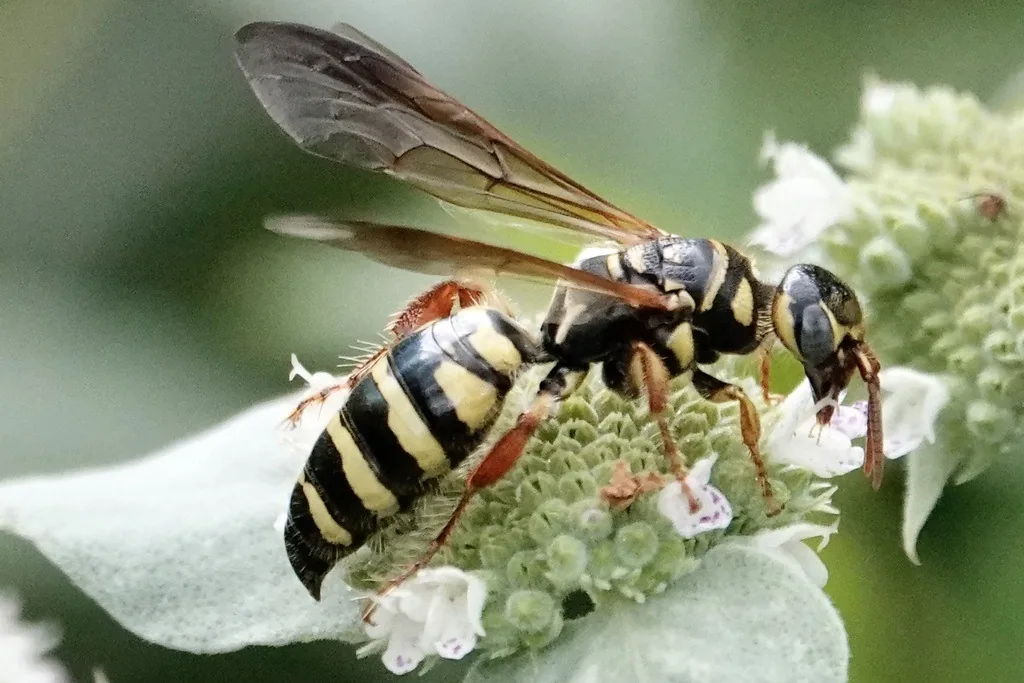
- Both sexes are black or dark with yellow bands and about 3/4 to 1 inch long, with smoky wings and yellow markings on the thorax.[2][1]
- Females are robust, with stocky rust- or orange-red legs, thick hind thighs for digging, wider yellow bands, and orangish antennae with some yellow at the base.[1][2]
- Males are slender, with yellow legs and long, straight black antennae, and they carry a black, curved, hooklike point at the tip of the abdomen. It is a false stinger.[1][2]
- Males are often seen in groups clinging to one plant, while females are usually seen alone.[1]
Look-alikes
| Look-alike | How to tell them apart |
|---|---|
| Other Myzinum wasps | North America north of Mexico has 10 species in the genus, and three others occur in Missouri. The five-banded is the most common one in the eastern United States; for a certain identification, specialists examine the shape of the reproductive organs.[1] |
Where it lives
Found throughout most of the country, it is the most common Myzinum in the East; Missouri and Kansas both report it statewide. GBIF's 1990-2026 U.S. records (about 2,500) come from 37 states on the map, most from Texas, Illinois and Minnesota.[2][1][6]
Biology and life cycle
Adults are out mainly in mid to late summer; in Missouri, July through September are the peak months.[1][2]
Adults drink nectar, especially from yarrow, goldenrods, bonesets, sunflowers, rattlesnake master, mountain mints, wild bergamots, milkweeds and dogbanes.[1][2]
A female digs into the soil to reach a scarab beetle grub, such as a Japanese beetle or May beetle larva, paralyzes it with a sting and lays a single egg on it; a 2024 study describes Myzinum females as ectoparasitoids that place one egg on the host's body.[1][2][4]
The wasp larva feeds on the grub, eating nonessential tissue first and the vital organs last, then pupates and spends the winter underground as a pupa.[1][2]
There is one generation a year, timed to when beetle grubs are plentiful in the soil.[1]
Males rest together on the same plant stem night after night or through the afternoon heat. Groups occasionally settle on house siding; they gather where there is nectar, shade or tall grass to shelter in overnight.[1][2]
Numbers swing from year to year with the grub populations they depend on, so some summers bring large emergences.[2]
Damage and signs
- They damage nothing; K-State calls them no threat to people, pets or landscaping.[2]
Health risk
Only females have a stinger, and they use it on grubs. MDC says they sting people only if handled, stepped on barefoot or otherwise threatened, and males cannot sting at all. Wasp stings are usually painful; MedlinePlus says to call 911 for trouble breathing, wheezing or shortness of breath after a sting.[1][2][5]
Control
Prevention
No control is needed. MDC calls these wasps beneficial and K-State notes they have been promoted for biocontrol, because their larvae kill the grubs of pest scarabs such as Japanese beetles and May beetles; the clusters of males die off as summer goes on.[1][2]
To avoid the rare sting, leave the females alone and don't go barefoot where they are active.[1]
Thynnid or tiphiid?
Names vary by source. MDC places it in the thynnid wasp family, Thynnidae, which used to be treated as a subfamily of the tiphiid wasps (Tiphiidae); K-State calls it the five-banded tiphiid wasp, and a 2024 study still lists Myzinum under Tiphiidae. Both groups are sometimes called flower wasps.[1][2][4]
Common questions
- Is the cluster of black-and-yellow wasps on my plant a nest?
- No. These wasps are solitary and have no colony to defend. The clusters are males resting together, often on the same plant each night, and they cannot sting. Disturbed groups fly in circles, which can look like an angry swarm.[1][2]
- Does the hooked tip on a male's abdomen sting?
- No. It is a false stinger with no venom and can't harm people, though K-State notes it is often mistaken for a stinger.[1][2]
- Will these wasps help with grubs in my lawn?
- They help. Females lay their eggs on scarab grubs, including white grubs in turf, and the wasp larvae kill them; they have been promoted as biocontrol on farms and turf, though parasitism changes from season to season.[1][2]
Sources
- Missouri Department of Conservation, “Five-Banded Thynnid Wasp (Field Guide).” mdc.mo.gov/discover-nature/field-guide/five-banded-thynnid-wasp (accessed 2026-11-11)
- Kansas State University Extension Entomology, “Flower Wasps Getting Attention In Yards and Fields (A. Zukoff, July 22, 2022).” www.k-state.edu/news/kansasbugs/articles/2022/07/flower-wasps-getting-attention-in-yards-and-fields.html (accessed 2026-11-11)
- iNaturalist, “Myzinum quinquecinctum taxon page (order and family).” www.inaturalist.org/taxa/136466 (accessed 2026-11-11)
- Micron, via PubMed, “da Silva M, Justino CEL, Carnimeo FH, Noll FB, Billen J (2024), Morphology and ultrastructure of the colleterial glands in Myzinum flower wasps (Tiphiidae, Hymenoptera), Micron 176:103561.” pubmed.ncbi.nlm.nih.gov/37918269/ (accessed 2026-11-11). Cited from the PubMed abstract.
- MedlinePlus, U.S. National Library of Medicine, “Insect bites and stings (Medical Encyclopedia 000033).” medlineplus.gov/ency/article/000033.htm (accessed 2026-11-11)
- Global Biodiversity Information Facility (GBIF), “Myzinum quinquecinctum (five-banded thynnid wasp): occurrence records in the U.S., 1990-2026 (GBIF occurrence search).” api.gbif.org/v1/occurrence/search?taxonKey=8512717&country=US&hasGeospatialIssue=false&occurrenceStatus=PRESENT&year=1990%2C2026&facet=stateProvince&facetLimit=400&limit=0 (accessed 2026-11-11). State counts are records reported (iNaturalist research-grade, museum specimens, surveys), not abundance.