On this page
How to identify it
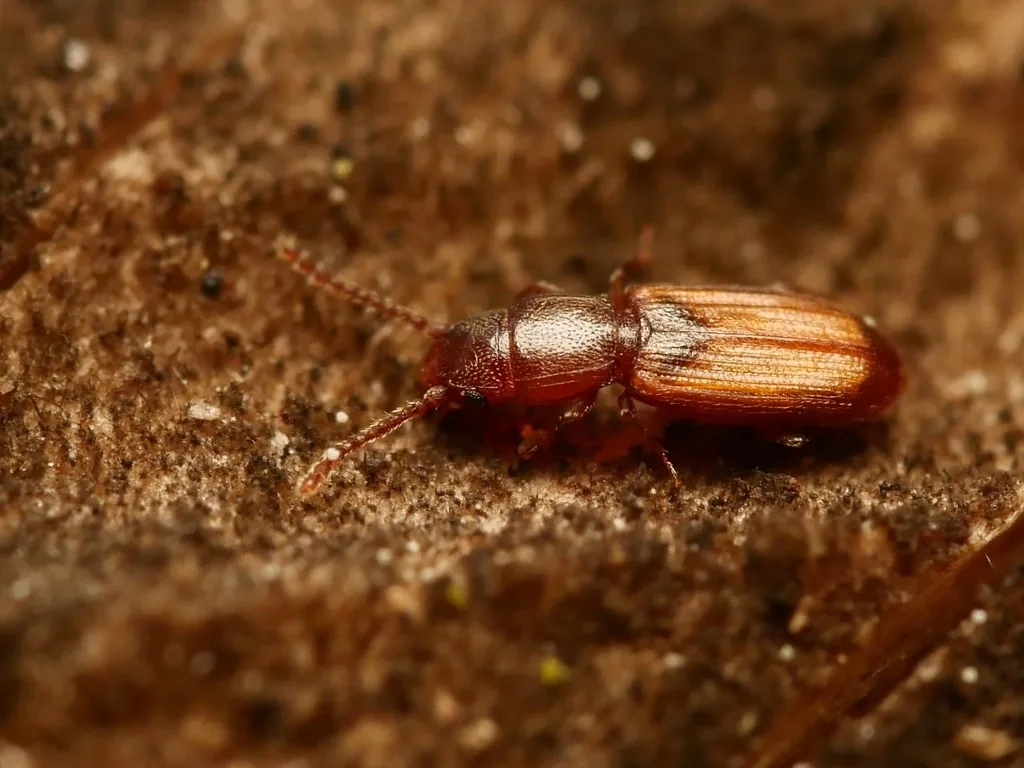
- Adults are reddish brown, flat, shiny and only about 2 mm (1/12 inch) long, with long, slender antennae, and they are strong fliers.[1]
- In the rusty grain beetle the antennae are about half as long as the body in both sexes, while males of the flat grain beetle and flour mill beetle have antennae more than two-thirds the body length.[1]
- The rusty grain beetle's prothorax, the segment behind the head, narrows toward the back; in the other two it is more nearly square.[1]
- Larvae are white, somewhat flattened and about 3 mm (1/8 inch) long, with a slightly darker head and a small forked tip at the end of the abdomen.[1]
Look-alikes
| Look-alike | How to tell them apart |
|---|---|
| Rusty grain beetle and flat grain beetle | The two are hard to tell apart; compare antenna length in males and the shape of the segment behind the head.[1] |
Where it lives
Purdue covers them as common stored-product pests, and UF/IFAS lists flat grain beetles among the usual pantry pests in Florida homes; the rusty grain beetle is the most cold-tolerant of the three.[1][2]
Biology and life cycle
Females lay eggs one at a time in crevices of grain kernels, between kernels or in debris, and can keep laying for more than 34 weeks, about 242 eggs each on average.[1]
The larvae burrow into kernels, pass through four stages and spin a silken cocoon; development from egg to adult takes 22 to 24 days for rusty and flat grain beetles at 90 to 95 °F and high humidity, and about 30 to 35 days for the flour mill beetle.[1]
Adults and larvae are cannibalistic and eat the eggs and pupae of their own kind.[1]
Damage and signs
- They can't feed on sound grain but attack kernels with even slight damage, preferring the germ and sometimes hollowing out the whole kernel; mold makes kernels more suitable for them.[1]
- Recorded foods include wheat, flour, corn, rice, barley, oilseeds, dried fruits, chilies, cocoa, coffee berries and nutmeg.[1]
- Pantry pests usually build up in unused foods that were infested when bought or in packages that weren't sealed, then spread to other exposed food; often the first sign is beetles crawling or flying near the pantry.[2]
Health risk
They contaminate stored food; neither source reports bites, stings or other harm to people or pets.[1][2]
Control
Prevention
Keep foods in tightly sealed containers, since unsealed packages invite infestation.[2]
Sanitation
Find the source: inspect every susceptible food, throw out badly infested items, vacuum shelves and cabinets, wash them with warm, soapy water and caulk cracks where beetles hide.[2]
Traps and physical control
To save an item, heat it in an oven at 130 °F for 30 minutes or freeze it at 0 °F for four days, sealed in a plastic bag to limit condensation, and use it soon afterward.[2]
Pesticides
A crack-and-crevice insecticide can be used in emptied, cleaned cabinets; remove all food first, let the spray dry before restocking, and follow the label.[2]
Common questions
- What are the tiny reddish-brown beetles in my flour?
- Very small (about 1/12 inch), flat, shiny reddish-brown beetles with long antennae in flour or grain products are likely flat grain beetles such as the rusty grain beetle.[1][2]
- How do I get rid of beetles in my pantry?
- Throw out infested food, vacuum and wash the shelves, freeze or heat any items worth saving, and store food in sealed containers.[2]
Sources
- Purdue Extension Entomology, “Rusty, Flat, and Flour Mill Beetles, Cryptolestes spp. (E-227, L. J. Mason, November 2018).” www.extension.entm.purdue.edu/publications/E-227/E-227.html (accessed 2026-10-17)
- UF/IFAS Extension (EDIS), “Pantry and Stored Food Pests (ENY-213/IG095).” ask.ifas.ufl.edu/publication/IG095 (accessed 2026-10-17)
- iNaturalist, “Cryptolestes taxon page (order and family).” www.inaturalist.org/taxa/174094 (accessed 2026-10-06)