On this page
How to identify it
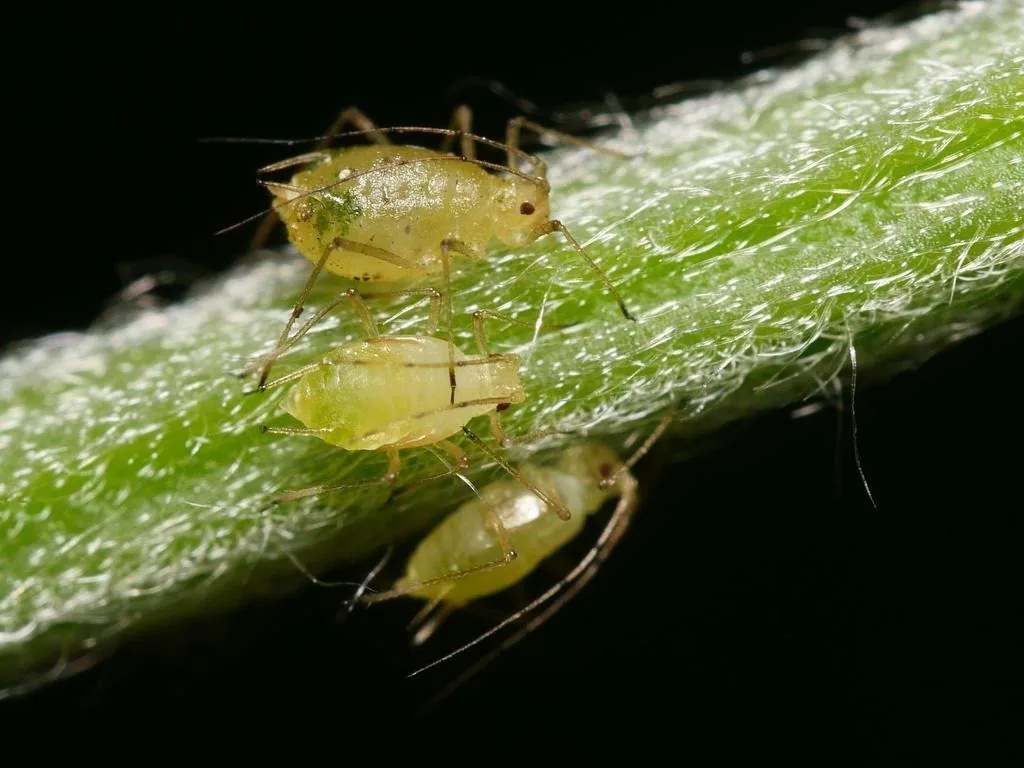
- Look for dark green patches at the base of the cornicles (the paired 'tailpipes' at the rear of the body).[2][3]
- The legs and antennae have black tips or black lines.[2][3]
- Under magnification, the bumps at the antennal bases make a pronounced notch in the front of the head, with straight, parallel sides.[2]
Look-alikes
| Look-alike | How to tell them apart |
|---|---|
| Green peach aphid | Lacks the foxglove aphid's black lines on the legs and antennae and the dark green spots at the rear of the body.[3] |
Where it lives
Found worldwide in all but the coldest land habitats. In the United States, UMass Extension's greenhouse program treats it as a pest of greenhouse crops such as geranium.[1][3]
Biology and life cycle
It has one of the broadest host ranges of any aphid, recorded from more than 82 plant families of both monocots and dicots.[1]
Crops it is particularly important on include tomato, peppers, tobacco, celery, carrots, tulip bulbs, cucurbits and legumes, as well as greenhouse strawberries, potato and many ornamentals.[1]
It has been implicated in spreading at least 45 plant viruses.[1][4]
Damage and signs
- Feeding removes sap from the plant's phloem and can stunt growth, and foxglove aphids tend to cause more leaf distortion than some other aphids.[4][3]
- In soybean, research describes it as a major pest that can reduce yields.[6]
- Infested plants show the aphids themselves, their whitish shed skins and sticky honeydew on leaf undersides, buds and young growth.[3]
Health risk
The sources describe it only as a plant pest; none mentions any risk to people or pets.[1][3]
Control
Prevention
Scout greenhouse plants by checking leaf undersides, buds and young growth for aphids, their whitish shed skins and honeydew.[3]
Plant resistance is being studied: in one study, the soybean cultivar Dowling reduced the aphid's survival and reproduction and was less preferred for settling.[6]
Biological control
Research has found the American hoverfly, Eupeodes americanus, a promising biological control agent against foxglove aphid on greenhouse pepper.[5]
Common questions
- How can I tell foxglove aphids from green peach aphids?
- Foxglove aphids have black lines on the legs and antennae and dark green spots at the base of the cornicles; green peach aphids lack these marks.[3][2]
- Does the foxglove aphid only feed on foxglove?
- No. Despite the name, it is one of the least picky aphids, recorded on plants in more than 82 families, including vegetables, field crops and ornamentals.[1]
- Why are my geranium leaves twisted?
- Foxglove aphids tend to cause more leaf distortion than some other aphids, so check the undersides of distorted leaves and young growth for them.[3]
Sources
- USDA APHIS PPQ Identification Technology Program (idtools.org), “Aulacorthum solani fact sheet, AphID: Identification guide for cosmopolitan and polyphagous aphid species (C. Favret and G. Miller).” www.aphid.aphidnet.org/Aulacorthum_solani.php (accessed 2026-11-09)
- UMass Extension Greenhouse Crops and Floriculture Program, “Aphid - Foxglove Aphid Identification.” www.umass.edu/agriculture-food-environment/greenhouse-floriculture/photos/aphid-foxglove-aphid-identification (accessed 2026-11-09)
- UMass Extension Greenhouse Crops and Floriculture Program, “Aphids - Foxglove aphid feeding injury on geranium.” www.umass.edu/agriculture-food-environment/greenhouse-floriculture/photos/aphids-foxglove-aphid-feeding-injury-on-geranium (accessed 2026-11-09)
- Genetics Society of America / Oxford University Press (G3), “Torres J, Rozo-Lopez P, Brewer W, Saleh Ziabari O, Parker BJ. Draft genome sequence of the glasshouse-potato aphid Aulacorthum solani. G3: Genes, Genomes, Genetics 15(3):jkaf013 (2025) (abstract).” doi.org/10.1093/g3journal/jkaf013 (accessed 2026-11-09)
- Wiley (Insect Science), “Fauteux A, Soares AO, Lucas E. Larval development and voracity of Eupeodes americanus (Diptera: Syrphidae): comparison of the focal prey Aphis gossypii and the banker prey Rhopalosiphum padi. Insect Science 31(2):575-586 (2024) (abstract).” doi.org/10.1111/1744-7917.13255 (accessed 2026-11-09)
- Entomological Society of America (Journal of Economic Entomology), “Han X, Lei J, Zhang Y, Jia Y, Wang X, Liu J, Tian Z. Feeding behavior, life-history traits, and settling preference of Aulacorthum solani (Hemiptera: Aphididae) on resistant and susceptible soybeans. Journal of Economic Entomology 117(6):2658-2668 (2024) (abstract).” doi.org/10.1093/jee/toae210 (accessed 2026-11-09)
- iNaturalist, “Aulacorthum solani taxon page (order and family).” www.inaturalist.org/taxa/330194 (accessed 2026-11-09)