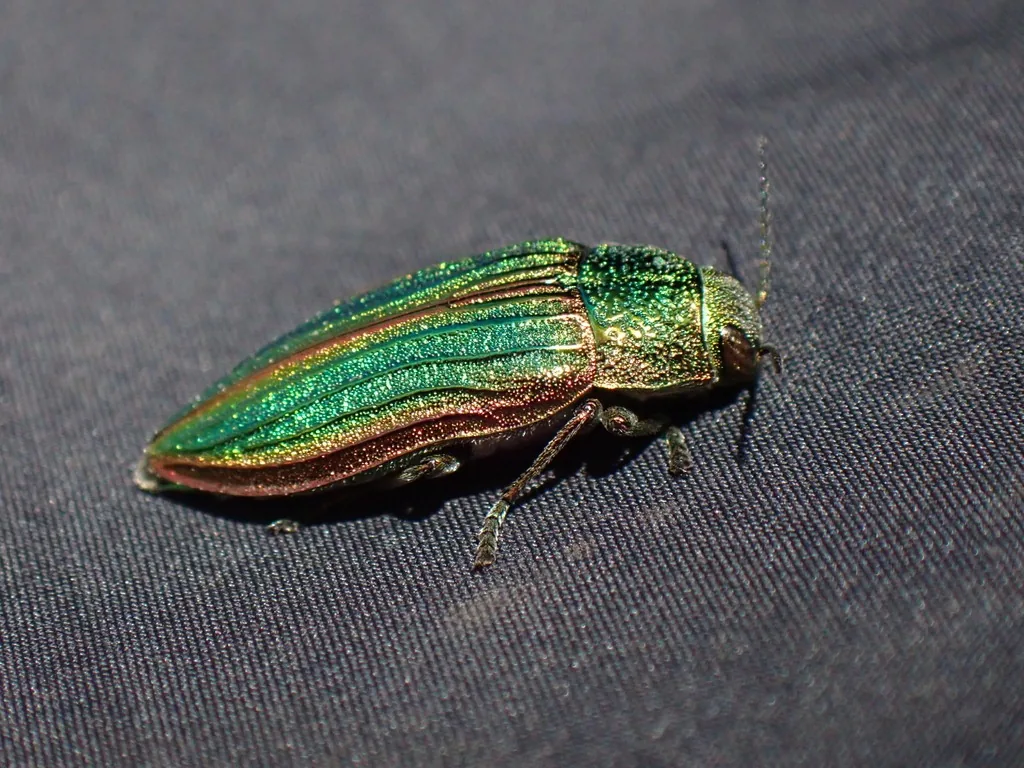
On this page
How to identify it
- The usual sign is an oval exit hole in flooring, framing, window sash or other woodwork, either in the board the larva grew in or in adjoining woodwork it bored through.[1]
- Larval galleries are oval or flattened in cross section, tightly packed with fine, light-colored frass, and finely grooved on the walls. Young larvae cut flattened tunnels only 0.5 to 1 mm wide, so infested lumber is hard to spot before it's used.[1]
- Larvae working in a structure can sometimes be heard chewing, and a mine near the surface can show as a slight dimple or trough in the wood.[1]
Look-alikes
| Look-alike | How to tell them apart |
|---|---|
| Powderpost beetles | UC IPM notes that powderpost beetles attack hardwoods and bamboo, whose pores take their eggs, while the golden buprestid develops in conifers such as Douglas-fir and pine.[2][1] |
Where it lives
Native to western North America, from central British Columbia to southern California.[1]
Biology and life cycle
In the forest, adults lay eggs on recently dead or dying trees and unseasoned logs, especially ones whose bark was injured by fire, logging or lightning; unseasoned lumber with bark still on it can also be attacked.[1]
Females lay eggs in late spring or summer in bark crevices and scars close to the wood, singly or in masses coated with an adhesive secretion, and the eggs hatch soon afterward.[1]
Larvae bore into the wood, usually 1 to 2 cm (about 3/8 to 3/4 inch) below the sapwood surface, and widen their mines as they grow; occasionally they reach the heartwood.[1]
Mature larvae pupate at the end of their galleries in late summer, become adults in the fall and overwinter in the galleries, then chew out the following spring. In the forest the larval stage lasts 2 to 4 years.[1]
New adults must feed on Douglas-fir foliage before they mature and mate; this feeding does no significant damage.[1]
In seasoned, dry wood in buildings the life cycle stretches out: larvae may live up to 60 years, and adults can emerge at any season.[1]
Hosts listed by the Canadian Forest Service are lodgepole pine, Rocky Mountain Douglas-fir and western hemlock, with Douglas-fir, ponderosa pine and western redcedar as secondary hosts.[1]
Damage and signs
- In buildings the damage is usually light: mined boards or timbers and exit holes cut through finished surfaces. Structural damage is rare and happens only in special cases, such as many larval galleries close together in wide-grained wood.[1]
- Unless the exit holes are exposed to the weather, further deterioration is unlikely. One to five beetles emerge from a house of average construction, and five or more from a single board or timber is rare.[1]
Health risk
The Canadian Forest Service treats it as a pest of wood, and neither source mentions bites, stings or any other risk to people or pets.[1][2]
Control
Prevention
Beetles that emerge in a newer building came from the lumber. UC IPM notes that forest wood borers emerging from infested wood in newly built structures aren't able to reinfest the wood there, and in nature the golden buprestid lays its eggs on dead or dying trees and unseasoned logs.[2][1]
Indoors, unless the exit holes are exposed to the weather, further deterioration of the wood is unlikely.[1]
Common questions
- Why did a beetle chew its way out of the wood in my house years after it was built?
- Golden buprestid larvae that were in the lumber when it was milled can keep developing in seasoned wood for decades, up to 60 years, and the adults can emerge at any season.[1]
- Will they spread to the rest of my house?
- No. In nature the beetles lay eggs on recently dead or dying trees and unseasoned logs, and UC IPM notes that forest wood borers emerging in new buildings can't reinfest the wood there.[1][2]
- Is my house structurally at risk?
- Rarely. The damage is usually light, mostly exit holes marring the surface; structural damage happens only when many galleries are close together in wide-grained wood.[1]
Sources
- Natural Resources Canada, Canadian Forest Service, “Golden buprestid (Trees, insects and diseases of Canada's forests).” tidcf.nrcan.gc.ca/en/insects/factsheet/306 (accessed 2026-11-08)
- University of California Statewide IPM Program, “Pest Notes: Wood-Boring Beetles in Homes (Publication 7418).” ipm.ucanr.edu/PMG/PESTNOTES/pn7418.html (accessed 2026-11-08)
- iNaturalist, “Buprestis aurulenta taxon page (order and family).” www.inaturalist.org/taxa/215596 (accessed 2026-11-08)