On this page
How to identify it
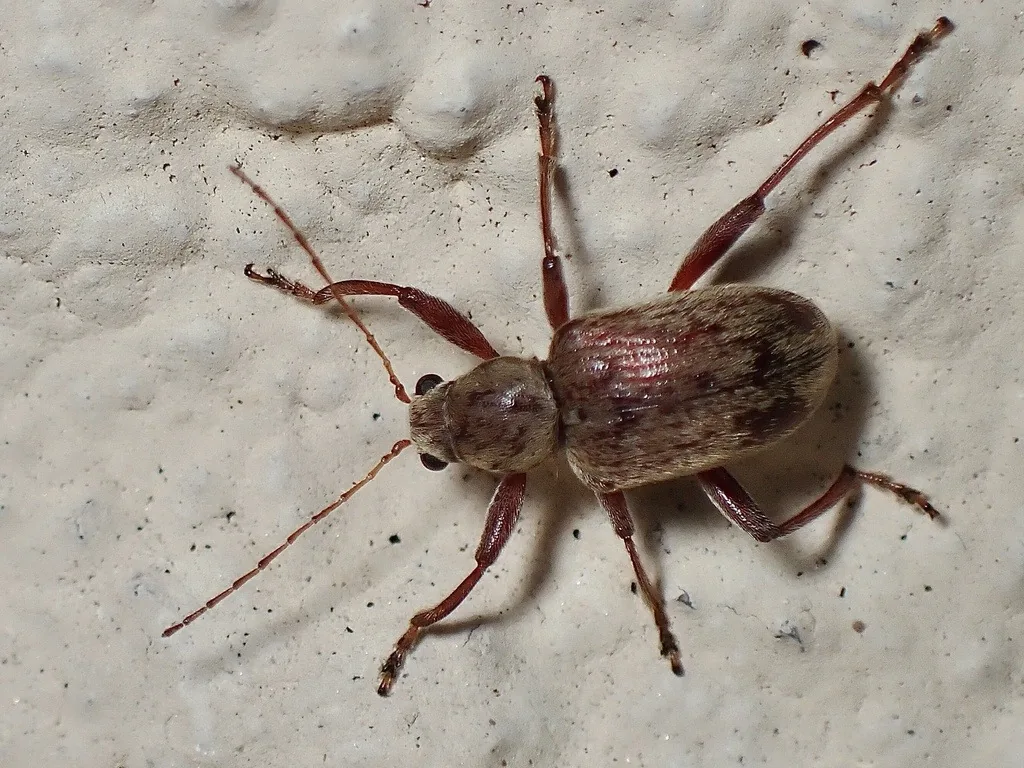
- A small grayish-brown to chestnut beetle with a fine, light-colored pile of hairs over the thorax and wing covers; older adults look darker as the hairs wear off. Virginia Tech gives the length as about 6 mm, the Cornell sheet as 8 to 10 mm (5/16 to 3/8 inch). Beetles feed first on sucker growth and the lower canopy and are most active in mid to late morning.[1][2]
- The feeding sign is a chain-like pattern of small marks on the leaf, similar to the marks left by larval grape flea beetles. In heavy infestations adults also feed on the upper canopy and on immature berries.[1][2]
- Eggs are creamy-yellow to white, oblong and 1 to 1.5 mm, laid in tight clusters of about 20 to 100 in crevices between layers of bark on canes and stems; peeling off strips of loose bark from early June into August exposes them. Larvae are creamy-white grubs with a dark brown head that live in the top 30 cm of soil within 45 to 60 cm of the trunk; pupae are 5 to 7 mm, pearly white turning brown.[2][1]
Look-alikes
| Look-alike | How to tell them apart |
|---|---|
| Grape flea beetle | Its larvae make chain-like feeding marks on grape leaves similar to those of adult grape rootworms.[1] |
| Southern grape rootworm (Fidia longipes) | A related species found to be more common than F. viticida in North Carolina; its distribution in Virginia is not known.[1] |
Where it lives
A native species occurring from the Atlantic Seaboard states west to North Dakota, Nebraska, Kansas and Texas, on wild grapes, Virginia creeper and redbud as well as vineyards. In North Carolina the southern grape rootworm is the more common Fidia.[2][1]
Biology and life cycle
One generation a year, though some individuals take two. Adults emerge from the soil between late May and early to mid July depending on soil temperature, about two weeks after pupation, which takes place in the upper 15 cm of soil in cells usually 40 to 60 cm from the vine base around the time of grape bloom. They mate within about a week, lay their first eggs three to seven days later, and live one to seven weeks, feeding on foliage for three or four weeks or more.[2][1]
Each female lays about 100 eggs in clusters under loose bark, from early June through late July at peak and sometimes into September. Eggs hatch in 10 to 15 days and the larvae drop to the ground, enter the soil and feed on roots until cold weather, passing through five instars. Most finish feeding in the season they hatch; those that do not overwinter as larvae, feed a second season, and emerge as adults the following spring.[2][1]
Larvae overwinter in cells 1 to 2 cm to more than 50 cm deep among the roots, moving back toward the surface in spring to finish feeding or pupate.[1][2]
Damage and signs
- Larvae prefer small tender roots and, in heavy infestations, channel along the inner bark of larger roots. Vines become unthrifty, yields drop, and marked reductions in vigor and production have been seen in as little as three years; after several years of infestation vines can die. Damage is more severe on soil poorly suited to grapes.[2][1]
- Adult feeding on leaves, and on berries at high densities, is comparatively inconsequential; it mainly serves as the visible warning. Because adults disperse slowly, infestations are usually spotty within a region and within a vineyard.[2]
Health risk
A vineyard pest only; neither source describes any effect on people.[1][2]
Control
Prevention
Scout weekly from late May: look for the first adults on trunks, canes and leaves, and check sucker growth and the lower canopy where feeding begins. In suspect vineyards peel strips of loose bark from June into August to look for egg clusters.[2]
Traps and physical control
Intensive shallow cultivation of the soil around vines until adults emerge in late June destroys pupae, which lie in the top 15 cm of soil.[1][2]
Pesticides
Control is aimed at the adults, and timing decides whether it works. Treat when the first beetles are seen, which runs from late May to early or mid July by location; a spray applied too early will not persist through the three to four weeks over which adults emerge, and one applied too late lets eggs already laid under the bark hatch and the larvae reach the soil. Check the vineyard weekly after treatment and apply a second spray if any adults are found. Virginia Tech notes that the first and second grape berry moth sprays may also control grape rootworm, except materials specific to caterpillars, and that carbaryl has been a common recommendation; ask the local extension office for current materials.[2][1]
Common questions
- My grape leaves have little chains of holes. What is doing it?
- Chain-like feeding marks in early summer are the signature of adult grape rootworms, though larval grape flea beetles leave similar marks. Look for small hairy brown beetles on sucker growth and lower leaves in mid to late morning.[1][2]
- The leaf damage is minor. Why bother treating?
- Because the leaf feeding is the only visible part of the problem: the eggs those adults lay become root-feeding grubs for the next nine to ten months, and heavy root feeding can cut vigor and yield within three years or kill vines.[2][1]
- When should I spray?
- At first adult sighting, between late May and mid July depending on where you are, with a follow-up if beetles are still present a week later. Spraying before emergence wastes the residue; spraying after egg laying misses the generation.[2]
Sources
- Virginia Tech Department of Entomology (Virginia Fruit Page), “Grape rootworm, Fidia viticida (Walsh) (Virginia Fruit Page, D. G. Pfeiffer).” virginiafruit.ento.vt.edu/rootworm.html (accessed 2026-11-10)
- New York State Agricultural Experiment Station, Cornell University (eCommons), “Grape Rootworm, Grape IPM Insect Identification Sheet No. 7 (Dennehy and Clark, 1986).” ecommons.cornell.edu/entities/publication/f91091d0-90a7-44ad-87f7-1d7db704ea64 (accessed 2026-11-10)
- iNaturalist, “Neofidia lurida taxon page (order and family).” www.inaturalist.org/taxa/1133803 (accessed 2026-11-10)