On this page
How to identify it
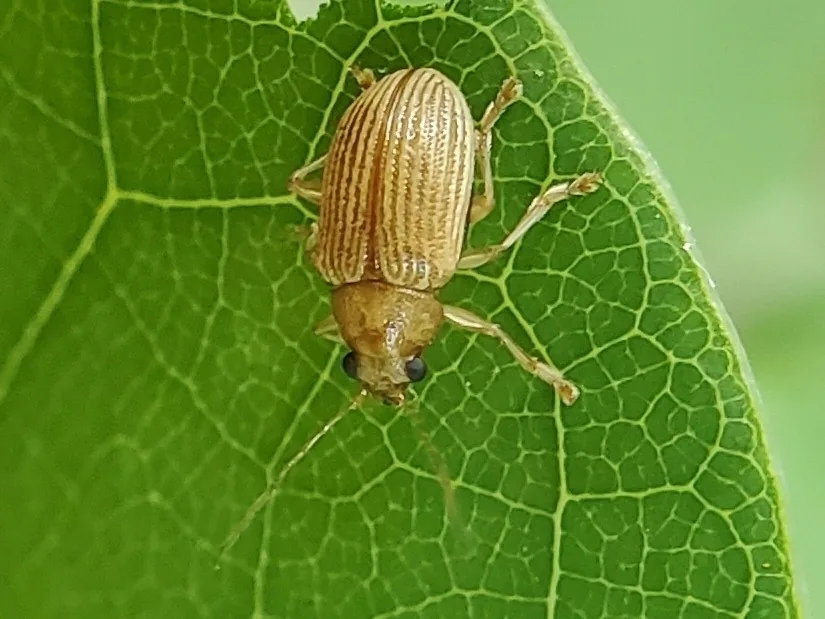
- Adults are small oval beetles, 1/8 to 3/16 inch long (NC State measures 4 to 5 mm), yellowish brown to clay-orange.[1][2]
- The wing covers look striped: NC State describes lengthwise rows of shallow indentations, and CPN describes parallel tan lines.[1][2]
- Larvae are stout, C-shaped, grayish-white to tan grubs up to about 1/4 to 5/16 inch long, with a dark brown head and neck shield, three pairs of legs near the head and small fleshy bumps along the abdomen.[1][2]
- The pupa is about 4 mm long, whitish at first and gradually darkening.[1]
Look-alikes
| Look-alike | How to tell them apart |
|---|---|
| Bean leaf beetle | Illinois Extension notes that grape colaspis adults resemble bean leaf beetles. Look for the grape colaspis's yellowish-brown wing covers with rows of shallow pits that make them look striped.[3][1] |
| Nematode injury | Colaspis root injury is often mistaken for nematode damage. It can be told apart by feeding marks on the roots and on the bark of the underground stem, and adult beetles in the plant tops help confirm it.[1][2] |
Where it lives
Colaspis beetles are found in most soybean-growing areas of the United States, and the grape colaspis is the most common of them.[2]
Biology and life cycle
It overwinters in the soil as a small grub and can spend the winter below the plow layer.[1][2]
In spring the grubs move up near the surface (in late May, according to NC State) and feed on the roots of young plants.[1][2]
After pupating, adults come out of the soil in midsummer and feed on a wide variety of crops.[2]
Mating and egg-laying happen within about two weeks of emergence; females lay eggs in the soil of soybean, alfalfa and other legume fields, and CPN notes corn is also suitable. Eggs hatch in one to two weeks.[2][3][1]
The new larvae feed on roots in the fall before overwintering, and there is one generation a year throughout North America.[2]
The insect is almost always confined to spots in a field and is most abundant on organic soils; dry soil makes its injury worse.[1][2]
Damage and signs
- Grubs feeding on roots leave seedlings with few lateral roots and chewed bark on the underground stem, and young plants may be stunted or die, thinning the stand.[1][3]
- Corn and rice are more vulnerable to the root feeding than soybean.[2]
- Adults chew soybean leaves but are seldom numerous enough to cause economic defoliation.[2][1]
- Illinois Extension describes it as a common insect that only occasionally hurts corn and soybean there; 2018 was an outbreak year, with stand losses and some replanting in parts of the state.[3]
Health risk
It is a crop pest; NC State, the Crop Protection Network and Illinois Extension describe only injury to plants.[1][2][3]
Control
Prevention
To confirm a problem, dig around damaged plants and look for the grubs; sweep-netting adults in midsummer can help you plan for next year, though no thresholds exist.[2]
Once damage shows, there is no rescue treatment; the only decision is whether to replant. Replanted soybeans are seldom attacked because the grubs that caused the injury have already turned into beetles.[3][1][2]
NC State calls crop rotation the best option, since adults lay eggs in the previous season's soybeans and problems follow a soybean crop. CPN adds that rotating with cotton or rice may reduce damage, but soybean-corn rotation hasn't been shown to reduce populations because corn is also suitable for egg-laying.[1][2]
Traps and physical control
Tillage doesn't help, because the larvae can overwinter below the plow layer.[1]
Pesticides
Any chemical control has to go on at planting. CPN and Illinois Extension suggest an insecticidal seed treatment, or a soil insecticide, only for fields with a history of colaspis damage, along with practices that give vigorous early root growth; Illinois notes there is little data on how well these work in the Midwest, and NC State considers insecticides ineffective against this insect.[2][3][1]
Common questions
- My soybean stand has patchy, stunted spots. Could it be grape colaspis?
- It could. Dig up affected seedlings and look for small, C-shaped white grubs with brown heads, roots with few side roots, and chewed bark on the underground stem. Colaspis damage is often mistaken for nematode injury.[1][2]
- Can I spray to stop grape colaspis after the damage appears?
- No. There are no rescue treatments once the grubs have injured the stand; the decision then is whether to replant.[3][2][1]
- Do the adult beetles hurt soybean leaves?
- They feed on the foliage, but the leaf feeding is seldom enough to matter economically; the grubs on the roots do the real damage.[1][2]
Sources
- NC State Extension, “Grape Colaspis in Soybean (D. Reisig, 2020).” content.ces.ncsu.edu/grape-colaspis-in-soybean (accessed 2026-11-08)
- Crop Protection Network (multi-state university extension collaboration), “Colaspis Beetles in Soybean (F. Musser and E. Hodgson, 2021).” cropprotectionnetwork.org/encyclopedia/colaspis-beetles-in-soybean (accessed 2026-11-08)
- University of Illinois Extension, “Plan to scout for last season's crop pests and diseases (April 19, 2019).” extension.illinois.edu/node/21372 (accessed 2026-11-08)
- iNaturalist, “Colaspis brunnea taxon page (order and family).” www.inaturalist.org/taxa/217308 (accessed 2026-11-08)