On this page
How to identify it
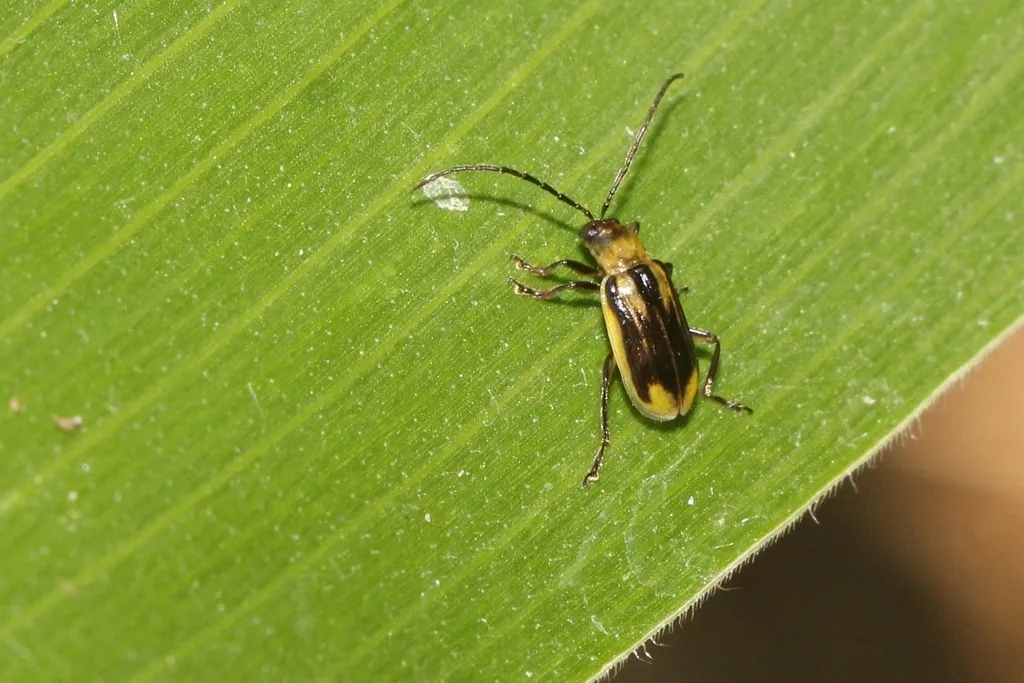
- Adults are beetles about 1/4 inch long. The western corn rootworm is yellowish to pale green with three distinct black stripes, and its wing covers stop short of the tip of the abdomen; the northern corn rootworm is plain green with no black markings.[1][2]
- The larvae are slender and white, up to about 1/2 inch long, and live in the soil feeding on roots.[2]
- Badly damaged corn leans over and then bends back upward, a pattern called goose-necking. Adults leave brown patches near the leaf tips where they have eaten the upper surface down to the lower one.[1]
Look-alikes
| Look-alike | How to tell them apart |
|---|---|
| Spotted cucumber beetle (southern corn rootworm) | The southern corn rootworm, better known as the spotted cucumber beetle, has 11 prominent black spots on green wing covers. It is only an occasional pest of corn, and because it lays its eggs in spring on many kinds of plants, it can damage first-year corn.[1] |
Where it lives
They are pests throughout the US Corn Belt. In Kentucky the western corn rootworm is the most common species attacking corn and the northern the least common, and Illinois Extension covers both.[1][2]
Biology and life cycle
Western and northern corn rootworm females lay their eggs in the soil at the base of corn plants in late summer and fall; the eggs spend the winter there and hatch in late spring or early summer.[1][2]
The larvae feed only on the roots of corn and a few other grasses, and newly hatched larvae can travel only a short distance through the soil, so larvae that hatch where no corn is growing die.[1][2]
Larvae pass through three stages, pupate in the soil and emerge as adults in July. There is one generation a year.[2][1]
In states north of Kentucky a soybean variant of the western corn rootworm lays its eggs in soybean fields, so corn planted there the next year can be damaged; Kentucky had no reports of the variant as of early 2026.[1][2]
Damage and signs
- Larvae chew the roots, and severe infestations destroy three or more complete rings of roots in June. Damaged plants may show drought stress even in moist soil and fall over, and lodging before pollination is finished cuts yield.[1][2]
- Adults feed on the green silks of sweet corn, which can keep ears from pollinating and filling, and they damage cucumber and squash blossoms; Illinois notes that adult damage is usually not significant in commercial crops.[2][1]
Health risk
They feed only on plants; Kentucky and Illinois mention no risk to people.[1][2]
Control
Prevention
Rotate crops. Because western and northern larvae die without corn roots nearby, planting corn where corn did not grow last year prevents most root damage, and gardeners can simply move the sweet corn patch. In Kentucky it often takes two to four years of continuous corn to build damaging numbers.[1][2]
Rotation fails where adults lay eggs in other crops, as with the soybean variant. Yellow sticky trap counts late the previous summer help decide whether a field needs treatment.[2][1]
Pesticides
In sweet corn, Illinois advises protecting green silks while beetles are present and clipping them, and stopping once the silks turn brown; foliar sprays used against corn earworm or corn borer also control rootworm beetles before they lay eggs.[2]
For corn that follows corn, seed treatments, soil insecticides and Bt corn have all given consistent results in Kentucky; consider which other pests each option also covers.[1]
Common questions
- Why is my corn leaning over and curving back up?
- That goose-necked shape is characteristic of corn rootworm larvae chewing the roots.[1]
- What is eating the silks on my sweet corn?
- Corn rootworm beetles are one cause: they feed on green silks and can keep the ears from filling.[2][1]
- Does crop rotation really work against corn rootworms?
- Usually, for western and northern corn rootworms, because their larvae die if they hatch where no corn roots grow. It fails where a variant lays its eggs in other crops, such as the soybean variant found north of Kentucky.[1][2]
Sources
- University of Kentucky Entomology, “Corn Rootworms in Kentucky, ENTFACT-152 (R. Bessin, January 2026).” entomology.ca.uky.edu/ef152 (accessed 2026-11-08)
- University of Illinois Extension, “Corn Rootworm (Insects).” extension.illinois.edu/insects/corn-rootworm (accessed 2026-11-08)
- iNaturalist, “Diabrotica virgifera taxon page (order and family).” www.inaturalist.org/taxa/218294 (accessed 2026-11-08)