On this page
How to identify it
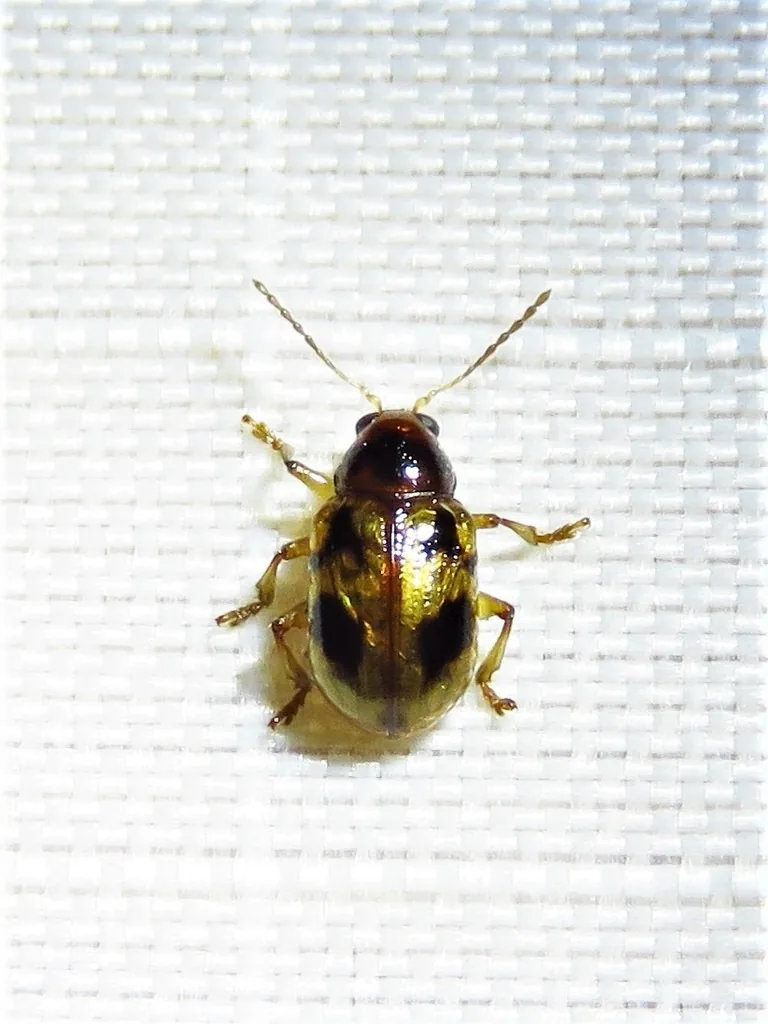
- A shiny, oval beetle about 1/8 inch long, brown to dark brown, with four dark blotches on the wing covers.[1][2]
- The larva is a slender, creamy white grub, slightly longer than the adult (up to about 1/5 inch), living in the soil or potting mix and feeding on roots.[1][2]
- The leaf damage is distinctive: small round to oval or elongated holes, generally no more than 1/16 inch across, chewed into the leaves.[1][2]
- Adults feed at night and hide by day in the foliage or in debris at the base of the plant. Knocked off a plant, they play dead for up to a minute, then scurry or fly for cover.[1][2]
Where it lives
NC State reports it on strawberry and ornamentals in North Carolina, where the beetles are active from at least April through November, and Alabama and USDA researchers note widespread reports of damage in azalea nurseries in the Southeast.[1][2]
Biology and life cycle
Adults spend the winter in mulch or soil crevices; in mild climates they feed on warm days through the winter. They become active in late winter or spring, from February to March in mild areas and in April and May in North Carolina.[1][2]
Females lay eggs on older leaves near the soil surface, in the lower canopy, or in the potting mix and debris at the base of the plant. The grubs burrow into the soil to feed on roots and pupate there, and new adults appear from midsummer and feed on foliage through early fall.[1][2]
Development from egg to adult takes about 41 days at 85°F and 82 days at 70°F. Older studies reported one generation a year with a possible partial second, but research on container azaleas in the Gulf states found evidence of up to four generations a year. The same researchers noted that the beetle in nurseries may be a different species from the one described in the older papers.[2]
The beetle can complete its entire life cycle in a container azalea without needing another host plant. Records include azalea, rhododendron, sourwood, Virginia sweetspire, strawberry and, in older literature, greenhouse roses.[2][1]
Damage and signs
- The adult beetles cause the damage, chewing numerous small holes in the leaves. Heavy feeding on container azaleas has made it a threat to profitable azalea production.[2][1]
- Despite the name, the rootworms themselves do relatively little harm; in ornamentals they do not occur in large enough numbers to damage the roots seriously.[1][2]
Health risk
It is a leaf-feeding beetle of strawberry and ornamentals. Neither NC State nor the Alabama and USDA researchers describe any risk to people.[1][2]
Control
Prevention
Because the beetles feed at night, check plants after dark with a flashlight. In nurseries, shake infested plants over a clean ground cover, or strike them over a sweep net, and look for beetles in the debris that falls.[1][2]
Pesticides
NC State says pyrethroid insecticides should give more than adequate control because they last a long time on the leaves, and that carbaryl also works but may need to be reapplied. Pyrethroids are toxic to fish, so do not use them around ponds, pools or streams.[1]
In a greenhouse trial on azaleas, carbaryl and chlorpyrifos gave the best control, while acephate and spinosad were not effective. Growers report better results from spraying at night, when the beetles are active, than in the daytime.[2]
Common questions
- What is making tiny round holes in my azalea leaves?
- The strawberry rootworm is one likely cause. The small brown beetles chew round or oval holes no more than about 1/16 inch across at night and hide during the day, so check the plants after dark with a flashlight.[1][2]
- Do strawberry rootworms damage roots?
- Very little. The grubs feed on roots, but NC State says they do negligible root damage; the beetles' leaf feeding is the main problem.[1]
- When should I spray for strawberry rootworm?
- Growers report better results from nighttime sprays, when the beetles are out feeding. NC State notes that pyrethroids last longer on the plant than carbaryl.[2][1]
Sources
- NC State Extension, “Strawberry Rootworm on Ornamentals, PDIC factsheet.” content.ces.ncsu.edu/strawberry-rootworm-on-ornamentals (accessed 2026-11-09)
- Alabama Cooperative Extension System and USDA Agricultural Research Service (PDF hosted by USDA ARS), “Strawberry Rootworm Biology and Control (C. P. Hesselein and D. W. Boyd Jr.), SNA Research Conference Proceedings 48 (2003): 174-176.” ars.usda.gov/ARSUserFiles/60620500/BoydPDF/HesseleinandBoyd.pdf (accessed 2026-11-09)
- iNaturalist, “Paria fragariae taxon page (order and family).” www.inaturalist.org/taxa/227207 (accessed 2026-11-09)