On this page
How to identify it
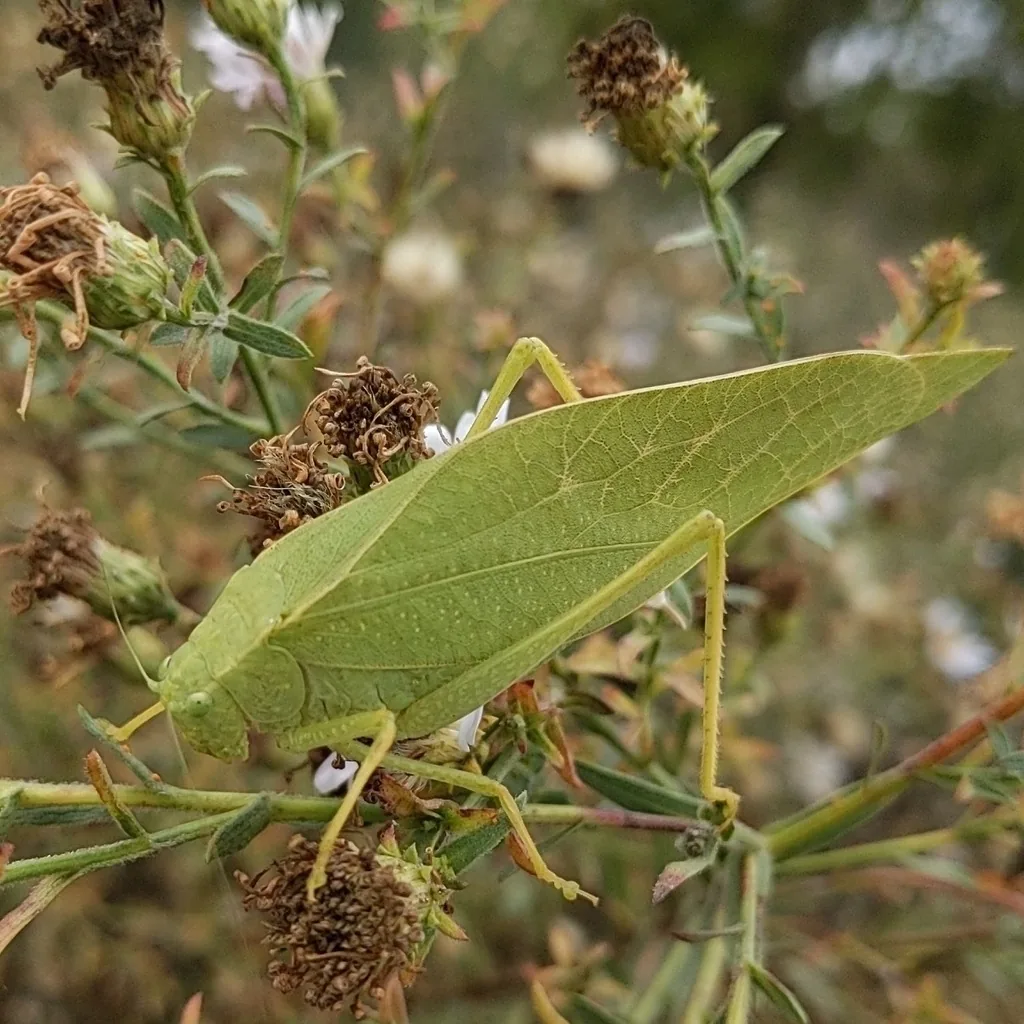
- Adults are 2 to 2 1/2 inches long and bright green, with threadlike antennae longer than the body.[1][2]
- It is similar to the lesser angle-winged katydid but larger, lacks a brown patch on the back and has a small tooth on the front edge of the shield behind the head.[2]
- Eggs are oval, brown or gray, and laid in a row along the edge of a leaf.[1]
Look-alikes
| Look-alike | How to tell them apart |
|---|---|
| Lesser angle-winged katydid | Smaller, with a brown patch behind the pronotum and no tooth on its front edge.[2] |
| Oblong-winged katydid | Another false katydid; a round-headed species with very long hind legs.[2] |
Where it lives
Broad range across the eastern and southwestern United States; common throughout Florida.[1][2]
Biology and life cycle
Nymphs closely resemble adults.[1]
In Florida, numbers are highest from June through September.[1]
The song is a sharp single tick given every few seconds plus an even, rapid series of 10 to 20 ticks.[2]
Damage and signs
Health risk
Harmless to people and pets.[1]
Control
Prevention
Damage is usually minor; young citrus is the main case where protection from this katydid is needed.[1]
Common questions
Sources
- University of Florida IFAS Extension (EDIS, Featured Creatures), “Citrus Pest Quick Guide: Broadwinged Katydid (Microcentrum rhombifolium) (ENY-2109).” ask.ifas.ufl.edu/publication/IN1423 (accessed 2026-10-16)
- Missouri Department of Conservation, “Katydids (Field Guide).” mdc.mo.gov/discover-nature/field-guide/katydids (accessed 2026-10-16)
- iNaturalist, “Microcentrum rhombifolium taxon page (order and family).” www.inaturalist.org/taxa/84752 (accessed 2026-10-06)