On this page
How to identify it
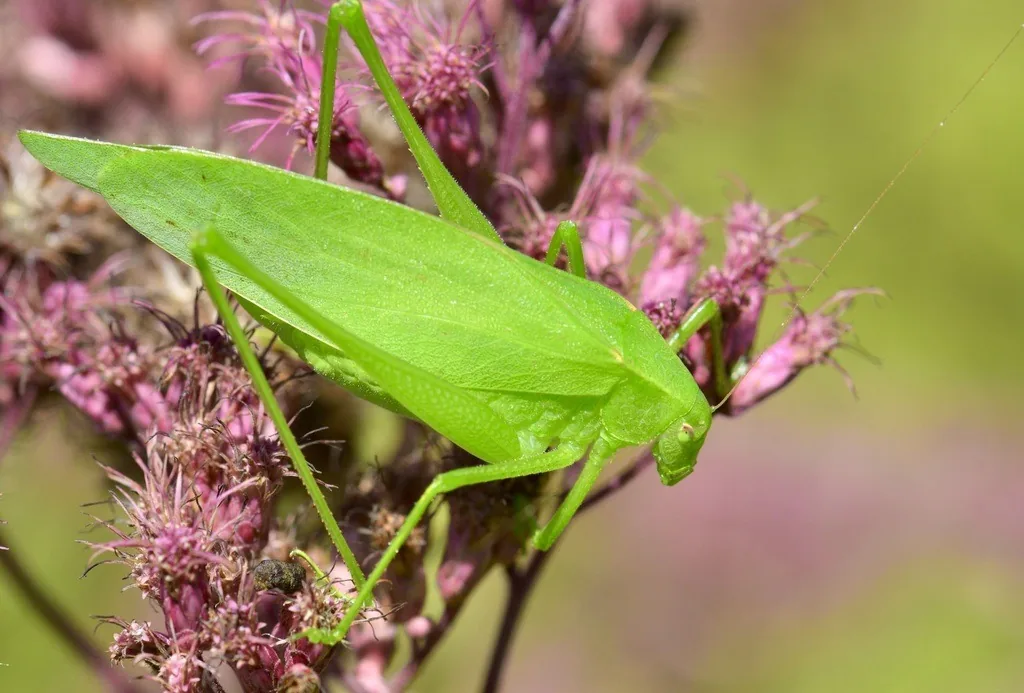
- Adults are about 1.6 to 2 inches long with very long hind legs and a rounded top of the head.[1][2]
- The hind wings extend beyond the leathery forewings, which marks it as a false katydid.[1]
- Pink and other colors are inherited, not seasonal; MDC notes pink is apparently caused by a dominant gene.[1][2]
Look-alikes
| Look-alike | How to tell them apart |
|---|---|
| Common true katydid | True katydids have shorter forewings that bulge out at the sides, and sing the famous katy-did call.[1][2] |
| Greater angle-winged katydid | Another member of the false katydid subfamily; its call is a sharp tick plus a rapid series of ticks.[2] |
Where it lives
Found throughout the eastern United States and into Ontario and Quebec; in Florida it is recorded only from the Panhandle.[1]
Biology and life cycle
Eggs are laid in soil and may take two or more years to hatch, depending on location.[1]
Nymphs look like wingless adults and reach maturity in about two months; adults peak from late June to mid-August.[1]
Its call is a single quick rasp repeated every few seconds.[1][2]
Damage and signs
- Lives in the understory of deciduous woods, shrubs and tall weeds, often on goldenrod; it is not known to damage economically important plants.[1]
Health risk
Harmless to people and pets.[1]
Control
Prevention
Tolerating katydids is usually best; if plants need protection, netting or floating row covers keep them off.[1]
Common questions
Sources
- University of Florida IFAS Extension (EDIS, Featured Creatures), “Oblong-Winged Katydid, Amblycorypha oblongifolia (EENY-638).” ask.ifas.ufl.edu/publication/IN1109 (accessed 2026-10-16)
- Missouri Department of Conservation, “Oblong-Winged Katydid (Field Guide).” mdc.mo.gov/discover-nature/field-guide/oblong-winged-katydid (accessed 2026-10-16)
- iNaturalist, “Amblycorypha oblongifolia taxon page (order and family).” www.inaturalist.org/taxa/1399823 (accessed 2026-10-06)