On this page
How to identify it
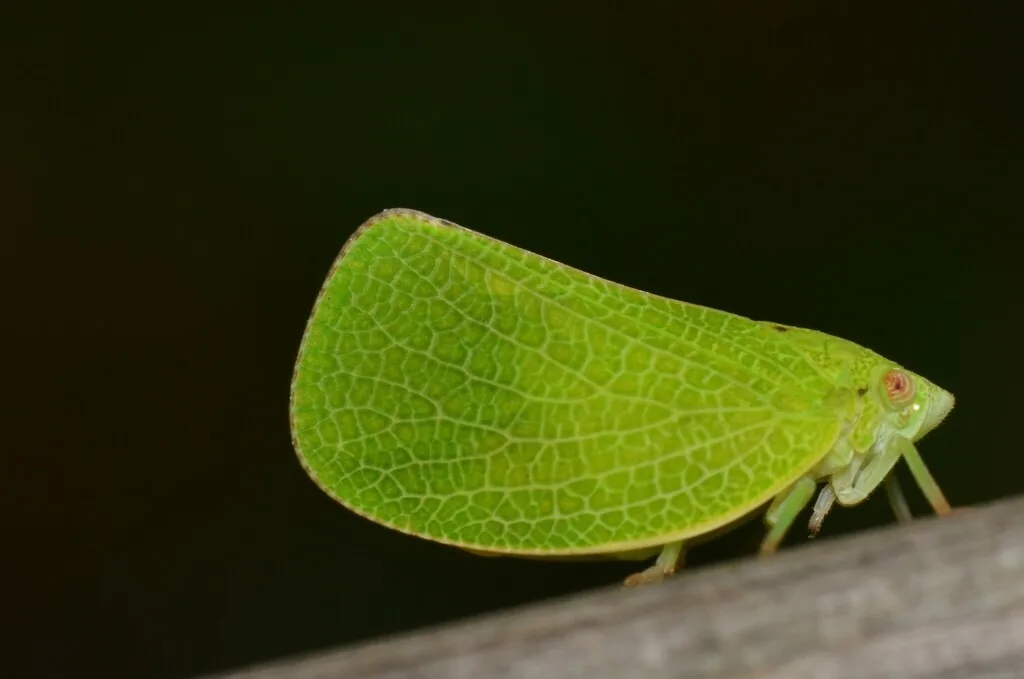
- Adults are leaf mimics: planthoppers in this family look like small leaves or seedpods.[2]
- Like other planthoppers, it has antennae set low on the sides of the head, below the eyes, with two thick basal segments and a thin bristle at the tip.[2]
- Nymphs look like tiny toads, mottled gray and humped, and often secrete so much white, fluffy wax that they disappear under it.[1]
- A disturbed nymph often jumps 12 to 18 inches.[1]
Look-alikes
| Look-alike | How to tell them apart |
|---|---|
| Leafhoppers, treehoppers and spittlebugs | MDC separates planthoppers from these relatives: treehoppers have an enlarged shield behind the head that covers the abdomen, leafhoppers have rows of small spines on the hind shins, and spittlebugs have only one or two stout spines there.[2] |
Where it lives
MDC describes it as a common planthopper, and NC State profiles it as a landscape insect in North Carolina. It has also been introduced into Europe.[2][1]
Biology and life cycle
It feeds on many kinds of herbs, shrubs and trees, sucking sap through straw-like mouthparts.[1][2]
There is one generation a year. Females use a sword-shaped egg-layer to insert eggs into the bark of the host plant, and the eggs hatch the following spring.[1]
Nymphs feed through the bark of twigs and stems, and development can take more than 300 days. They sometimes feed in mixed groups with other planthopper nymphs.[1]
Its enemies include dryinid wasps, whose larvae develop inside the nymphs and kill them, Leptus mites, and a caterpillar, Epipyrops barberiana, that feeds on nymphs and adults. The wax may help shield nymphs from dryinid wasps.[1]
Damage and signs
- Direct feeding does not seem to harm the health of most ornamental plants.[1]
- Like other planthoppers it excretes sticky honeydew, and sooty mold fungi can grow on it and darken leaves and stems; the mold does not infect the plant.[1]
- Planthoppers have been reported as pests of ginseng, a crop whose appearance matters to buyers. In Europe, where this species was recently introduced, it is considered a greater threat than in North Carolina.[1]
Health risk
NC State calls it virtually harmless, and neither NC State nor MDC mentions any risk to people.[1][2]
Control
Prevention
Usually no control is needed. It does relatively little damage to ornamentals, and few planthoppers are pests of landscape plants.[1][2]
Traps and physical control
If the nymphs bother you, first try knocking them off with a stream of water from a garden hose.[1]
Biological control
Natural enemies, including dryinid wasps, Leptus mites and a predatory caterpillar, attack the nymphs.[1]
Pesticides
NC State considers resistance unlikely, so any insecticide labeled for home landscape use should give adequate control if treatment is truly needed.[1]
Common questions
- What is the white fluff on my shrub's twigs?
- It may be green cone-headed planthopper nymphs, which can secrete enough white, fluffy wax to hide completely. The fluff may help protect them from predators such as dryinid wasps.[1]
- Will green cone-headed planthoppers hurt my plants?
- Rarely. Their feeding does not seem to harm most ornamentals, though sooty mold can grow on the honeydew they excrete.[1]
- How long does a planthopper take to grow up?
- Eggs laid in bark hatch the next spring, and development may take more than 300 days; there is one generation a year.[1]
Sources
- NC State Extension, “Green Coneheaded Planthopper (PDIC factsheet, J. Baker; published 2015, reviewed 2019).” content.ces.ncsu.edu/green-coneheaded-planthopper (accessed 2026-11-09)
- Missouri Department of Conservation, “Planthoppers (Field Guide).” mdc.mo.gov/discover-nature/field-guide/planthoppers (accessed 2026-11-09)
- iNaturalist, “Acanalonia conica taxon page (order and family).” www.inaturalist.org/taxa/84806 (accessed 2026-11-09)