On this page
How to identify it
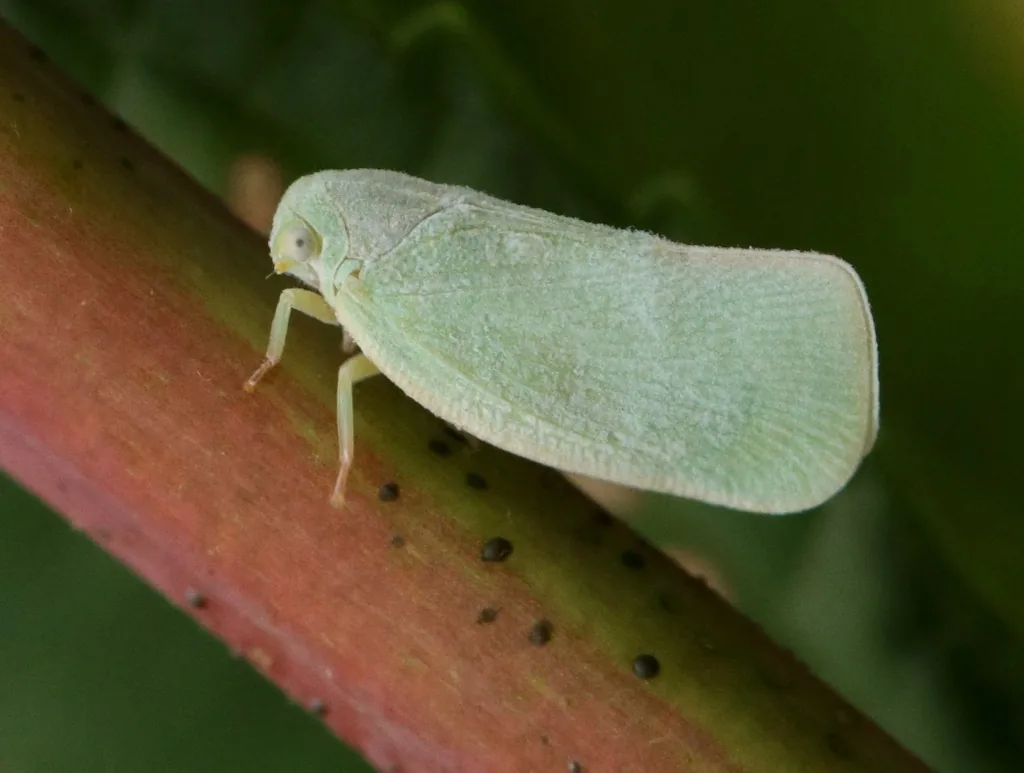
- Adults are shaped like a narrow wedge, like the citrus flatid planthopper, and are pale green to whitish, with the rear corner of each wing forming a right angle.[2][3][1]
- Nymphs are white, broad and flat-headed, and cover themselves in long filaments of fluffy white wax that stays on the plant after they move.[2][3][1]
- Touch the fluff and a nymph often jumps several inches, which mealybugs, woolly aphids and soft scales never do.[1]
Look-alikes
| Look-alike | How to tell them apart |
|---|---|
| Citrus flatid planthopper | Its adults are whitish gray under a white powder rather than pale green, and the northern flatid's nymphs have a broader, flatter head.[2][3] |
| Mealybugs | Mealybugs also wear white wax but crawl slowly or not at all when disturbed; planthopper nymphs jump.[1] |
Where it lives
It is more common in the northern United States than its southern relative, the citrus flatid planthopper, and also occurs through North Carolina from the coastal plain to the mountains.[2][1][3]
Biology and life cycle
Eggs spend the winter inserted in a zipper-like row in the bark of the current year's growth of a woody host, often a tree such as black walnut.[1]
Nymphs hatch in spring, from April on the coastal plain to June at higher elevations, and often drop to understory plants to feed.[1]
Development from egg to adult takes about 178 days; adults are out from late June to late September, and there is one generation a year.[1]
Damage and signs
Health risk
It feeds only on plant sap; NC State, Oklahoma State and NC Parks mention no risk to people.[1][2][3]
Control
Pesticides
Control is not usually warranted; Oklahoma State suggests treating only if you see real damage or black sooty mold and nymphs are still present.[2]
Common questions
- What is the white fluff on my shrub that jumps?
- Most likely a planthopper nymph, such as the northern flatid planthopper, hiding under the wax it secretes; mealybugs and scales don't jump.[1][2]
- Will snowy planthoppers kill my plants?
- Rarely. They can be numerous but do little apparent damage, though egg-laying punctures can kill a few small twigs.[3][2]
Sources
- NC State Extension, “Snowy Planthopper (PDIC Factsheet).” content.ces.ncsu.edu/snowy-planthopper-4 (accessed 2026-10-19)
- Oklahoma State University Extension, “'Waxy cotton' on plants may indicate presence of pest (E. Rebek, July 25, 2017).” news.okstate.edu/articles/agriculture/2017/waxy-cotton-on-plants-may-indicate-presence-of-pest (accessed 2026-10-19)
- North Carolina Division of Parks and Recreation (NC Biodiversity Project), “Hoppers of North Carolina: Flatormenis proxima, Northern Flatid Planthopper.” auth1.dpr.ncparks.gov/bugs/view_1.php?id=14566 (accessed 2026-10-19)
- iNaturalist, “Flatormenis proxima taxon page (order and family).” www.inaturalist.org/taxa/415285 (accessed 2026-10-06)