On this page
How to identify it
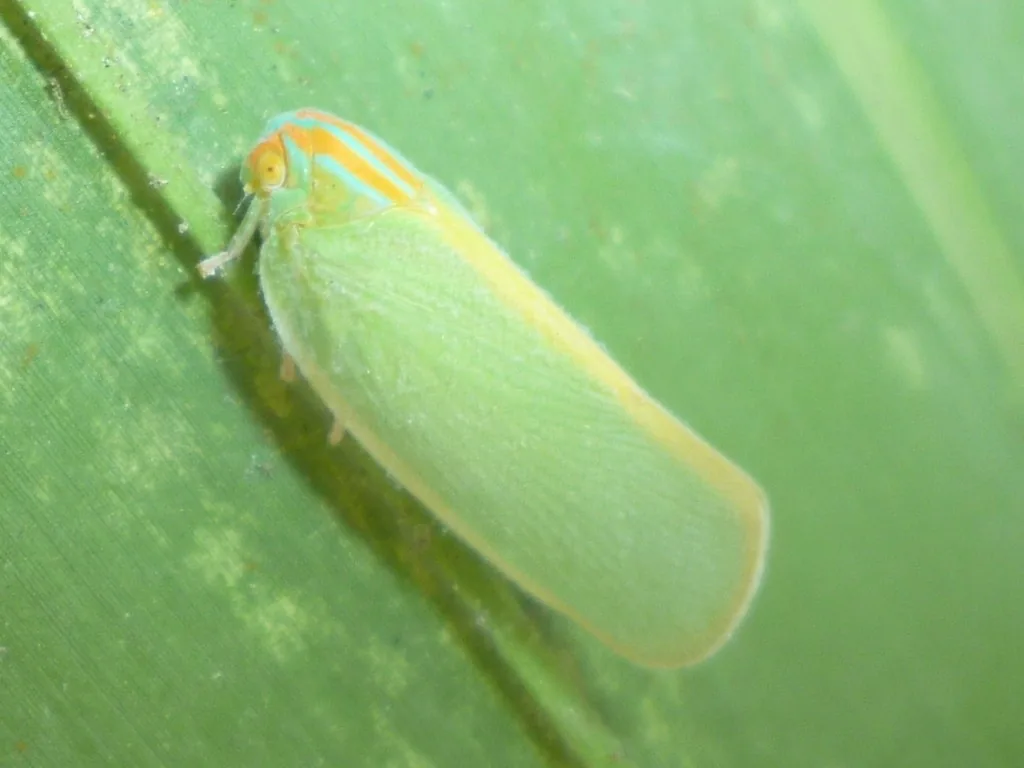
- Adults are about 11 mm long, flattened from side to side and triangular, like tiny sailboats, light blue-green with orange to reddish stripes on the head and thorax, orange-yellow wing borders and orange eyes.[1]
- Nymphs are light green with faint orange stripes, partly hidden under a fluffy white wax that looks cottony on the frond.[1][2]
Look-alikes
| Look-alike | How to tell them apart |
|---|---|
| Citrus flatid planthopper | Other flatid planthoppers can look similar at a glance, but the palm flatid's blue-green color with orange stripes and its palm habitat set it apart.[1][2] |
Where it lives
It has been reported throughout the Florida peninsula and in southeastern Georgia, and also in Cuba; it has been intercepted in California on nursery plants shipped from Florida but is not known to be established there.[1][2]
Biology and life cycle
There is one generation a year. Eggs are probably laid in palm tissue in late summer and hatch in January, and young nymphs appear on cabbage palmetto fronds by the second week of January.[1]
Nymphs pass through five stages, growing from about 1.4 to 4.7 mm, and in southern Florida reach adulthood as early as May; by late summer neither nymphs nor adults are on the palms.[1]
Both nymphs and adults feed on the lower surface of older, more horizontal fronds; the main hosts are cabbage palmetto and saw palmetto, though adults turn up on many palms in gardens.[1]
Damage and signs
Health risk
It feeds only on palm sap; UF/IFAS and Florida's Division of Plant Industry mention no risk to people.[1][2]
Control
Prevention
Control is seldom needed: populations are generally sparse, and UF/IFAS notes that no research has been done on chemical controls because the insect isn't economically important.[1]
Common questions
- What are the blue-green insects under my palm fronds?
- Most likely palm flatid planthoppers, common on cabbage palmetto and saw palmetto in Florida; they are conspicuous but usually harmless.[1][2]
- Should I spray my palm for flatid planthoppers?
- Usually not. Colonies are typically small and do little harm; only dense ones cause enough honeydew and sooty mold to notice.[1][2]
Sources
- University of Florida IFAS Extension, Featured Creatures, “Flatid Planthopper, Ormenaria rufifascia (Walker), EENY-351 / IN643 (F. W. Howard).” edis.ifas.ufl.edu/publication/IN643 (accessed 2026-10-19)
- Florida Department of Agriculture and Consumer Services, Division of Plant Industry, “Ormenaria rufifascia (Walker), a planthopper pest of palms, Entomology Circular No. 37 (F. W. Mead, June 1965; copy hosted by the Florida State Collection of Arthropods).” thefsca.org/wp-content/uploads/2025/10/ent037.pdf (accessed 2026-10-19)
- iNaturalist, “Ormenaria rufifascia taxon page (order and family).” www.inaturalist.org/taxa/179705 (accessed 2026-10-06)