On this page
How to identify it
- The full-grown caterpillar is up to 35 mm long. The back is creamy yellow with orange patches down the midline; along each side runs a rust-colored, dark-edged stripe marked with a broken yellow line, above a light yellow stripe below the spiracles. The head is light tan covered with dark spots.[1]
- The USDA manual gives the same pattern in other words: cream above with broken orange dorsal and subdorsal lines, dark brownish red on the sides with black-edged light lines, pale brownish green below, and a pale brown head.[2]
- In British Columbia the caterpillars feed in the open on amabilis fir, grand fir, Douglas-fir and western hemlock; in California they are found in needle tips of young Monterey pine tied together at the ends of branches.[1][2]
Look-alikes
| Look-alike | How to tell them apart |
|---|---|
| Phantom hemlock looper | The phantom hemlock looper (Nepytia phantasmaria) shares the Douglas-fir and western hemlock hosts, but its 28 mm caterpillar is smooth lime green with dark-edged yellowish lines and strongly resembles a Douglas-fir needle at rest, and local outbreaks have killed mature trees in British Columbia city parks; the hoary conifer looper's caterpillar is cream, orange and rust striped and occurs only as scattered individuals.[2][1] |
| Western false hemlock looper | The western false hemlock looper (Nepytia freemani) of British Columbia, Idaho and Utah has a slim caterpillar striped tan and yellow outlined in black above and pinkish below, and it has local outbreaks in pole- and sapling-sized stands; the hoary conifer looper has a creamy yellow back with orange patches and rust side stripes and is rated innocuous.[2][1] |
Where it lives
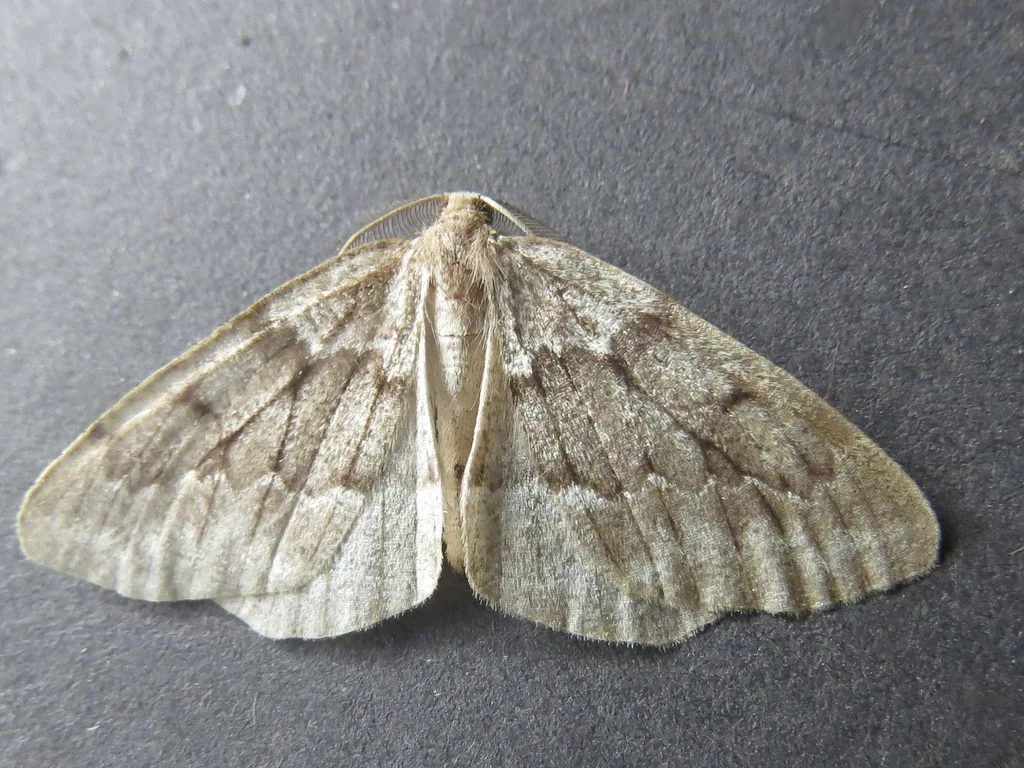
Natural Resources Canada records the subspecies nigrovenaria in British Columbia, and the USDA manual describes it in British Columbia and California.[1][2]
Biology and life cycle
The caterpillar is a solitary, free-living defoliator. In British Columbia its hosts are Douglas-fir, western hemlock, amabilis and grand fir, and the USDA manual adds pine, spruce and western redcedar. In California the larvae tie the needles of young Monterey pine together at the branch tips and feed inside.[1][2]
The species overwinters as a part-grown (mid-instar) caterpillar. Caterpillars feed from April to June and pupate in June; the moths emerge from late July to early August, mate and lay eggs, and the new caterpillars hatch soon after and feed until the weather cools in fall.[1]
The genus Nepytia includes four species that feed on conifers in the West; the USDA manual rates two of them potentially important, particularly in city forest parks, while recording this one only as scattered individuals.[2]
Damage and signs
Health risk
The sources describe it only as a conifer needle feeder and mention no effect on people.[1][2]
Control
Prevention
No control is needed. The caterpillars occur as scattered individuals and Natural Resources Canada rates the species innocuous.[1][2]
Common questions
- What is the cream and orange striped caterpillar on my fir or hemlock?
- In British Columbia, a 35 mm caterpillar with a creamy yellow back, orange midline patches, rust-colored dark-edged side stripes and a dark-spotted tan head, feeding on fir, Douglas-fir or western hemlock between April and June, is the hoary conifer looper.[1]
- Why are the needle tips of my young Monterey pine tied together?
- In California the USDA Forest Service manual records this caterpillar tying the needles of young Monterey pine together at the tips of branches and feeding on them.[2]
- Is it a serious pest?
- No. Natural Resources Canada rates it innocuous and the USDA Forest Service manual records it only as scattered individuals on its hosts.[1][2]
Sources
- Natural Resources Canada, Canadian Forest Service, “Nepytia umbrosaria nigrovenaria, Trees, insects and diseases of Canada's forests.” tidcf.nrcan.gc.ca/en/insects/factsheet/1000026 (accessed 2026-11-10)
- USDA Forest Service, “Western Forest Insects, Miscellaneous Publication 1339 (R. L. Furniss and V. M. Carolin, November 1977; scanned copy).” archive.org/details/CAT78702369 (accessed 2026-11-10)
- iNaturalist, “Nepytia umbrosaria taxon page (order and family).” www.inaturalist.org/taxa/196605 (accessed 2026-11-10)