On this page
How to identify it
- The grown caterpillar is 24 to 32 mm long and slim, striped lengthwise in tan and yellow outlined with fine dark lines, with a broad yellow stripe along the spiracles and a pinkish underside. The tan areas turn green just before pupation.[1][2]
- Its head is squarish, tan on top and sides with black spots, and pale yellow in front.[1][2]
- Partly eaten needles litter the branches and ground, because the caterpillar eats only part of a needle and then chews it off at the base. Heavily fed trees look scorched.[1]
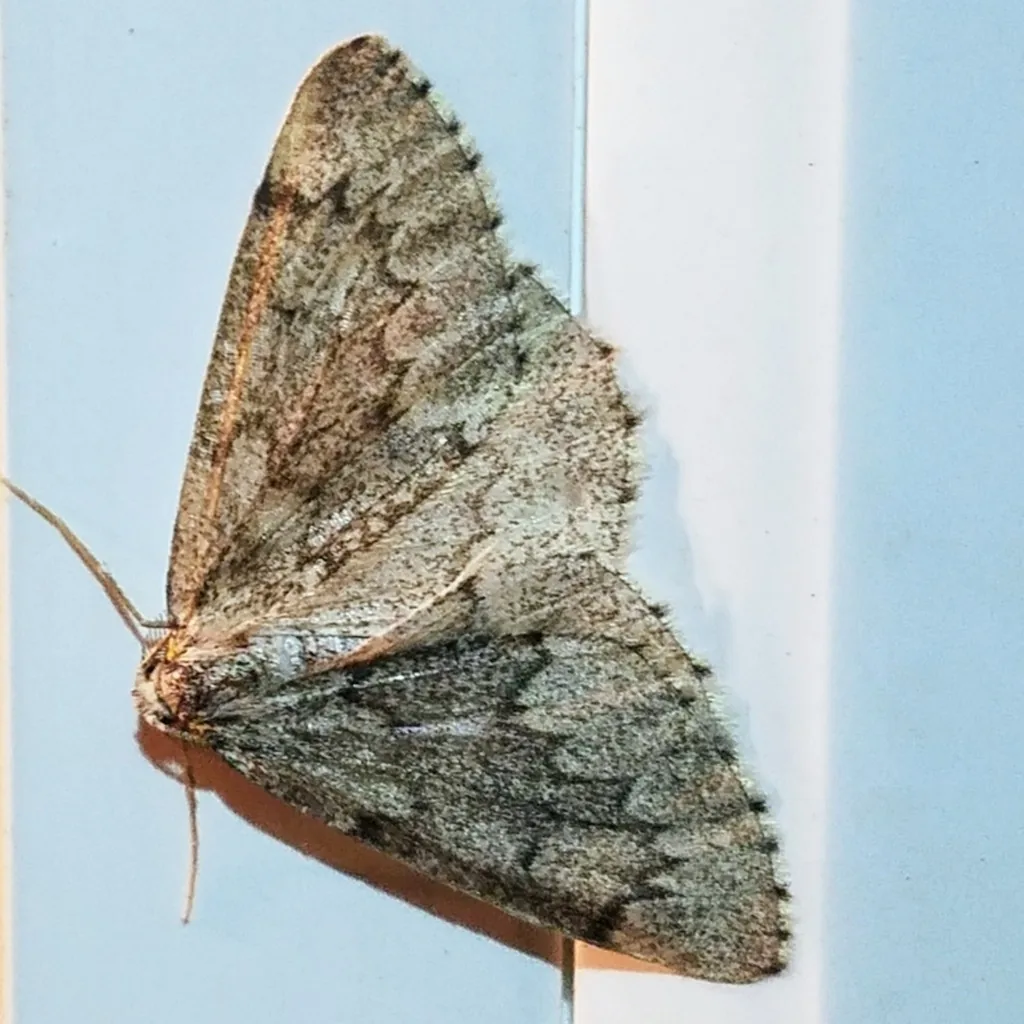
- The moth is gray with dark markings and a wingspread of about 25 mm. It looks like the phantom hemlock looper moth but has gray rather than white wings and a gray, not yellow-tinted, top of the head.[2]
Look-alikes
| Look-alike | How to tell them apart |
|---|---|
| Phantom hemlock looper | The phantom hemlock looper (Nepytia phantasmaria) is the coastal species. Its moth is white with black markings and a yellowish head, and its caterpillar is lime green rather than tan and yellow.[2] |
| False hemlock looper | The eastern false hemlock looper (Nepytia canosaria) reaches west only to Manitoba and Saskatchewan on spruce; older records of it from the Rocky Mountains westward generally refer to N. freemani.[2] |
Where it lives
It occurs in British Columbia and the interior western United States, including Idaho and Utah.[1][2]
Biology and life cycle
Douglas-fir is the preferred host in British Columbia and white fir in Utah. Subalpine fir, Engelmann spruce, western larch, western hemlock and ponderosa pine are also fed on.[1][2]
There is one generation a year, and the egg overwinters. The moths fly from August to October and lay an average of about 70 eggs, singly or in small clusters, on both sides of the needles.[1][2]
The caterpillars hatch in late May and feed first on the new growth. As the current year's needles run out they move in toward the trunk and eat older foliage.[1][2]
They are solitary, wasteful feeders, often eating only part of a needle and cutting it off at the base. Pupation takes place on twigs or foliage in late July or August.[1]
Damage and signs
Health risk
The sources treat it only as a conifer defoliator and report no effect on people.[1][2]
Control
Prevention
No control has been warranted. Local outbreaks in young stands subside without treatment, and neither source recommends anything for landscape trees.[2][1]
Common questions
- Why does my Douglas-fir look scorched, with half-eaten needles everywhere?
- A looper that bites needles off at the base after eating only part of them produces that scorched look. In the interior West the western false hemlock looper is a likely cause; check for slim tan-and-yellow striped inchworms.[1]
- Do I need to spray for it?
- No. The USDA manual says its local outbreaks have not caused damage warranting control.[2]
Sources
- Natural Resources Canada, Canadian Forest Service, “Western false hemlock looper, Trees, insects and diseases of Canada's forests.” tidcf.nrcan.gc.ca/en/insects/factsheet/1000001 (accessed 2026-11-10)
- USDA Forest Service, “Western Forest Insects, Miscellaneous Publication 1339 (R. L. Furniss and V. M. Carolin, November 1977; scanned copy).” archive.org/details/CAT78702369 (accessed 2026-11-10)
- iNaturalist, “Nepytia freemani taxon page (order and family).” www.inaturalist.org/taxa/225810 (accessed 2026-11-10)