On this page
How to identify it
- The grown caterpillar is up to 28 mm long, smooth and lime green, with a green head carrying ten prominent black spots. Yellowish, dark-edged lines run along the sides, with a white subdorsal stripe edged in fine dark green and a yellow stripe along the spiracles.[1][2]
- At rest the caterpillar strongly resembles a Douglas-fir needle.[2]
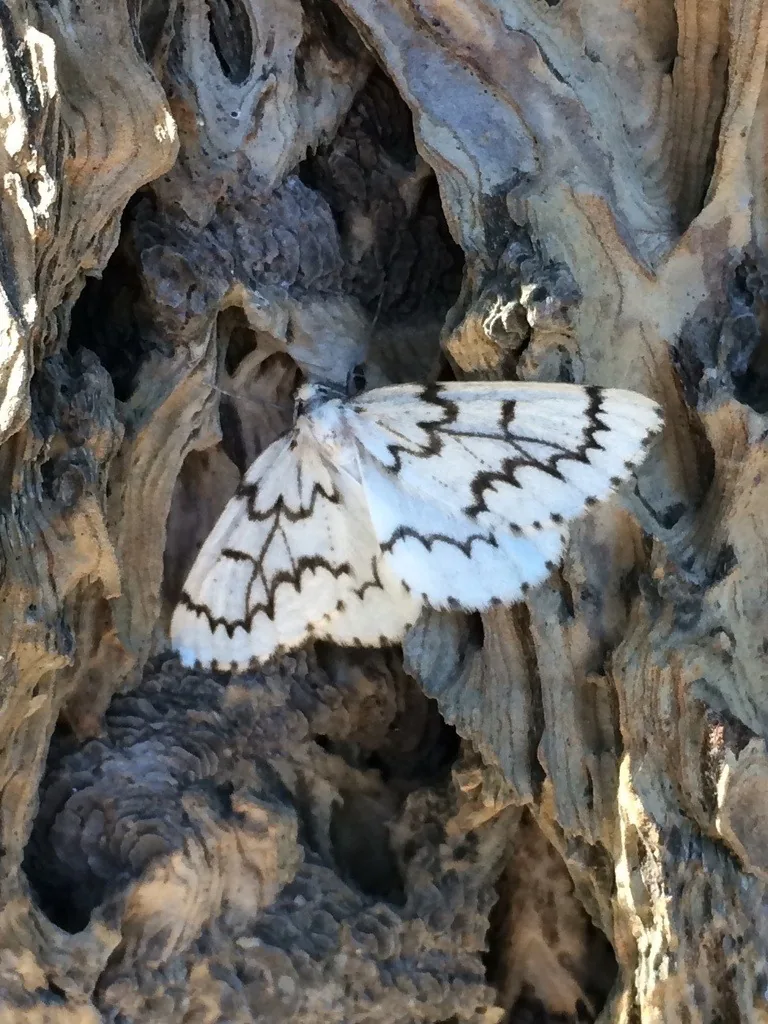
- The moth is white to very light gray with strong black markings, a yellowish crown to the head, and a wingspread of about 25 mm.[2]
Look-alikes
| Look-alike | How to tell them apart |
|---|---|
| Western false hemlock looper | Nepytia freemani, the western false hemlock looper of the interior, has a moth that looks much the same except that the ground color of the wings is gray rather than white and the top of the head is gray without yellow tints. Its caterpillar is tan and yellow rather than green.[2] |
| Hemlock looper | The hemlock looper (Lambdina fiscellaria) is the better-known defoliator of western hemlock, and the phantom hemlock looper has been reported abundant during its outbreaks.[2] |
| Greenstriped forest looper | The greenstriped forest looper (Melanolophia imitata) is another green, striped inchworm on the same coastal conifers; its moth is mottled gray-brown, not white.[2] |
Where it lives
It occurs in British Columbia, Oregon and California along the Pacific coast.[1][2]
Biology and life cycle
Douglas-fir and western hemlock are the preferred hosts. Western redcedar, Sitka spruce, true firs such as amabilis and grand fir, and pines are also recorded.[1][2]
There is one generation a year and the winter is passed as an egg. In northern California the eggs are laid from late September to late October; in British Columbia the moths fly in September and October and lay up to 115 eggs singly or in small groups on the undersides of needles.[1][2]
The caterpillars hatch in late May and early June and feed first on the new foliage. The older caterpillars prefer the older foliage.[1][2]
They are solitary feeders. Pupation takes place on the foliage in August, starting in late August in northern California.[1][2]
In California a virus disease evidently keeps the insect in check much of the time.[2]
Damage and signs
- The phantom hemlock looper is common but is not often seen, because outbreaks are local and sporadic. Severe defoliation can reduce growth, kill the top of the tree, or kill the tree.[1][2]
- In British Columbia, short-lived local outbreaks in municipal parks at Burnaby, New Westminster and Hope (1956 to 1957 and 1994) and in natural forest near Coquitlam Lake (1982) and Port Mellon (2001) killed mature Douglas-fir and western hemlock. In northern California, pole-size and smaller Douglas-fir and understory white fir have been killed.[1][2]
Health risk
The sources describe it only as a defoliator of conifers and report no harm to people.[1][2]
Control
Prevention
The USDA manual singles out city forest parks as the places where Nepytia loopers are potentially important, so park managers on the coast are the ones who need to watch for a buildup.[2]
Biological control
Natural controls do most of the work: outbreaks subside on their own, and in California a virus is evidently an effective natural control agent. Neither source recommends a treatment for home trees.[2][1]
Common questions
- What is the green inchworm on my Douglas-fir that looks like a needle?
- On the Pacific coast a smooth lime-green looper with a black-spotted green head is likely the phantom hemlock looper. At rest it strongly resembles a Douglas-fir needle.[1][2]
- Will phantom hemlock loopers kill my tree?
- Usually not. Outbreaks are local and short-lived, but severe defoliation has killed mature Douglas-fir and western hemlock in British Columbia parks and smaller trees in northern California.[1][2]
Sources
- Natural Resources Canada, Canadian Forest Service, “Phantom hemlock looper, Trees, insects and diseases of Canada's forests.” tidcf.nrcan.gc.ca/en/insects/factsheet/1000004 (accessed 2026-11-10)
- USDA Forest Service, “Western Forest Insects, Miscellaneous Publication 1339 (R. L. Furniss and V. M. Carolin, November 1977; scanned copy).” archive.org/details/CAT78702369 (accessed 2026-11-10)
- iNaturalist, “Nepytia phantasmaria taxon page (order and family).” www.inaturalist.org/taxa/334645 (accessed 2026-11-10)