On this page
How to identify it
- The caterpillar is a plain inchworm, green to brown, with no warts or swellings; the USDA Forest Service guide calls it a candidate for the least distinguished geometrid caterpillar in its pages. UF/IFAS gives the full-grown length as about 2 cm (3/4 inch), and the USDA guide as under 2.5 cm (1 inch).[2][1]
- In the green form the body is somewhat see-through, and the breathing tube that links the spiracles shows inside many of the abdominal segments. The spiracles are small and dark, and the head is unmarked except for the dark eyes. Some caterpillars have pinkish legs behind the head, but they are usually unpigmented.[2]
- The caterpillar grips strongly and is hard to dislodge, and by day it often rests on the underside of a leaf.[2]
Look-alikes
| Look-alike | How to tell them apart |
|---|---|
| Episemasia solitaria caterpillar | Another geometrid caterpillar that feeds on the same hollies and is likely to leave similar feeding damage on the foliage.[1] |
| Holly leafminers | Leafminer larvae, such as Phytomyza vomitoriae on yaupon holly, feed inside the leaf and leave a mine between its upper and lower surfaces instead of chewing notches in the edge. They belong to a group of about 12 Phytomyza species that feed on hollies in North America.[1] |
Where it lives
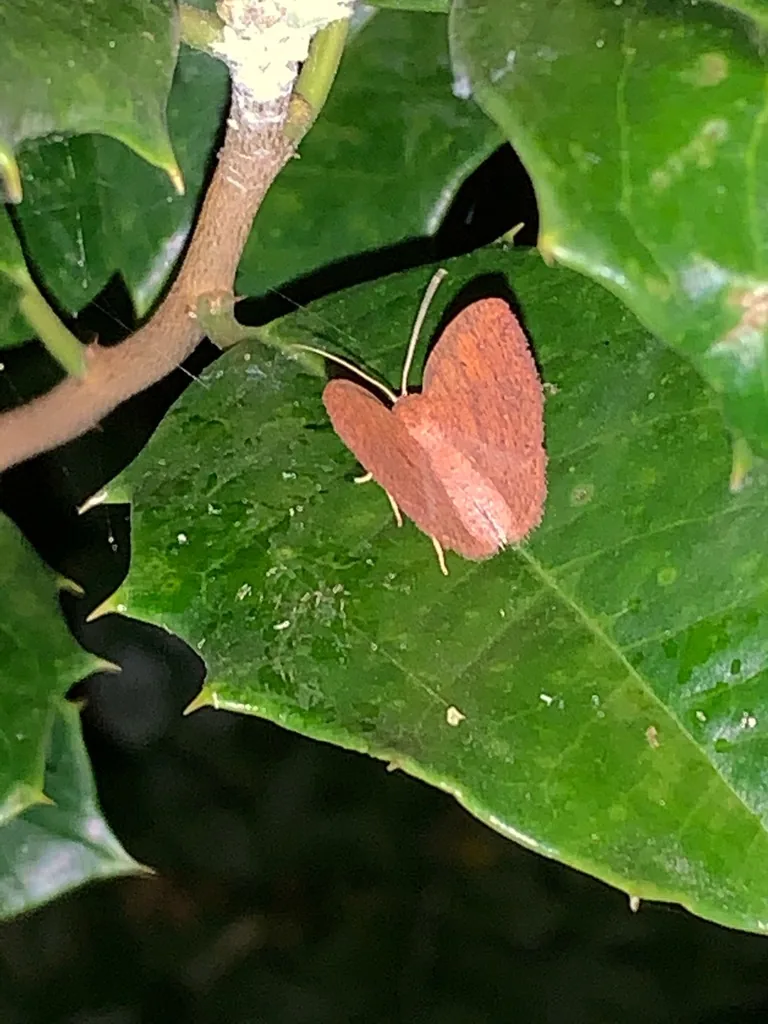
UF/IFAS describes the moth as native to the southeastern United States. The USDA Forest Service guide calls it especially common along the coastal plain and suggests that individuals found in northern states may be migrants from the South.[1][2]
Biology and life cycle
It feeds on hollies. UF/IFAS lists American holly and yaupon holly among several evergreen hollies it notches, and in the Northeast it may feed only on American holly. It turns up in woodlands, swamps and yards.[1][2]
In Maryland there are at least three generations, with caterpillars present through much of the summer and fall. In Connecticut, where it is rare and may not be a resident, full-grown caterpillars appear in July and August and again from September into early November.[2]
Full-grown caterpillars pupate in the soil beneath the host plant.[1]
How it gets through winter is unclear. Adults seen in May in Massachusetts suggest the pupa overwinters, but a caterpillar found in early January in New Jersey and late-fall adults in Maryland point to an egg or caterpillar instead.[2]
Damage and signs
- The caterpillars chew notches in the leaf margins of evergreen hollies, including American holly and yaupon holly. UF/IFAS says caterpillars on yaupon holly are relatively uncommon and not known to cause significant damage.[1]
Health risk
Neither UF/IFAS nor the USDA Forest Service mentions any bite, sting or other risk to people.[1][2]
Control
Traps and physical control
UF/IFAS says that on yaupon holly, tolerating the feeding or removing the caterpillars by hand, if necessary, is likely the best control option. Check the undersides of leaves, where the caterpillars often rest by day, and expect them to cling tightly.[1][2]
Common questions
- What is chewing notches in the edges of my holly leaves?
- One possibility is the holly looper, a plain green or brown inchworm about 2 cm long that notches the leaf margins of evergreen hollies such as American and yaupon holly. Look for it on the undersides of leaves by day.[1][2]
- Do holly loopers need to be controlled?
- UF/IFAS says caterpillars on yaupon holly are relatively uncommon and not known to cause significant damage, so tolerating them or picking them off by hand is likely the best option.[1]
- Where do holly loopers go to pupate?
- Into the soil beneath the holly they fed on.[1]
Sources
- University of Florida/IFAS Extension, “Yaupon Holly Culture and Pest Management for Tea Production and Ornamental Use, ENY-2054 (M. A. Borden, M. A. Wilhelm and A. G. Dale, 2020).” journals.flvc.org/edis/article/view/121727 (accessed 2026-11-09)
- USDA Forest Service, Forest Health Technology Enterprise Team, “Geometroid Caterpillars of Northeastern and Appalachian Forests, FHTET-2001-10 (D. L. Wagner, D. C. Ferguson, T. L. McCabe and R. C. Reardon, September 2001; scanned copy).” archive.org/details/geometroidcaterp00wagn (accessed 2026-11-09)
- iNaturalist, “Ilexia intractata taxon page (order and family).” www.inaturalist.org/taxa/203052 (accessed 2026-11-09)