On this page
How to identify it
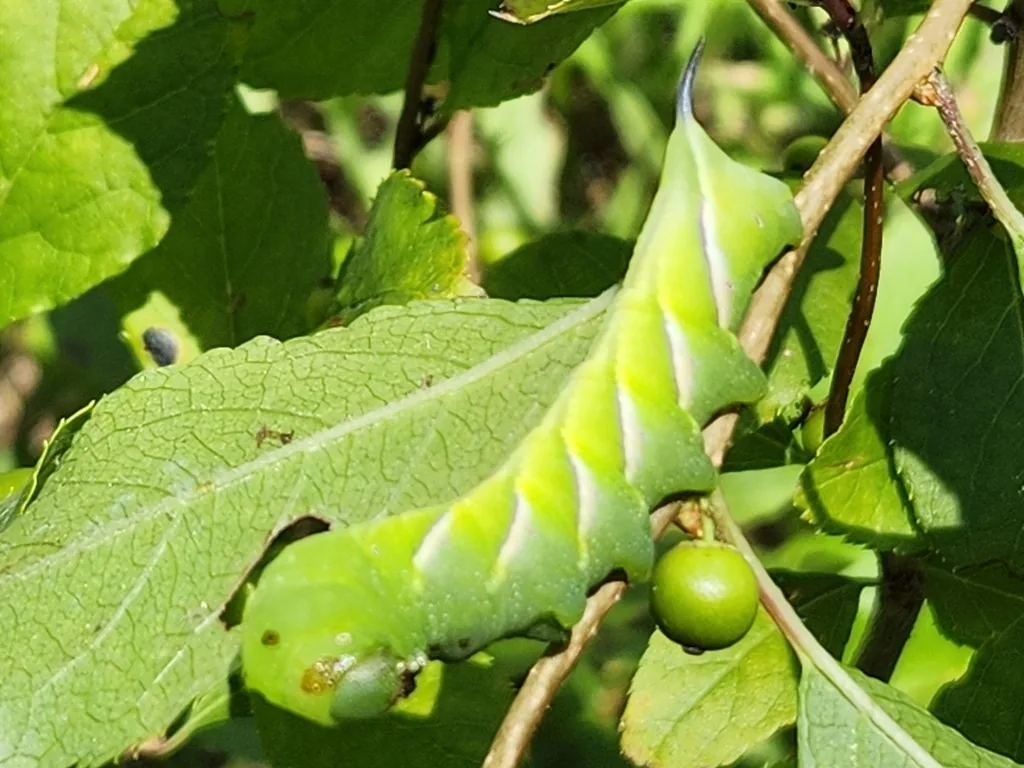
- The caterpillar is a smooth, pale green hornworm with a plain green head that has no bands. Six slanting white stripes run along the sides of the abdomen; the lower end of each continues forward onto the segment ahead, and the stripes are sometimes edged with dark along the top.[1]
- The horn at the rear is slender and blue. The legs behind the head are black with a yellow band at the base, and the breathing pores along the sides are small and black with a white outer ring.[1]
- UF/IFAS notes that the caterpillar occurs in bright green or brown forms.[2]
- Like almost all hornworms it carries its horn on top of the eighth abdominal segment, and its large droppings often give away its presence in a tree or garden.[1]
Look-alikes
| Look-alike | How to tell them apart |
|---|---|
| Other green hornworms | Food plants help in telling hornworms apart. On holly, pawpaw or sweetfern, a smooth green hornworm with six slanting white stripes and a slender blue horn points to the pawpaw sphinx.[1] |
Where it lives
The USDA Forest Service includes it among the caterpillars of eastern forests, with two generations a year in the South and one in the North. UF/IFAS lists it on yaupon holly, a native of the southeastern coastal plain from Texas to Virginia.[1][2]
Biology and life cycle
The caterpillars feed on hollies and related plants, pawpaws and sweetfern, and yaupon holly is a recorded host. They can be found from June to November.[1][2]
On yaupon holly a caterpillar works from the tip of a twig back toward the branch, often eating whole leaves rather than chewing notches in them.[2]
Hornworms are often noticed when they leave the plant and wander over the ground looking for a place to pupate.[1]
Damage and signs
- Feeding strips leaves from the tips of twigs, but on yaupon holly the twig generally grows new leaves the following year. UF/IFAS says caterpillars on yaupon holly are relatively uncommon and not known to cause significant damage.[2]
Health risk
When handled, hornworms may thrash from side to side and regurgitate, but neither source mentions any bite, sting or other risk to people.[1][2]
Control
Traps and physical control
UF/IFAS says that on yaupon holly, tolerating the feeding or removing the caterpillars by hand, if necessary, is likely the best control option.[2]
Common questions
- What is the big green caterpillar with a blue horn on my holly?
- It may be a pawpaw sphinx hornworm: smooth and pale green, with six slanting white side stripes and a slender blue horn. Hollies, including yaupon holly, are among its food plants.[1][2]
- Will my yaupon holly recover after a hornworm strips a twig?
- Generally yes. UF/IFAS notes that the twig usually produces new leaves the following year, and that these caterpillars are not known to cause significant damage on yaupon.[2]
- Does a pawpaw sphinx caterpillar need to be treated?
- UF/IFAS says caterpillars on yaupon holly are relatively uncommon, and that tolerating them or picking them off by hand if necessary is likely the best option.[2]
Sources
- USDA Forest Service, Forest Health Technology Enterprise Team, “Caterpillars of Eastern Forests, FHTET-96-34 (D. L. Wagner, V. Giles, R. C. Reardon and M. L. McManus, November 1997; scanned copy).” archive.org/details/caterpillarsofea001997 (accessed 2026-11-09)
- University of Florida/IFAS Extension, “Yaupon Holly Culture and Pest Management for Tea Production and Ornamental Use, ENY-2054 (M. A. Borden, M. A. Wilhelm and A. G. Dale, 2020).” journals.flvc.org/edis/article/view/121727 (accessed 2026-11-09)
- iNaturalist, “Dolba hyloeus taxon page (order and family).” www.inaturalist.org/taxa/143441 (accessed 2026-11-09)