PestControlBasics
Menu

Ivory-Marked Borer

Eburia quadrigeminata (iNaturalist: Coeleburia quadrigeminata)[3]

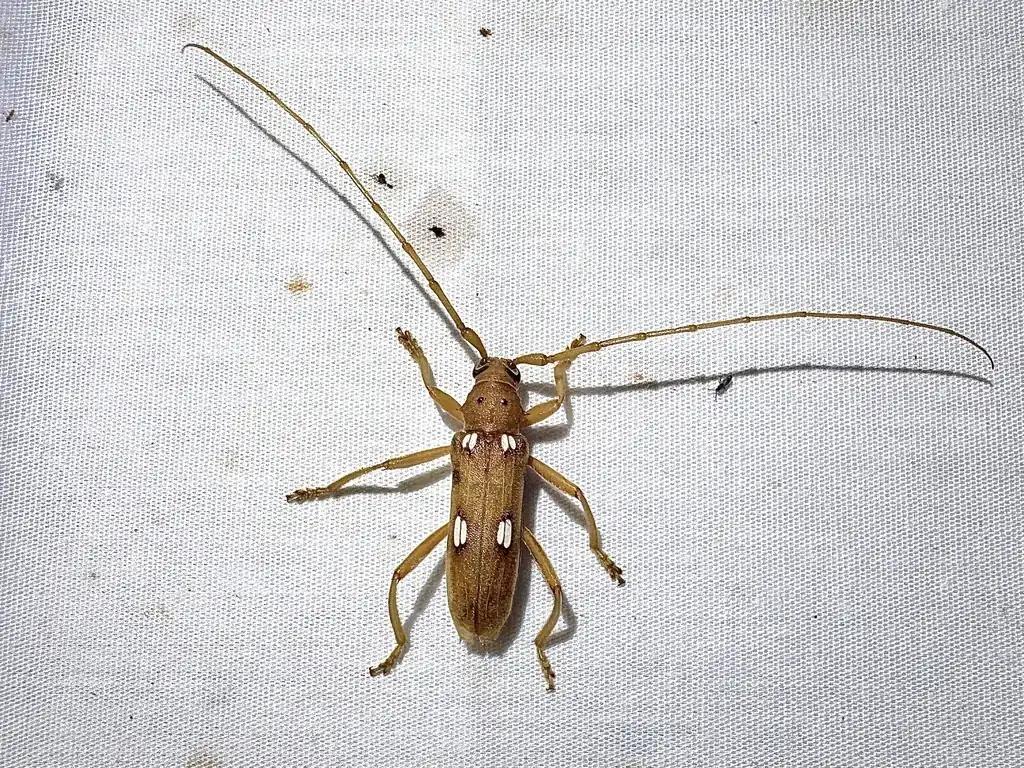
The ivory-marked borer is a golden-brown longhorned beetle with four pairs of ivory spots whose grubs bore into the heartwood of dead hardwood trees.[1][2]

Group
Insect
Order
Coleoptera
Family
Cerambycidae
US records
24 states
Sources
3 cited
Updated
2026-10-16
Ivory-marked borer, a tan longhorned beetle with pairs of ivory spots
Ivory-marked borer, a tan longhorned beetle with pairs of ivory spots. Photo: Samuel Paul Galick, public domain (CC0), via iNaturalist
On this page
  1. Identification
  2. Where it lives
  3. Biology
  4. Damage and signs
  5. Health risk
  6. Control
  7. Related profiles
  8. Common questions
  9. Sources

How to identify it

  • Adults are about 1/2 inch long, brown to golden brown, with four pairs of ivory spots on the wings, each pair ringed by a darker halo.[1]
  • It is the only longhorned beetle with four distinct pairs of pale spots on its forewings, and the thorax has a small spine on each side.[1]

Where it lives

Found in the eastern United States, including North Carolina and Missouri.[1][2]

US map: public records from 24 states since 1990 (GBIF).

Biology and life cycle

Females lay eggs in cracks of dead trees; grubs bore into the heartwood and usually finish in about two years.[1]

If infested wood is milled into flooring or furniture, the grubs can keep developing slowly; adults may appear five to seven years later, and one emerged from a 40-year-old bookcase.[1][2]

Adults feed on leaves and twigs and come to lights at night.[1]

Damage and signs

  • It infests dead hardwoods such as hickory, locust, ash, oak, maple, cherry and elm, and apparently dead cypress, but not living trees.[1][2]
  • Beetles emerging from finished wood leave exit holes in flooring or furniture.[1][2]

Health risk

None to people or pets.[1][2]

Control

Prevention

Because it does not infest living trees, it is little threat in landscapes, and no chemical control is necessary.[1]

Common questions

Why did a beetle come out of my wood floor?
Ivory-marked borer grubs can survive milling and emerge from flooring or furniture years later.[1][2]
Will it spread to my other furniture?
NC State notes it infests dead hardwood trees, not living trees, and says no chemical control is necessary.[1]

Sources

  1. NC State Extension, “Ivory-marked Borer (PDIC Factsheet).” content.ces.ncsu.edu/ivory-marked-borer (accessed 2026-10-16)
  2. Missouri Department of Conservation, “Ivory-Marked Beetle (Field Guide).” mdc.mo.gov/discover-nature/field-guide/ivory-marked-beetle (accessed 2026-10-16)
  3. iNaturalist, “Coeleburia quadrigeminata taxon page (order and family).” www.inaturalist.org/taxa/1674296 (accessed 2026-10-06)

Updated 2026-10-16. Built from sourced records. Spot an error? Tell us.