On this page
How to identify it
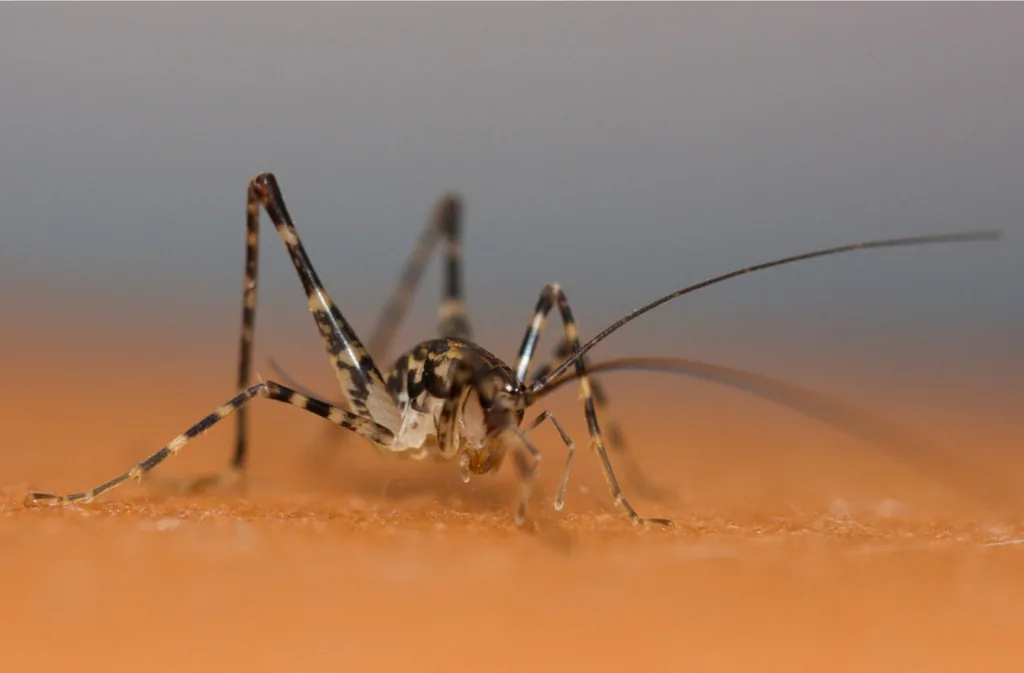
- Like other camel crickets it is humpbacked and wingless, with long antennae and large hind legs. Camel crickets cannot fly or chirp, but they can jump a surprisingly long way.[3]
- It is told apart from the much more common greenhouse camel cricket by the spines on the long lower segment of its legs (the tibiae), about 30 instead of about 60, and by the length of the tibial spurs, the sheen and distinctive pattern of the pronotum, and its coloring.[1]
- Camel crickets are generally tan, reddish brown or dark brown and grow to about 1 inch long, not counting legs and antennae. The young look like small adults.[3]
Look-alikes
| Look-alike | How to tell them apart |
|---|---|
| Greenhouse camel cricket (Diestrammena asynamora) | The other Asian camel cricket in North American houses, and by far the more common one: 94 percent of the household Diestrammena records identified to species in the 2014 survey. It has about 60 tibial spines, roughly twice as many.[1] |
Where it lives
It is an Asian species. In the 2014 survey its records came only from the northeastern United States, in Massachusetts, Pennsylvania and New Jersey, with earlier informal reports from around New York City. In southwestern China it is the dominant insect in karst caves.[1][2]
Biology and life cycle
The 2014 identification rested on photographs, so the researchers called it putative D. japanica and recommended examining museum specimens to confirm it. It was the first report of the species as an introduced insect in the United States in the scientific literature.[1]
Of the 108 household Diestrammena submissions that could be identified to species, seven were Japanese camel crickets and the rest greenhouse camel crickets. Overall, these Asian camel crickets turned up in eastern houses far more often than native camel crickets did.[1]
Camel crickets favor cool, moist places such as basements, cellars, caves and the undersides of logs. They are almost entirely nocturnal and feel their way in the dark with their long antennae and legs.[3]
Camel crickets eat organic debris, insects and other small arthropods. In Chinese caves this species is omnivorous and its diet follows the light: near cave entrances it eats more moss and ferns, and in dim and dark zones more animal carcasses and fungi.[3][2]
Indoors, camel crickets are unlikely to breed unless conditions are just right, with enough darkness and moisture.[3]
Damage and signs
- Camel crickets are of no economic importance in homes, though they can become a nuisance in greenhouses.[3]
Health risk
The Missouri Department of Conservation describes camel crickets as completely harmless.[3]
Control
Prevention
Large numbers of camel crickets in a basement can point to a moisture problem, and fixing the dampness comes first.[3]
Pesticides
Pesticides are occasionally needed where camel crickets become a nuisance in greenhouses.[3]
Common questions
- How can I tell a Japanese camel cricket from a greenhouse camel cricket?
- With a sharp photo, count the spines on the long lower leg segments: about 30 on the Japanese camel cricket and about 60 on the greenhouse camel cricket. The pattern, sheen and coloring of the pronotum also differ.[1]
- Are Japanese camel crickets dangerous?
- No. Camel crickets are completely harmless, though they can become a nuisance in greenhouses.[3]
- Why do camel crickets show up in my basement?
- They seek out cool, damp, dark places, and finding many of them in a basement can mean there is a moisture problem.[3]
Sources
- PeerJ, full text in PubMed Central (PMC4157299), “Epps, Menninger, LaSala and Dunn. Too Big to Be Noticed: Cryptic Invasion of Asian Camel Crickets in North American Houses. PeerJ 2: e523 (2014), doi:10.7717/peerj.523.” doi.org/10.7717/peerj.523 (accessed 2026-11-09)
- Frontiers in Microbiology (Frontiers), full text in PubMed Central (PMC9812492), “Dong, Chen, Fang, Wu et al. Gut Bacteria Reflect the Adaptation of Diestrammena japanica (Orthoptera: Rhaphidophoridae) to the Cave. Frontiers in Microbiology 13: 1016608 (2022), doi:10.3389/fmicb.2022.1016608.” doi.org/10.3389/fmicb.2022.1016608 (accessed 2026-11-09)
- Missouri Department of Conservation, “Camel Crickets (Cave Crickets) (Field Guide).” mdc.mo.gov/discover-nature/field-guide/camel-crickets-cave-crickets (accessed 2026-11-09)
- iNaturalist, “Diestrammena japanica taxon page (order and family).” www.inaturalist.org/taxa/425403 (accessed 2026-11-09)