On this page
How to identify it
- The first sign, in May and June, is tiny caterpillars inside needle tubes or bundles of larch needles webbed together with silk. Older caterpillars wrap silk around longer bundles to make compact tubes.[1]
- The caterpillar is 10 to 12 mm long in Natural Resources Canada's photographs; western Zeiraphera larvae are dirty white to pale yellow with dark brown heads and reach up to 14 mm.[1][2]
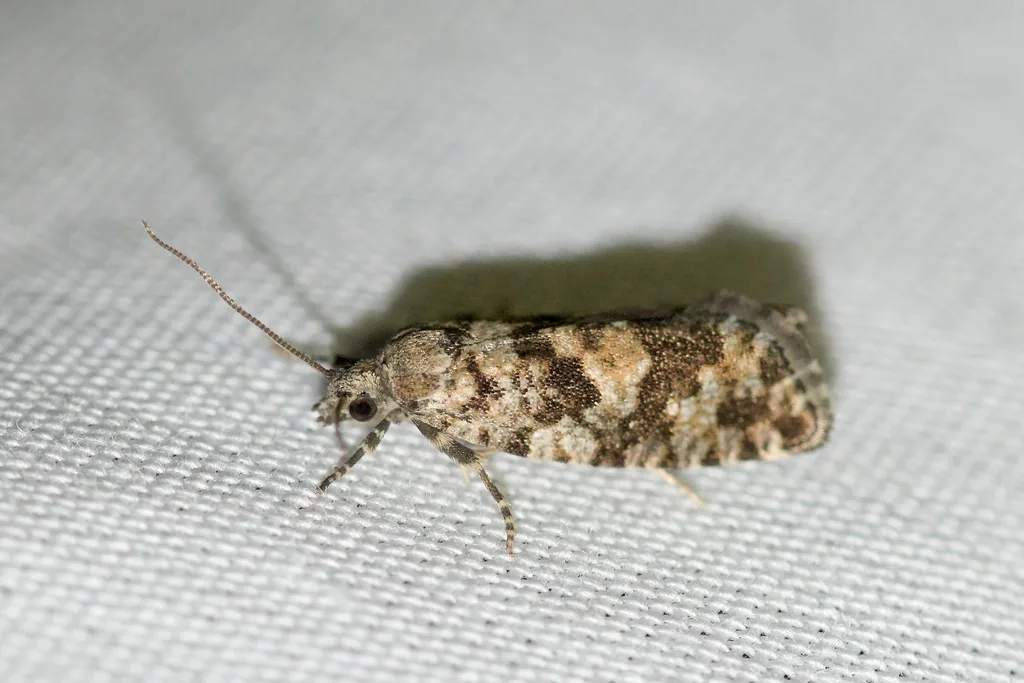
- The moth is an inconspicuous mottled grayish to brownish tortricid with a wingspan of about 17 mm; western species of the genus span about 10 to 20 mm.[1][2]
- Heavily infested larch turn red and put out shorter new needles later in the season.[1]
Look-alikes
| Look-alike | How to tell them apart |
|---|---|
| Spruce bud moth | The spruce bud moth (Zeiraphera canadensis) is a sister species on spruce. The western Zeiraphera are closely related and look alike, and the USDA manual says confusion persists about which species are on spruce and true fir; the larch needleworm is the one whose main hosts are tamarack and western larch.[2][1] |
| Larch casebearer | The larch casebearer (Coleophora laricella) is a far more serious larch defoliator. Its caterpillar is only about 6 mm long and feeds from inside a small case cut from a hollowed needle, with cases clustered at the bases of buds, rather than webbing whole needle bundles into silk tubes.[3][1] |
| Larch sawfly | Larch sawfly larvae are gray-green with jet-black heads, about 16 mm long, and feed in groups in the open on the needles of older twigs; they do not build silk needle tubes.[3][1] |
Where it lives
It is transcontinental in southern Canada and the northern United States. Outbreaks have been recorded on western larch in British Columbia, Washington, Idaho and Montana and on tamarack in eastern Canada, with isolated pockets in Ontario and eastern Quebec.[2][1][3]
Biology and life cycle
The main hosts are tamarack and black spruce in Canada; the USDA manuals list tamarack, western larch and white fir, and say it appears to prefer larch and spruce while several other conifers are also infested.[1][2][3]
Eggs are laid in clusters and tucked into cones of the current year's crop. They hatch the following spring, and the young caterpillars feed on bundles of young needles.[1]
Older caterpillars attack longer bundles of needles, wrapping silk around them to form compact tubes. When feeding is finished they drop to the ground and spin a cocoon in the litter, where they pupate.[1]
The insect was first reported in Canada in 1937, having long been confused with the European Zeiraphera diniana. The USDA manual explains that the western Zeiraphera are native species once wrongly recorded as introduced European ones, which muddled many early survey records.[1][2]
The first recorded infestation was in 1965 on western larch in British Columbia; in 1966, 518,000 acres were infested in Montana. By the early 1970s the only outbreaks reported were on tamarack in eastern Canada, and after a decline in 1975 only isolated pockets remained in Ontario and eastern Quebec.[1][2]
Damage and signs
- When the caterpillar population is large, severe defoliation turns the trees red and reduces their growth. Because the feeding comes early in the season, the trees produce new needles before winter, although these are shorter than normal.[1]
- Outbreaks are conspicuous but usually short-lived and not very extensive, and the USDA manual says their effect on the trees has not been considered serious.[1][2]
Health risk
The sources treat it only as a defoliator of larch and spruce and mention no effect on people.[1][2][3]
Control
Prevention
Natural Resources Canada says no control measures are required, because tamarack stands cover a small area and infestations are short. A reddened larch produces a new flush of shorter needles before winter.[1]
Traps and physical control
On a yard larch, the silk-bound needle bundles are easy to find in May and June and can be pinched off with the caterpillars inside.[1]
Common questions
- Why is my tamarack turning red in early summer?
- Caterpillars of the larch needleworm web bundles of young needles into silk tubes in May and June, and heavy feeding reddens the tree. The tree normally grows a new set of shorter needles before winter.[1]
- Is the larch needleworm the European larch bud moth?
- No. It was long confused with the European Zeiraphera diniana, but the North American insect is a native species, first reported in Canada in 1937.[1][2]
- Do I need to spray?
- Natural Resources Canada says no control measures are required; outbreaks are short-lived and the trees refoliate the same season.[1]
Sources
- Natural Resources Canada, Canadian Forest Service, “Larch needleworm, Trees, insects and diseases of Canada's forests.” tidcf.nrcan.gc.ca/en/insects/factsheet/11213 (accessed 2026-11-10)
- USDA Forest Service, “Western Forest Insects, Miscellaneous Publication 1339 (R. L. Furniss and V. M. Carolin, November 1977; scanned copy).” archive.org/details/CAT78702369 (accessed 2026-11-10)
- USDA Forest Service, “Eastern Forest Insects, Miscellaneous Publication 1175 (W. L. Baker, 1972; scanned copy).” archive.org/details/easternforestins1175bake (accessed 2026-11-10)
- iNaturalist, “Zeiraphera improbana taxon page (order and family).” www.inaturalist.org/taxa/233967 (accessed 2026-11-10)