On this page
How to identify it
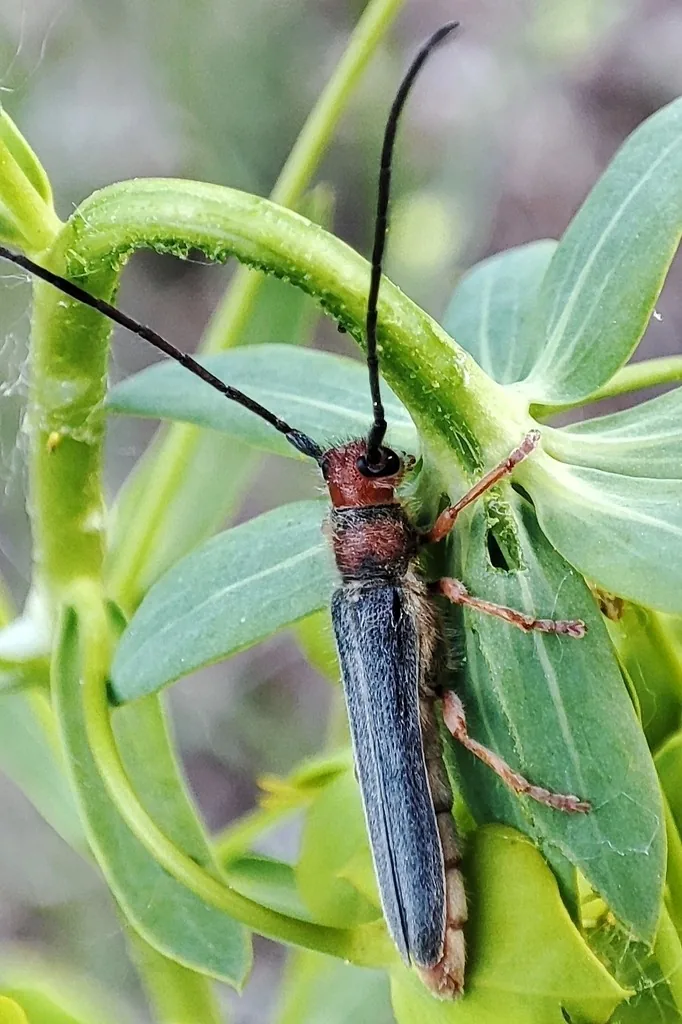
- Adults are slender longhorn beetles 10 to 12 mm long with long, dark antennae, a red head and black eyes. The body is dark gray above and lighter gray with reddish markings below, and the legs are yellowish brown. Look for them on leafy spurge foliage through the summer.[1]
- Girdled leafy spurge stems are the field sign. The female chews a ring around a stem, makes a hole and deposits one egg; girdled stems often die back.[1][2]
- Mature larvae are up to 20 mm long, slender and white with a yellowish head, and the body is obviously segmented with inflated segments. The mining is not visible unless a stem and root crown are split open.[1]
Look-alikes
| Look-alike | How to tell them apart |
|---|---|
| Cypress spurge clearwing moth (Chamaesphecia empiformis) | Its larvae also mine spurge stems and roots, but they prefer cypress spurge, reach only about 15 mm and lack the obvious inflated segments of the stem borer's larva.[1] |
| Leafy spurge flea beetles (Aphthona spp.) | The other beetles released on leafy spurge are small jumping flea beetles whose adults eat leaves and flowers and whose larvae feed on root hairs and young roots, not inside the stems.[2] |
Where it lives
Native to Europe. Italian stock released in the United States in 1980 failed to establish, and populations from Austria, Hungary and Italy were released on leafy spurge from 1982. In Canada, Swiss stock was released on leafy spurge from 1979 and on cypress spurge from 1986. In North America the beetle is established only on leafy spurge; in Canada it is established only in Alberta, where it is considered rare. It prefers mesic sites, is believed to do well in riparian areas and has survived harsh winter temperatures.[1]
Biology and life cycle
Adults emerge in early to mid-summer and feed on leafy spurge leaves and flowers. The female girdles a stem, chews a hole and lays a single egg, up to 40 over her lifetime. The hatching larva mines down the stem until it reaches the root crown and nearby lateral roots, overwinters there and pupates in the root crown in spring. The new adult chews through the remaining plant tissue and emerges from the soil.[1]
There is one generation a year in Europe, but full development may take two years in colder parts of North America.[1]
Damage and signs
- Larval mining kills shoots and reduces the plant's root reserves. Adult feeding is generally insignificant, but the stem girdling often leads to shoot death and cuts seed production. Leafy spurge is the only host in North America.[1][2]
- In the United States the beetle was at first expected to greatly depress leafy spurge, but for several years densities appeared to stay too low to have significant impact, which at some sites was put down to the beetle attacking only particular leafy spurge biotypes. A Forest Service trial that released the beetle into caged and uncaged plots at six western sites, replicated three times, found it did not demonstrably reduce leafy spurge biomass, and evidence of egg laying declined after the release year, suggesting the populations were dwindling. Since 2020 many populations in the northwestern United States appear to have increased significantly, and the overall impact remains unclear until those populations are studied. In Canada small plants can be killed at high densities, but field populations are too low to matter.[1][3]
Health risk
A stem-boring beetle of leafy spurge; none of the sources describes any risk to people.[1][2][3]
Control
Prevention
Leafy spurge is a Class B noxious weed in Washington and on the state quarantine list, so plants, plant parts and seed may not be transported, sold or distributed into or within the state. The weed board lists the stem borer alongside Aphthona flea beetles and the tip gall midge as the biological controls in use, and notes that goats have been used to graze the weed selectively.[2]
Biological control
The stem borer is a deliberately introduced weed-control agent and needs no control itself. Expect it mainly on leafy spurge in moist and riparian settings, and do not count on it alone: field populations have historically been too low to reduce the weed, though the authors of the Forest Service study note that agents sometimes pass through long lag phases before increasing.[1][3]
Common questions
- I found girdled, dying spurge stems with a gray red-headed beetle nearby. Is it a pest?
- No, it is the leafy spurge stem borer, released on purpose against leafy spurge; the girdling is how the female prepares a stem for her egg, and the shoot death it causes is part of the intended damage.[1][2]
- Will it clear my leafy spurge?
- The record says not to expect that. Densities stayed low for years after release, a six-site Forest Service trial measured no drop in spurge biomass, and although northwestern populations appear to have grown since 2020, their effect has not yet been quantified.[1][3]
- How do I tell its larva from the clearwing moth larva in spurge roots?
- The stem borer's larva is bigger, up to 20 mm, white with a yellowish head and obviously inflated segments; the moth larva is up to about 15 mm, lacks the inflated segments and prefers cypress spurge.[1]
Sources
- North American Invasive Species Management Association (PDF hosted on Bugwood), “Milan (Bureau of Land Management), West (USDA ARS), Bourchier (Agriculture and Agri-Food Canada) and Randall (USDA Forest Service). Spurge Biocontrol Agents: History and Ecology in North America. In: Winston, ed., Biological Control of Weeds in North America, NAISMA-BCW-2024-40-SPURGES-A (2024).” bugwoodcloud.org/resource/files/29180.pdf (accessed 2026-11-10)
- Washington State Noxious Weed Control Board, “Leafy spurge (Euphorbia virgata).” www.nwcb.wa.gov/weeds/leafy-spurge (accessed 2026-11-10)
- USDA Forest Service (Treesearch 44756), “Progar (USDA Forest Service, Pacific Northwest Research Station), Markin, Milan, Barbouletos and Rinella. Population dynamics and impacts of the red-headed leafy spurge stem borer on leafy spurge. In: Proceedings of the XIII International Symposium on Biological Control of Weeds, Session 9; published in Invasive Plant Science and Management 4: 183-188 (2011).” research.fs.usda.gov/treesearch/44756 (accessed 2026-11-10)
- iNaturalist, “Oberea erythrocephala taxon page (order and family).” www.inaturalist.org/taxa/226076 (accessed 2026-11-10)