On this page
How to identify it
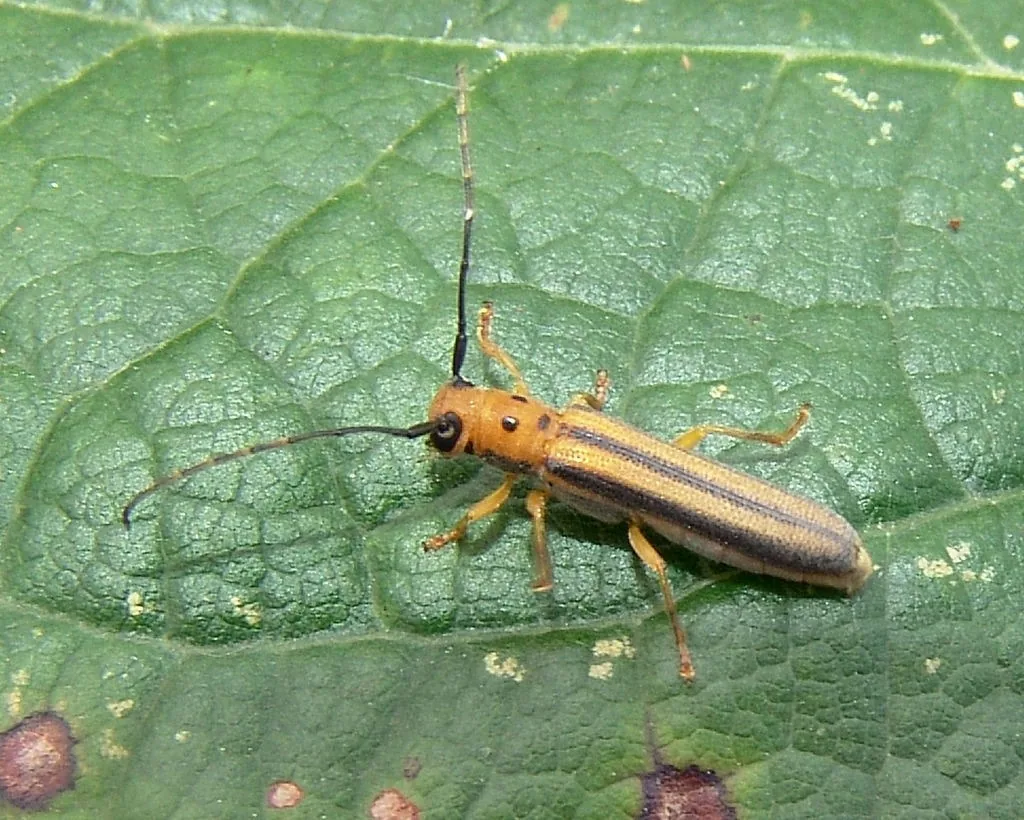
- A slender, elongate longhorned beetle about 1/2 to 5/8 inch (about 14 mm) long and only about 2.4 mm wide.[1][2]
- The head is black, while the thorax, most of the underside and the legs are yellow. The top of the thorax has two smooth black bumps, with another black spot just in front of the wing covers.[2]
- The wing covers vary in color but are usually yellowish tan, edged with a thin black line along the inner margins and a wider black line along the outer margins.[2]
- The larva is a slender, legless, pale yellow to white grub with a dark brown head, growing to about 7/8 to 1 inch (19 to 25 mm) long inside the twig.[1][2]
Look-alikes
| Look-alike | How to tell them apart |
|---|---|
| Raspberry cane borer | Another Oberea twig borer, which prefers raspberry and blackberry. The Forest Service handbook describes it as a mostly black longhorn about 13 mm long with a yellow thorax, while the dogwood twig borer's wing covers are usually yellowish tan.[2] |
Where it lives
Its range follows that of flowering dogwood in eastern and central North America. It has been recorded from Maine south to Florida and west to Texas, Kansas and North Dakota.[2]
Biology and life cycle
Adults appear in late spring once the new shoots have firmed up a little: in April and May in north Georgia, May through July in Pennsylvania, and late May to early August in Michigan.[1][2]
Before laying an egg, the female chews two rings of holes around a current-season shoot, from about 1/4 inch to 1 inch apart and roughly 3 to 6 inches from the tip. She slits the bark between the rings and slips a single egg, about 1/8 inch long, under a flap of bark.[1][2]
The grub hatches within a few weeks, tunnels a short way toward the tip, then turns and bores down the center of the stem. At regular intervals it chews small holes to the surface and pushes out frass, which hangs in long chains of pellets. The shoot above the girdled area wilts and dies.[1][2]
The grub overwinters in a cell inside the twig, sealed between plugs of fibrous frass, and pupates the next spring. In the South and over much of its range the life cycle takes one year; in Minnesota it takes two.[1][2]
Damage and signs
- The first sign is usually wilting and dying leaves at the tips of shoots and twigs during summer. Split an infested twig and you will find a long, narrow gallery down its center; the grub also girdles the woody stem, leaving V-shaped cuts where it breaks.[2]
- Infested branches often die or are weakened so much that they break off easily. Adults also chew elongate holes along the leaf veins.[1][2]
- On seedlings, sprouts and small shrubs such as sourwood, blueberry, rhododendron, azalea and laurel, the grub can keep boring down to the root crown and kill the whole plant above ground. The Forest Service handbook rates the injury as much more important on ornamentals than in forests.[2]
Health risk
It is a twig-boring beetle of dogwood and other woody plants. Neither NC State nor the Forest Service handbook describes any risk to people.[1][2]
Control
Traps and physical control
Prune out infested stems as soon as you notice wilting in early summer, cutting below the grub, and burn or otherwise destroy them so the grubs cannot survive to produce next year's beetles. The Forest Service handbook also advises pruning and destroying infested twigs before the adults emerge in spring.[1][2]
Biological control
Two parasitic wasps have been reared from the larvae, with parasitism rates of 50 to 80 percent, and woodpeckers prey on the grubs.[2]
Pesticides
Where protection is needed, NC State suggests spraying a pyrethroid in late spring to keep the new generation of beetles from laying eggs. Pyrethroids are very toxic to fish, so avoid using them around pools, ponds and streams. Because this is a sporadic pest, treatment is probably not needed every year.[1]
Common questions
- Why are the tips of my dogwood branches wilting in summer?
- The dogwood twig borer is one cause. Look for two rings of small chewed holes around the shoot below the wilted part and a row of tiny holes down the stem where the grub pushes out frass. Split the twig and the grub's tunnel runs down its center.[1][2]
- How do I get rid of dogwood twig borers?
- Prune infested twigs below the grub as soon as you see wilting and destroy them. Because it is a sporadic pest, spraying is probably not needed every year.[1]
- Does the dogwood twig borer attack other plants?
- Yes. Besides dogwood it attacks elm, viburnum, sourwood, blueberry, rhododendron, azalea, laurel, poplar, willow and mulberry, and occasionally apple and Prunus trees.[2]
Sources
- NC State Extension, “Dogwood Twig Borer (J. Baker), PDIC factsheet.” content.ces.ncsu.edu/dogwood-twig-borer-1 (accessed 2026-11-09)
- USDA Forest Service, “Guide to Insect Borers in North American Broadleaf Trees and Shrubs, Agriculture Handbook AH-706 (J. D. Solomon, 1995), dogwood twig borer account, pp. 374-376.” research.fs.usda.gov/treesearch/22150 (accessed 2026-11-09)
- iNaturalist, “Oberea tripunctata taxon page (order and family).” www.inaturalist.org/taxa/226087 (accessed 2026-11-09)