On this page
How to identify it
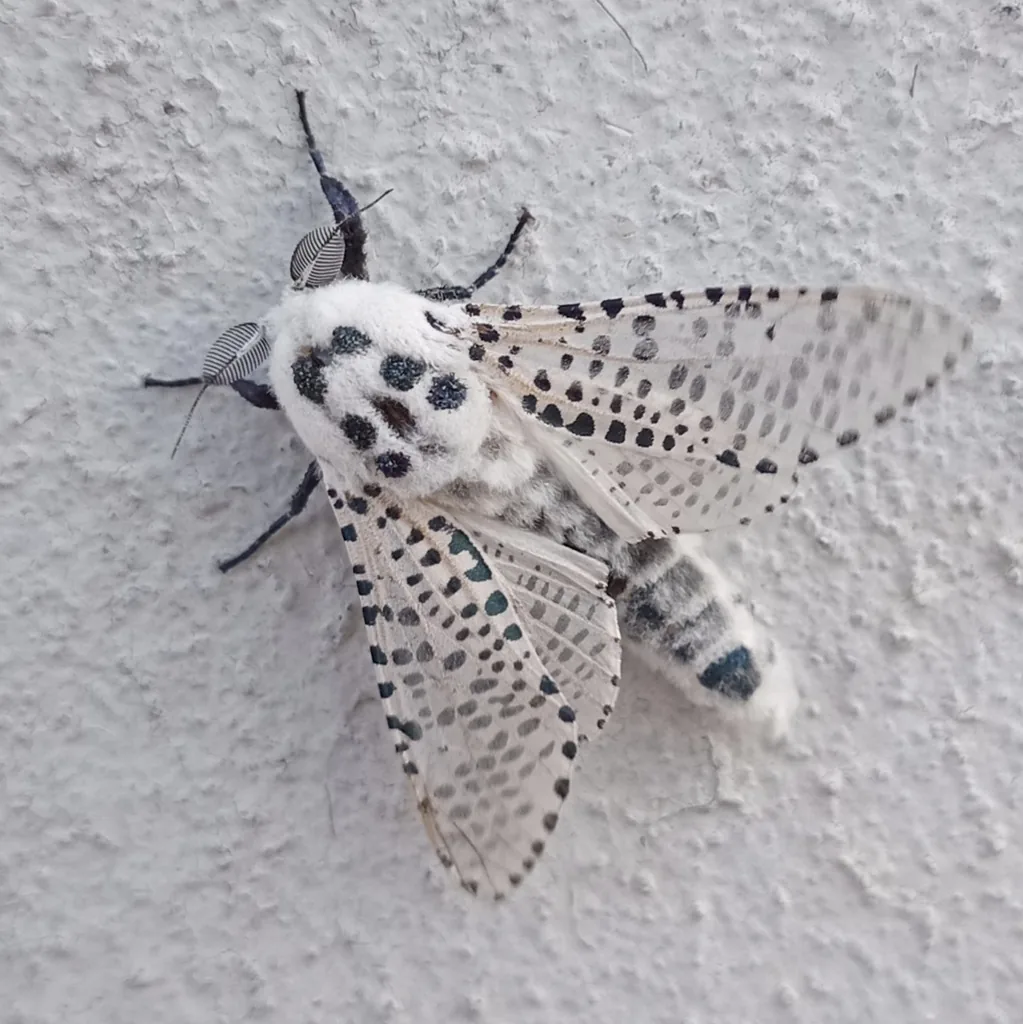
- Adults are white moths covered with black spots; UMass describes them as up to 1.5 inches long, UNH as about 3/4 inch.[1][2]
- Caterpillars are pale yellow to cream with black heads and small black dots, up to about 2 inches long when grown.[1][2]
- Large, coarse pellets of frass pushed out of bark cracks or tunnel openings show where a borer is feeding.[1][2]
Look-alikes
| Look-alike | How to tell them apart |
|---|---|
| Carpenterworm | A native wood-boring caterpillar, also called a carpenterworm, that causes similar damage on overlapping hosts.[1] |
Where it lives
Introduced from Europe and North Africa and first reported in New Jersey in 1887, it has since spread west and south; it is uncommon in New England.[1][2]
Biology and life cycle
Adults fly from about May to September, most commonly early July to mid-August in New Hampshire, and males are drawn to lights.[1][2]
Females lay eggs in clusters in bark crevices, up to 800 in a season; young caterpillars bore in through the bark and can move to a new branch if the first is too small.[1][2]
The life cycle takes two years, sometimes three, and pupation happens inside the tunnel.[1][2]
Damage and signs
- More than 125 kinds of deciduous trees are hosts, including apple, ash, birch, cherry, elm, maple, oak, pear and willow.[1][2]
- Small trees and branches suffer most, with dieback; in apples it often shows up in young trees that have had mechanical injury.[1][2]
- Populations generally stay low, so it has not been an important pest in New England.[1][2]
Health risk
Control
Prevention
Keep trees vigorous, especially with adequate water, and avoid mechanical injury to trunks.[1][2]
Traps and physical control
Tunnels are fairly straight, so a borer can often be killed by probing the opening with a flexible wire.[2]
Biological control
Common questions
Sources
- UMass Extension Landscape, Nursery and Urban Forestry Program (Landscape Insect & Mite Guide), “Zeuzera pyrina (Leopard Moth).” www.umass.edu/agriculture-food-environment/landscape/publications-resources/insect-mite-guide/zeuzera-pyrina (accessed 2026-10-16)
- UNH Cooperative Extension, “Borers in New Hampshire Apple Trees (fact sheet).” extension.unh.edu/resource/borers-new-hampshire-apple-trees-fact-sheet-0 (accessed 2026-10-16)
- iNaturalist, “Zeuzera pyrina taxon page (order and family).” www.inaturalist.org/taxa/200930 (accessed 2026-10-06)