On this page
How to identify it
- The mite is a tube-shaped eriophyid about 150 micrometers long with two pairs of legs; it can't be seen with the naked eye or a hand lens, only under high magnification.[1][2]
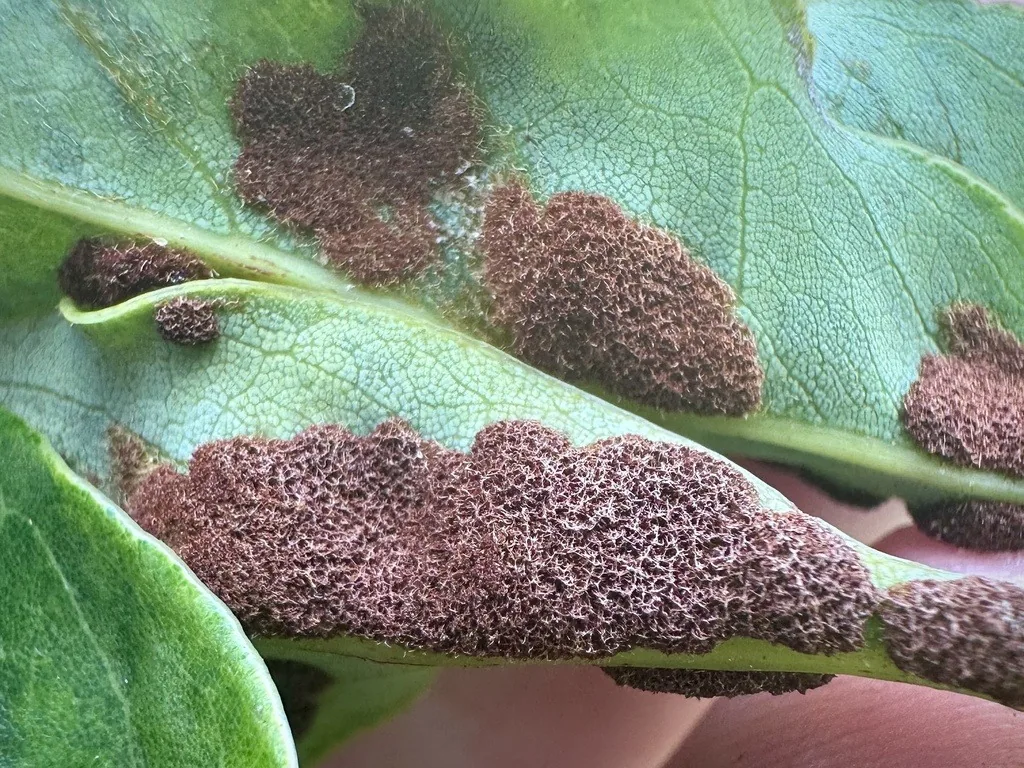
- What you can see are the erinea: dense, felt-like growths of leaf hairs that start on the underside of new leaves, often with a color change on the upper side, and infested leaves can become distorted or curled.[1]
- The erinea change as an infestation ages, from dense white to amber and finally dark brown or black once the mites have used up the leaf, and they can also form on stems, flowers and young fruit.[1][2]
Look-alikes
| Look-alike | How to tell them apart |
|---|---|
| Longan erinose mite (Aceria dimocarpi) | A close relative that attacks longan; the lychee erinose mite is highly specific to lychee, and in Florida and Brazil longan planted next to infested lychee never developed symptoms.[1] |
Where it lives
Native to Asia, it has been reported from India, Bangladesh, Thailand, China, Taiwan and Hawaii; in Florida it was found in 1955 and 1993 and eradicated both times, then found on Pine Island in Lee County in February 2018 and has since been detected in 13 Florida counties.[1][2]
Biology and life cycle
Eggs are laid only after erinea form, at the base of the hairs, and development from egg to adult takes about 14 days, so generations overlap.[1]
The mites prefer young flush and walk from leaf to leaf among new growth; they also ride on honeybees during bloom, drift on wind, and move on air-layered plants taken from infested trees, on infested fruit and on contaminated pruning tools.[1][2]
Trees that flush often, including young trees, are more attractive to the mite than dormant trees.[2][1]
Damage and signs
Health risk
It feeds only on lychee; UF/IFAS mentions no risk to people.[1][2]
Control
Prevention
Check new flush often, especially while trees are flushing, because the mite is microscopic and early detection is the best chance to contain it.[1]
Keep them out
Don't move lychee plants, air-layers or fruit out of infested areas; in 2021, lychee fruit and plant parts from Lee County were under quarantine.[1][2]
Traps and physical control
Pruning infested branches is the main tool; removed branches are burned, buried or chipped, and before heavy pruning the trunk is painted with a 50/50 mix of white latex paint and water to prevent sunscald.[2][1]
Pesticides
Sulfur doesn't kill mites inside erinea but protects new growth from reinfestation; Florida allows one sulfur product (Microthiol Disperss) on lychee under a Special Local Needs label, sprayed every 7 to 15 days from bud break until the new leaves harden.[2][1]
Miticides such as bifenazate and abamectin only protect leaves before an infestation; they don't kill the mite once erinea have formed.[1]
When to call a professional
In Florida, report suspected infestations to the Florida Department of Agriculture and Consumer Services, Division of Plant Industry; under its eradication program it confirms the mite, prunes the infested parts of the tree and treats it, and in 2021 that service was free.[2]
Common questions
- What are the fuzzy brown patches on my lychee leaves?
- Felt-like white, amber or brown patches of hairs on new lychee leaves are typical of the lychee erinose mite's erinea; in Florida, report them to FDACS Division of Plant Industry.[1][2]
- Can it spread to my longan tree?
- It is highly specific to lychee; a related mite attacks longan, and longan planted beside infested lychee in Florida and Brazil stayed free of symptoms.[1][2]
Sources
- UF/IFAS Extension (EDIS), “The Lychee Erinose Mite, Aceria litchii (Keifer) (Acari: Eriophyidae), EDIS IN1347 (2022).” edis.ifas.ufl.edu/publication/IN1347 (accessed 2026-10-19)
- Florida State Horticultural Society, “The Lychee Erinose Mite: A New Serious Pest of Lychee in Florida (Proceedings of the Florida State Horticultural Society 134:9-10, 2021; Wasielewski, Carrillo, Revynthi and Crane, UF/IFAS).” journals.flvc.org/fshs/article/download/133421/137324/245302 (accessed 2026-10-19)
- iNaturalist, “Aceria litchii taxon page (order and family).” www.inaturalist.org/taxa/1137604 (accessed 2026-10-06)