On this page
How to identify it
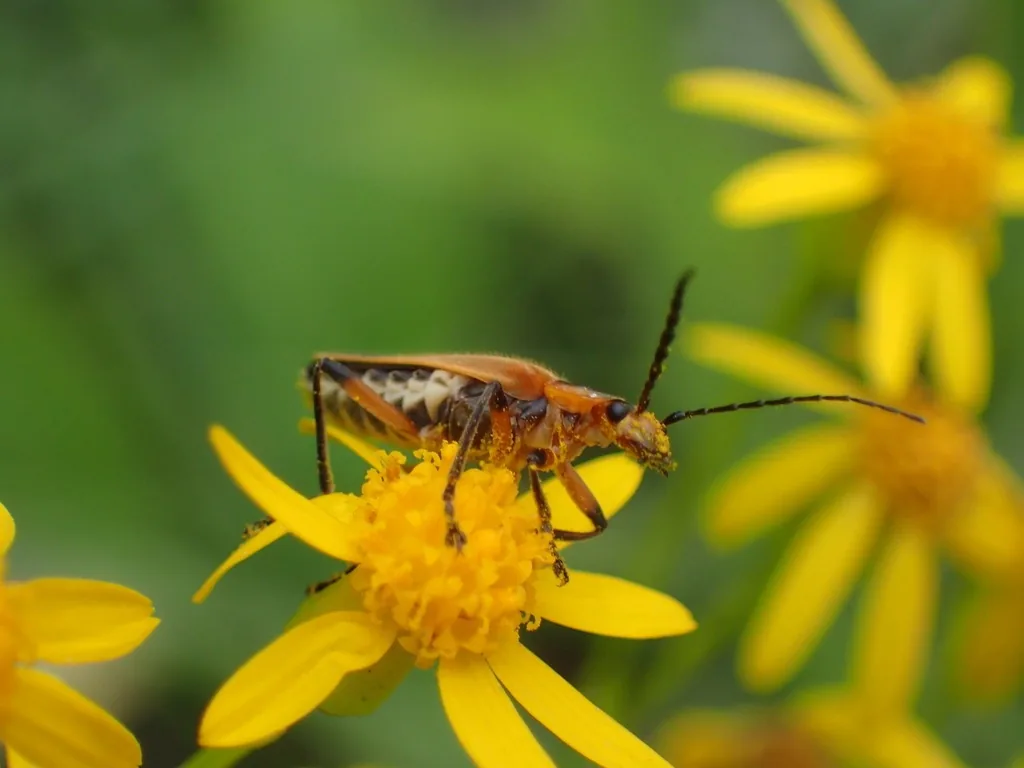
- A slender, soft-bodied beetle about 1/2 to 5/8 inch long with yellowish to orange wing covers.[2][1]
- Look for a black V-shaped mark running from the eyes to the back of the head. The wing covers range from plain to heavily streaked with black.[1]
- The dark mark on the shield behind the head is a band that reaches both its front and back edges, where the Pennsylvania leatherwing has a single spot in the center.[2]
- The wing covers are softer than most beetles', which is where the name leatherwing comes from.[1][3]
- Larvae are velvety and shaped like small caterpillars, darkening to black as they grow.[1][2]
- When disturbed, soldier beetle adults may pull in their legs and drop to the ground as if dead.[4]
Look-alikes
| Look-alike | How to tell them apart |
|---|---|
| Goldenrod soldier beetle, or Pennsylvania leatherwing (Chauliognathus pensylvanicus) | Has two brown-black spots near the tips of the wing covers and a central spot behind the head, and its adults are out in late summer and fall instead of spring.[2][1] |
| Fireflies | Soldier beetles look like fireflies but have no light organ on the abdomen, and the head is visible from above instead of hidden under a plate.[2][3] |
Where it lives
Common in Virginia crop fields in spring and in the Delmarva region from late May through early July. GBIF holds about 22,700 U.S. records since 1990, most from Virginia, Pennsylvania, Maryland, North Carolina and Ohio.[2][1][5]
Biology and life cycle
Virginia Tech says leatherwings have one generation a year. UC IPM, writing about soldier beetles as a whole, says larvae can live 1 to 3 years and that some species have 1 or 2 generations a year.[2][4]
Adults feed and mate on flowers. Females lay clusters of eggs: in the soil according to Virginia Tech, on the soil surface according to Delaware. Virginia Tech says they hatch in about 10 days; UC IPM gives about 1 week for soldier beetles in general.[2][1][4]
Newly hatched larvae are white and barely move until their first molt. They darken with each molt until they look like small black velvety caterpillars.[2]
Larvae hunt in the soil for grasshopper eggs, small caterpillars and other soft-bodied insects, and they also climb plants to hunt pests on leaves and fruit. MDC adds that soldier beetle larvae suck the juices out of insect eggs and of larvae such as maggots, earworms and borers.[1][3]
One larva can eat several Colorado potato beetle egg masses, or a batch of aphids or small caterpillars, in a day.[2]
The sources differ on what adults eat. Delaware says margined soldier beetles hunt aphids, caterpillars and other soft-bodied insects on flowers as well as taking nectar and pollen; UC IPM says adults of Chauliognathus feed only on honeydew, nectar and pollen.[1][4]
While moving between flowers, adults carry pollen, so they act as minor pollinators. In a 2023 study of common milkweed, soldier beetles were as effective pollinators as honey bees, flies, small bees and bumble bees.[1][6]
Soldier beetles can give off noxious defensive chemicals from glands on the abdomen, and their colors warn birds and other predators that they taste bad.[4][3]
Damage and signs
Health risk
It will not bite or sting.[1]
Control
Prevention
Leave it alone. To keep more of them around, plant flower strips or wildflowers and choose more selective, IPM-friendly insecticides when you do need to spray.[1]
Flowers in early spring support this species, while the fall goldenrod soldier beetle needs late-season flowers.[2]
Dead soldier beetles stuck to fall flowers
Beetles found dead and clinging to flowers in fall are usually the goldenrod species, not the margined leatherwing. In Arkansas, a fungus killed about 20 percent of goldenrod soldier beetles sampled from asters in 1996.[7]
Shortly before death, infected beetles clamp their jaws onto a flower head; about 15 to 22 hours later the fungus makes the dead beetle raise its wing covers and spread its wings.[7]
Common questions
- Are these orange and black beetles on my flowers hurting my plants?
- No. Margined soldier beetles do not damage flowers or other plant parts; they come for nectar and pollen, and the larvae eat soft-bodied insects.[1]
- Is it the same beetle I see on goldenrod in fall?
- No. The margined leatherwing is the spring species, and the Pennsylvania leatherwing (goldenrod soldier beetle) is active in fall. The fall species has two dark spots near the wing tips.[2]
- I found a black velvety larva in my sweet corn. Is that the pest?
- It may be a soldier beetle larva. They prey on soft-bodied insects and are sometimes found inside sweet corn ears already infested with corn earworm or sap beetle larvae.[1]
Sources
- University of Delaware Cooperative Extension, “Margined Solider Beetles - Predators & Pollinators (Weekly Crop Update).” sites.udel.edu/weeklycropupdate/?p=26431 (accessed 2026-11-11)
- Virginia Tech, Virginia Ag Pest and Crop Advisory, “Predator profile: Leatherwings (soldier beetles).” ag-pest-advisory.vaes.vt.edu/predator-profile-leatherwings-soldier-beetles/ (accessed 2026-11-11)
- Missouri Department of Conservation, “Soldier Beetles (Cantharids) (Field Guide).” mdc.mo.gov/discover-nature/field-guide/soldier-beetles (accessed 2026-11-11)
- University of California Statewide IPM Program (UC IPM), “Soldier Beetles (Natural Enemies Gallery).” ipm.ucanr.edu/natural-enemies/soldier-beetles/ (accessed 2026-11-11)
- Global Biodiversity Information Facility (GBIF), “Chauliognathus marginatus: U.S. occurrence records since 1990 by state (GBIF occurrence search).” api.gbif.org/v1/occurrence/search?taxonKey=6067157&country=US&hasGeospatialIssue=false&occurrenceStatus=PRESENT&year=1990%2C2026&facet=stateProvince&facetLimit=400&limit=0 (accessed 2026-11-11)
- Oecologia, via PubMed, “Herbivory, plant traits and nectar chemistry interact to affect the community of insect visitors and pollination in common milkweed, Asclepias syriaca (Gustafson et al. 2023).” pubmed.ncbi.nlm.nih.gov/36456875/ (accessed 2026-11-11)
- Journal of Invertebrate Pathology, via PubMed, “Zombie soldier beetles: epizootics in the goldenrod soldier beetle, Chauliognathus pensylvanicus, caused by Eryniopsis lampyridarum (Steinkraus et al. 2017).” pubmed.ncbi.nlm.nih.gov/28535871/ (accessed 2026-11-11)
- iNaturalist, “Chauliognathus marginatus taxon page (order and family).” www.inaturalist.org/taxa/84040 (accessed 2026-11-10)