On this page
How to identify it
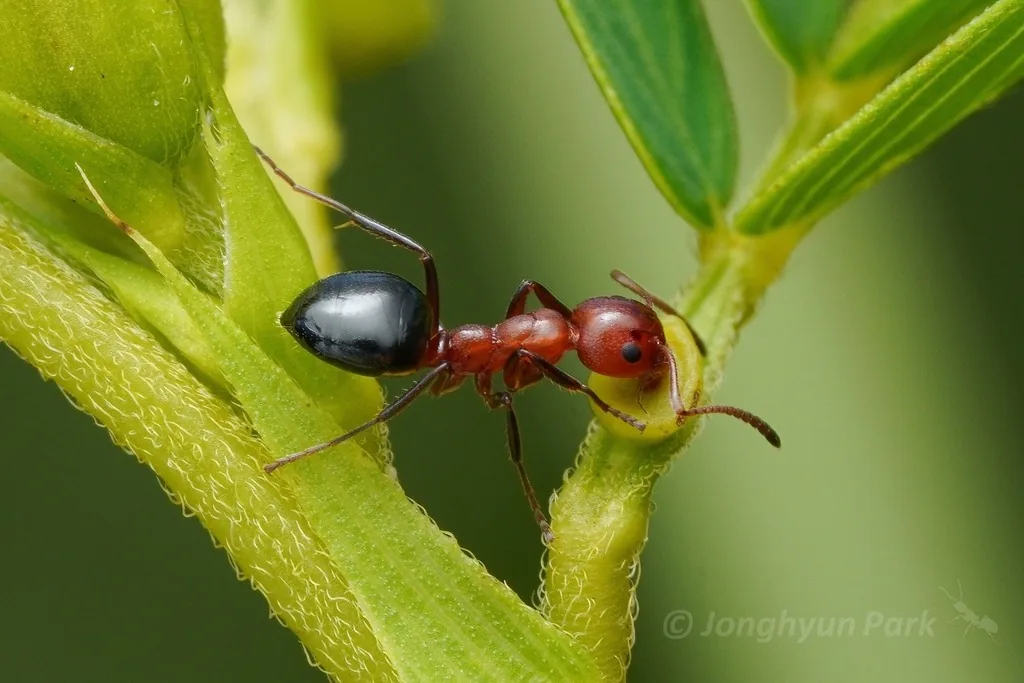
- A medium-sized worker, about 3.5 to 4.0 mm long, with the head, thorax and legs orange-brown to dark reddish brown and the gaster much darker, almost black, often with orange or reddish-brown patches on its first segment. All workers are the same caste, though their size can differ from colony to colony.[1][2]
- Seen from the side the propodeum is raised and strongly arched, with its rear face deeply hollowed out, and the groove between the mesonotum and propodeum is deeply impressed; the thorax is strongly sculptured and the body cuticle is harder than in other North American dolichoderine ants.[1]
- The rear half of the head, the top of the thorax and the gaster are shiny with fine pitting, while the front of the head below the eyes is coarsely pitted and the propodeum is strongly net-sculptured; there are almost no erect hairs on the upper surface.[1]
- Like other United States Dolichoderus it carries glands that release a pungent or smoky-smelling volatile secretion when disturbed.[1]
- The nest is a giveaway: a single large, shallow, cone- or egg-shaped chamber dug under a wiregrass clump or another plant with fibrous roots, broadly open to the surface around the plant's base.[2]
Look-alikes
| Look-alike | How to tell them apart |
|---|---|
| Odorous house ant (Tapinoma sessile) | Another dolichoderine with a defensive odor, but one of the thin-skinned dolichoderines; Dolichoderus has a harder, less flexible cuticle, strong sculpture on the thorax and a deeply concave rear face of the propodeum.[1] |
| Other Dolichoderus (D. plagiatus, D. pustulatus) | Related eastern species share the hard cuticle, sculptured thorax and concave propodeum; D. mariae is the one that prefers pure sand under grass tufts and builds open seasonal nests.[1][2] |
| Acrobat ants (Crematogaster) | Bicolored ants that also tend honeydew producers. Mary's odorous ant is told by its strongly arched propodeum with a deeply hollowed rear face, the deeply impressed groove in front of it, and the smoky-smelling secretion it releases.[1] |
Where it lives
Widely distributed in the eastern United States, with a range covering most of the eastern states; in the Southeast it is reported from Alabama, Arkansas, Florida, Georgia, Louisiana, Mississippi, North Carolina, South Carolina and Tennessee. It is uncommon, not found with regularity, but locally abundant where it occurs.[1][2]
Biology and life cycle
The species prefers pure sand, often in fields or other grassy areas, and nests beneath grass tufts or small bushes. In north Florida the ants excavate the soil under wiregrass clumps or other fibrous-rooted plants to form one large, shallow chamber open to the surface around the plant base.[1][2]
Colonies are large, with thousands of individuals and many queens. During the warm season a colony occupies many nests connected only by above-ground trails over which workers move between nests.[1][2]
The colony cycle is strongly seasonal. From one or two overwintering nests a colony expands to as many as 60 nests by late summer, then shrinks back to one or two by midwinter, reoccupying roughly the same ground each year. The ratio of workers to queens swings from over two thousand per queen in fall and winter to about 300 in midsummer, and most of the summer queens probably die in the fall.[2]
Fights observed where neighboring colonies meet suggest the colonies are territorial. Within their territories the ants tend aphids and scale insects for honeydew and scavenge dead insects; the museum likewise describes them collecting the sweet secretions of homopterans and eating other insects.[2][1]
Damage and signs
Health risk
Disturbed workers release a pungent or smoky-smelling secretion from their glands. Neither source reports stings or bites to people.[1]
Control
Prevention
No control is needed. This uncommon native ant nests in sandy fields and grassy areas and is not described as a pest by either source; leave its open nests under grass clumps alone.[1][2]
Common questions
- Why does the ant smell when I disturb it?
- United States Dolichoderus species have glands that produce a pungent or smoky-smelling volatile secretion, which is where the odorous ant name comes from.[1]
- Why are there so many nests in one patch of sand?
- One colony uses many nests in summer. From a couple of overwintering nests it can spread to around 60 nests by late summer, linked by trails over which workers move, then pulls back to one or two nests for winter.[2]
- Will it come into the house?
- Neither source describes it indoors. It nests in pure sand under grass tufts and feeds on honeydew and dead insects within its territory.[1][2]
Sources
- Mississippi Entomological Museum, Mississippi State University, “Ants of the Southeastern United States: Dolichoderus mariae Forel (J. A. MacGown, updated 2015).” mississippientomologicalmuseum.org.msstate.edu/Researchtaxapages/Formicidaepages/genericpages/Dolichoderus.mariae.htm (accessed 2026-11-10)
- Journal of Insect Science, abstract via PubMed, “The seasonal natural history of the ant, Dolichoderus mariae, in northern Florida (Laskis and Tschinkel 2009, Journal of Insect Science 9:2; PubMed 19611227).” doi.org/10.1673/031.009.0201 (accessed 2026-11-10)
- iNaturalist, “Dolichoderus mariae taxon page (order and family).” www.inaturalist.org/taxa/218622 (accessed 2026-11-10)