On this page
How to identify it
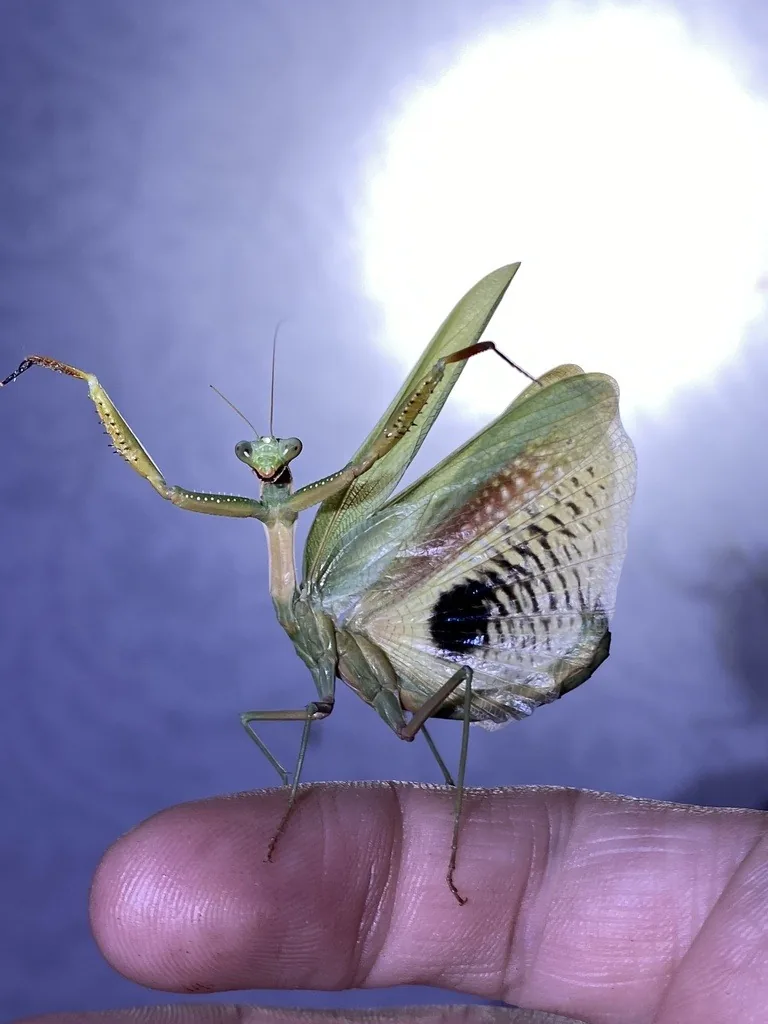
- The hind wings give it away when they open. Much of the inner two-thirds of the leading area is a dull brick red, and a shiny bluish-black blotch about as wide as the head sits in the fan of the wing, with yellowish outer parts crossed by curved dark bands.[2]
- California adults measured 51 to 53 mm long, about 2 inches. On males the front wings reach about to the tip of the abdomen and are opaque along the front half and clear behind; on females they are shorter, covering one-half to three-quarters of the abdomen.[2]
- Under magnification, the front thigh carries five spines along its lower outer edge, where Stagmomantis mantids such as the Arizona and California mantids have four. The shield on the face has a pair of short, blunt bumps.[2]
- Like other mantids it has leathery, narrow front wings, a triangular head that turns about 180 degrees and enlarged front legs held up in front of the head.[1]
Look-alikes
| Look-alike | How to tell them apart |
|---|---|
| Arizona mantis (Stagmomantis limbata) | A native California mantid with four spines on the lower outer edge of the front thigh instead of five.[2][1] |
| Chinese and European mantids | The other introduced mantids in California; the Chinese mantid is also sold to gardeners alongside this one.[1] |
| Minor mantid (Litaneutria minor) | Males often have a blackish-violet wing spot, but the species is more delicate, with a narrower head, short-winged females and only four front-thigh spines.[2] |
Where it lives
Native to the Mediterranean region. In California it was recorded from Fresno, Kern, Riverside and Imperial Counties by 1940, with later records in the Coachella Valley, Indio, Indian Wells and El Centro.[2]
Biology and life cycle
Winter passes in the egg stage. California egg cases measured 10 to 20 mm long and 6 to 7 mm wide, with about six rows of eggs and a distinct groove along the top where the nymphs emerge, roughly 60 to 120 eggs in each. One captive female collected from cotton at El Centro laid at least 10 egg cases.[2]
California mantids follow one generation a year: nymphs hatch from late winter to spring, grow through six or seven stages, and adults lay eggs in fall. Nymphs and adults usually do not survive the winter.[1]
In a UC Davis field study, males of this species and the Arizona mantis each met two or more females, but no male was seen mating more than once. Females of both species sometimes eat males.[3]
Mantids usually sit on flowers waiting for flying insects. Female mantids sometimes kill and eat males during courtship, but this does not happen in most matings.[1]
Damage and signs
Health risk
A predator of other insects. UC IPM calls mantids fascinating creatures and describes no harm to people.[1]
Control
Prevention
No control is needed. If you were thinking of buying them for pest control, UC IPM says mantids, including the Mediterranean mantid sold by mail order and in some garden stores, are of no benefit for biological control of pests.[1]
Common questions
- Is it worth buying Mediterranean mantis egg cases for my garden?
- No. UC IPM notes that mantids eat beneficial insects such as bees and hover flies as readily as pests and each eats relatively few insects, so they are of no benefit for biological pest control.[1]
- How do I know it is not a native mantis?
- Look at the hind wing when it is spread: a dull brick-red patch and a shiny bluish-black blotch mark this species. Native Stagmomantis mantids also have four spines on the underside of the front thigh, where this species has five.[2]
- Where do the egg cases end up?
- Mantids attach their egg masses to twigs or other surfaces. Fresh egg masses are frothy and pale and dry to a brown, hard, paper-like case.[1]
Sources
- University of California Statewide IPM Program, “Natural Enemies Gallery: Mantids, or Praying Mantises.” ipm.ucanr.edu/natural-enemies/mantids/ (accessed 2026-11-10)
- The Pan-Pacific Entomologist (Pacific Coast Entomological Society), via Biodiversity Heritage Library BioStor, “Gurney, A. B. (USDA Agricultural Research Service). Further notes on Iris oratoria in California (Orthoptera: Mantidae). The Pan-Pacific Entomologist 31(2) (1955) 67-72.” archive.org/download/biostor-225309/biostor-225309.pdf (accessed 2026-11-10)
- Animal Behaviour (Elsevier), “Maxwell, M. R. (University of California, Davis). Lifetime mating opportunities and male mating behaviour in sexually cannibalistic praying mantids. Animal Behaviour 55 (1998) 1011-1028, PMID 9632486.” pubmed.ncbi.nlm.nih.gov/9632486/ (accessed 2026-11-10)
- iNaturalist, “Iris oratoria taxon page (order and family).” www.inaturalist.org/taxa/67437 (accessed 2026-11-10)