On this page
How to identify it
- Body color ranges continuously from shades of green to brown, and some individuals show more than one color.[2]
- Adult males are green with a brown pronotum, the long plate behind the head. Adult females are more uniform in color, anywhere from green to brown.[2]
- Males have longer, working wings and fly. Adult females cannot fly.[2]
Where it lives
It is native to western North America and Central America. UC IPM lists it among the native mantids of California, and researchers collected its egg cases from gardens in a residential neighborhood of Davis, California.[2][1]
Biology and life cycle
UC IPM notes that mantids in California have one generation a year and spend the winter as eggs; adults and nymphs generally do not survive the winter.[1]
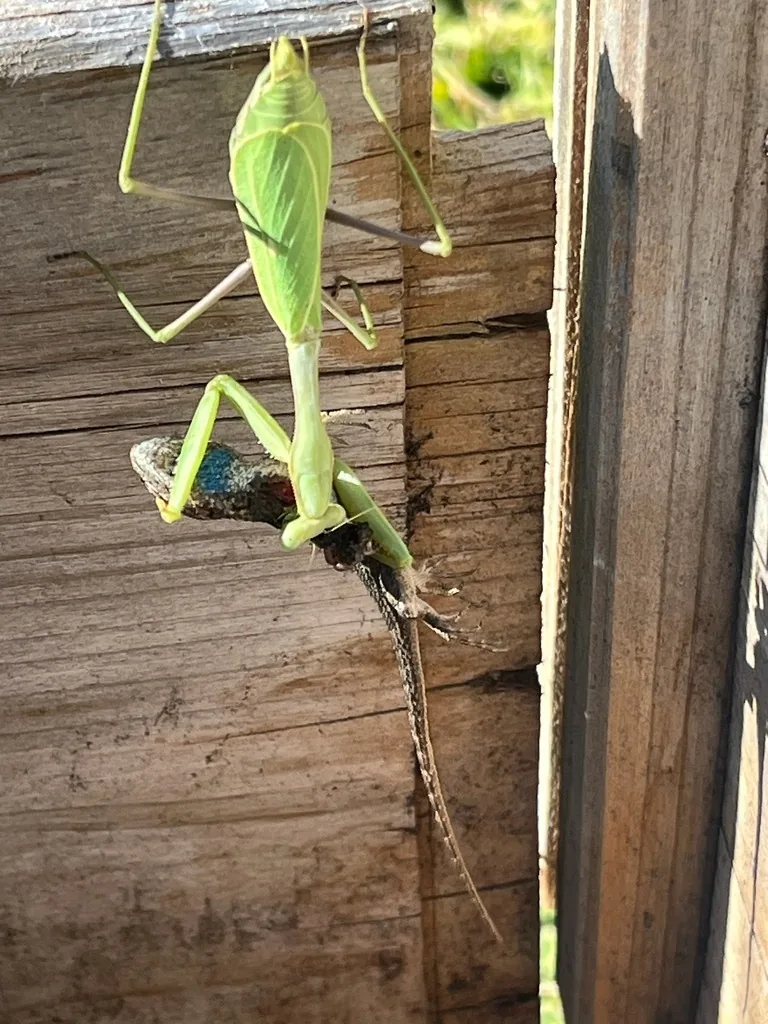
Mantids commonly wait on flowers for flying insects to arrive, then pounce. The Arizona mantis eats a wide range of insects and is itself eaten by spiders, birds, insect-eating mammals and other mantids.[1][2]
In a five-year study, longer females took longer prey and a wider range of prey sizes, carried more mature eggs, and laid heavier egg cases than shorter females. Longer females also reached adulthood earlier in the season.[3]
Nymphs shift somewhat toward the color of their surroundings as they develop, but the effect is small and variable, and adults do not choose resting spots that match their color.[2]
In the field, adult males move farther than females, and researchers suggest this difference in mobility may explain why the sexes are colored differently.[2]
Females sometimes kill and eat males during courtship, though UC IPM notes this does not happen in most matings and is not needed for egg laying. In field observations, individual males met two or more females, but no male was seen mating more than once.[1][4]
Damage and signs
- Like other mantids, it eats any insect it can catch, including beneficial and harmless insects such as bees, butterflies and syrphid flies.[1]
Health risk
It is an insect predator, and none of these sources describes any risk to people.[1][2]
Control
Prevention
No control is needed; it is a native predator. Do not count on it for pest control, though: UC IPM says mantids are of no benefit for biological pest control, because they eat beneficial insects as readily as pests, are relatively inactive, and each one eats relatively few insects.[1][2]
Biological control
The mantids sold by mail order and in some garden stores, UC IPM notes, are the introduced Chinese and Mediterranean mantids.[1]
Common questions
- Is the Arizona mantis the same as the bordered mantid?
- Yes. UC IPM lists Stagmomantis limbata as the Arizona or bordered mantid.[1]
- Can a female Arizona mantis fly?
- No. Adult females are flightless and stay put, while adult males have longer, working wings and fly in search of females.[2]
- Will mantids control pests in my garden?
- Not much. UC IPM says mantids are of no benefit for biological pest control: they eat bees, butterflies and syrphid flies as readily as pests, and each one eats relatively few insects.[1]
Sources
- University of California Statewide IPM Program, “Natural Enemies Gallery: Mantids, or Praying Mantises.” ipm.ucanr.edu/natural-enemies/mantids/ (accessed 2026-11-09)
- Ecology and Evolution (Wiley), full text in PubMed Central (PMC11705439), “Rosenheim, Rosenheim and Maxwell. Coloration in a Praying Mantis: Color Change, Sexual Color Dimorphism, and Possible Camouflage Strategies. Ecology and Evolution 15: e70398 (2025), doi:10.1002/ece3.70398.” doi.org/10.1002/ece3.70398 (accessed 2026-11-09)
- Environmental Entomology (Entomological Society of America), indexed in PubMed (PMID 24341955), “Maxwell and Frinchaboy. Consequences of intraspecific variation in female body size in Stagmomantis limbata (Mantodea: Mantidae): feeding ecology, male attraction, and egg production. Environmental Entomology 43: 91-101 (2014), doi:10.1603/EN12310 (abstract).” doi.org/10.1603/EN12310 (accessed 2026-11-09)
- Animal Behaviour (Elsevier), indexed in PubMed (PMID 9632486), “Maxwell. Lifetime mating opportunities and male mating behaviour in sexually cannibalistic praying mantids. Animal Behaviour 55: 1011-1028 (1998), doi:10.1006/anbe.1997.0671 (abstract).” doi.org/10.1006/anbe.1997.0671 (accessed 2026-11-09)
- iNaturalist, “Stagmomantis limbata taxon page (order and family).” www.inaturalist.org/taxa/121308 (accessed 2026-11-09)