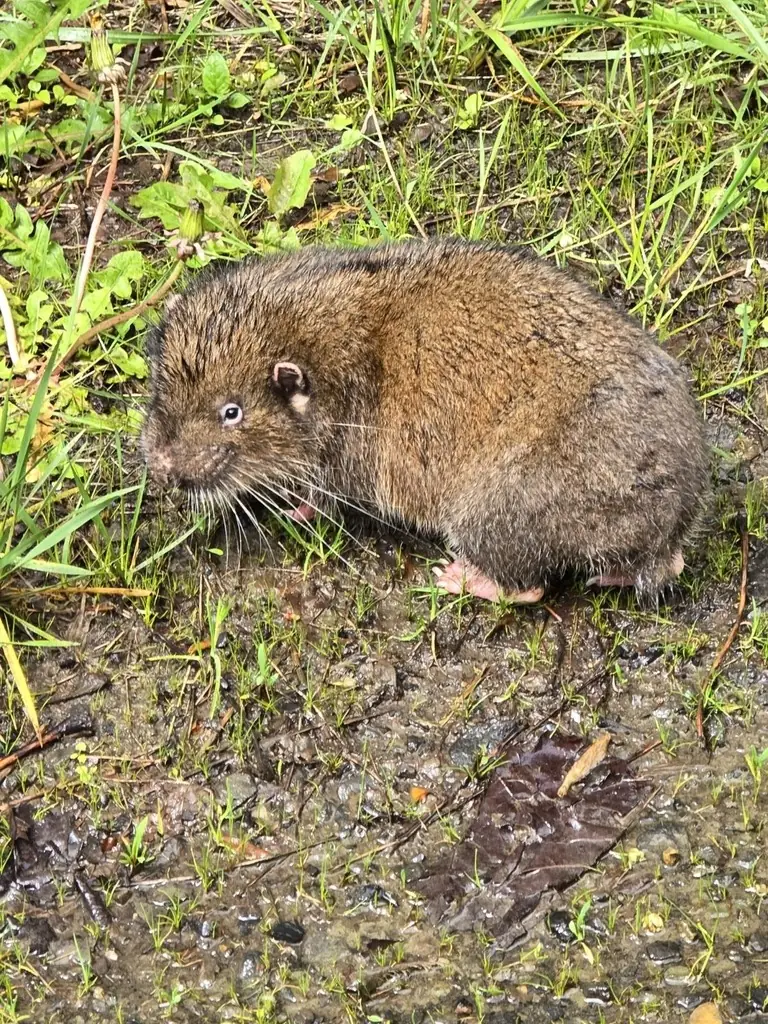
How to identify it
- A stocky rodent about 12 to 14 inches long that looks like an overgrown hamster or a tailless muskrat. Adults average about 2.3 pounds.[5][1][6]
- The tail is a stub about 1 inch long and often goes unnoticed.[1][6]
- Fur is grayish brown to reddish brown, with small eyes and ears, long silver whiskers, and a whitish spot of bare skin at the base of each ear.[1][6]
- The large, wide head joins the shoulders with no visible neck, and long curved front claws are built for digging, grasping and climbing.[1][5]
- Burrow openings are unusually large, about 6 to 8 inches across, often with dug-out soil and piles of clipped plants, called haystacks, nearby.[6][5]
Look-alikes
| Look-alike | How to tell them apart |
|---|---|
| Beavers | Despite the name, mountain beavers are not beavers. They got the name because they gnaw bark and cut limbs in a similar way, but they are small, nearly tailless land burrowers.[5][1] |
| Pocket gophers | Look for the mountain beaver's wide 6- to 8-inch tunnels, open entrances, soil kickouts and stacked plant haystacks; it also climbs shrubs and saplings to clip branches.[6][2][3] |
| Moles | Mountain beavers eat plants, so their tunnels come with clipped seedlings, stripped bark and piles of cut vegetation at the openings.[5][6] |
| Porcupines | Porcupines leave bark chips scattered under girdled trees and feed from the top down. Mountain beavers leave no chips and feed from the bottom up.[6][3][5] |
Where it lives
Found only in the Pacific coastal region, from southern British Columbia through western Washington and western Oregon into northern California and the Sierra Nevada. Numbers are highest in the Olympic Mountains and the Coast Range.[1][5][6]
Biology and life cycle
Mountain beavers live in moist forests and ferny slopes dominated by Douglas-fir and western hemlock, and sometimes in damp ravines in urban areas.[5][6][2]
Each animal digs its own burrow system with ten or more openings and chambers for nesting, food storage and droppings. Tunnels may run as deep as 10 feet.[5][6][2]
They are rarely seen above ground and are mostly active at night, feeding within about 50 feet of their burrows.[6][2]
They need about a third of their body weight in water each day, which they get mostly from the plants they eat.[6][5]
They are solitary except when breeding in late winter or early spring. Two to four young are born after about 30 days; females don't breed until about 2 years old.[5][2]
Sword fern and bracken fern are favorite foods, but they also eat salal, salmonberry, vine maple, alder and conifers.[2][5]
Damage and signs
- In forest plantings, mountain beavers clip conifer seedlings, mostly in winter and early spring, and girdle stems and roots of trees for up to about 20 years after planting.[3][6]
- Root girdling can kill trees with stems more than 6 inches in diameter and may let root diseases get established.[3]
- They climb shrubs and small trees to cut branches roughly 3/4 to 1 inch thick, leaving short stubs on the trunk.[2][5][6]
- Around homes they eat rhododendrons and other ornamental perennials, shrubs and trees. WDFW calls them more of an occasional garden nuisance than a long-term threat for homeowners.[5]
- Burrowing can undermine roadbeds, irrigation ditches and earthen dams and cause problems for livestock in pastures.[5]
Health risk
Mountain beavers are not a significant source of disease for people or pets. They bite hard and have very sharp claws, so never handle one. Wear rubber gloves around a dead one and wash your hands afterward.[5][6]
Control
Keep them out
Protect individual seedlings with solid, rigid plastic tubes. OSU notes mountain beavers can chew through mesh, and fencing cannot keep out a burrowing animal.[6][4]
Traps and physical control
Trapping is one of the most effective tools. Place traps in active main burrows, confirmed by fresh soil, clipped plants, tracks or cleared openings, rather than at surface openings.[6][4]
Live traps are recommended where pets may enter burrows. Set double-door cage traps level in a main burrow, cover them, and check them at least once or twice a day.[4][6]
Expect new animals to move into empty burrows. Follow-up trapping is needed, and WDFW suggests concentrating effort in late winter before young are born.[5][4][6]
Pesticides
Repellents are not recommended because mountain beavers clip plants rather than browse them. Fumigants don't work in their open, well-ventilated burrows, and none are registered.[6][4]
When to call a professional
An anticoagulant bait (chlorophacinone) is registered in western Oregon and Washington, but only for certified applicators. A wildlife damage control company can trap for you.[6][5]
Legal status and trapping rules
Mountain beavers are generally unprotected nongame animals, but one subspecies in Mendocino County, California, is federally listed as endangered.[1][6]
In Washington, they may be trapped or killed year-round, but any trap other than a live trap requires a special trapping permit from WDFW.[5][6]
Washington also prohibits releasing a mountain beaver anywhere except the property where it was legally trapped without a permit. Rules change, so check with your state wildlife agency first.[5][6]
Common questions
- Is a mountain beaver a real beaver?
- No. It is a primitive burrowing rodent more closely related to squirrels, named for the way it gnaws bark and cuts branches.[5][1]
- How do I know mountain beavers are causing the damage?
- Look for wide 6- to 8-inch burrow openings, soil kickouts, stacked cut plants and stems clipped at a clean angle. Their droppings stay underground, so scat at the site points elsewhere.[6][5]
- Will removing them solve the problem for good?
- Usually not. Others move into vacant burrow systems when good habitat remains, so plan on ongoing monitoring and follow-up trapping.[5][2][6]
Sources
- Internet Center for Wildlife Damage Management, “Mountain Beavers: Identification.” icwdm.org/mountain-beavers/ (accessed 2026-10-06). Run by university wildlife damage specialists (maintained at the University of Wisconsin-Stevens Point); species modules are based on Prevention and Control of Wildlife Damage (University of Nebraska Cooperative Extension, 1994).
- Internet Center for Wildlife Damage Management, “Mountain Beaver Biology.” icwdm.org/mountain-beavers/mountain-beaver-biology/ (accessed 2026-10-06). Run by university wildlife damage specialists (maintained at the University of Wisconsin-Stevens Point); species modules are based on Prevention and Control of Wildlife Damage (University of Nebraska Cooperative Extension, 1994).
- Internet Center for Wildlife Damage Management, “Mountain Beaver Damage Identification.” icwdm.org/mountain-beavers/mountain-beaver-damage-identification/ (accessed 2026-10-06). Run by university wildlife damage specialists (maintained at the University of Wisconsin-Stevens Point); species modules are based on Prevention and Control of Wildlife Damage (University of Nebraska Cooperative Extension, 1994).
- Internet Center for Wildlife Damage Management, “Mountain Beaver Damage Prevention and Control Methods.” icwdm.org/mountain-beavers/mountain-beaver-damage-prevention-and-control-methods/ (accessed 2026-10-06). Run by university wildlife damage specialists (maintained at the University of Wisconsin-Stevens Point); species modules are based on Prevention and Control of Wildlife Damage (University of Nebraska Cooperative Extension, 1994).
- Washington Department of Fish and Wildlife, “Mountain beaver (Aplodontia rufa): species and living with wildlife.” wdfw.wa.gov/species-habitats/species/aplodontia-rufa (accessed 2026-10-06)
- Oregon State University Extension Service, “Identifying and Managing Mountain Beaver Damage to Forest Resources (EM 9063, J. Taylor, D. Sphar and G. Ahrens, 2013).” extension.oregonstate.edu/sites/default/files/documents/em9063.pdf (accessed 2026-10-06)
- iNaturalist, “Aplodontia rufa taxon page (order and family).” www.inaturalist.org/taxa/43736 (accessed 2026-10-06)