On this page
How to identify it
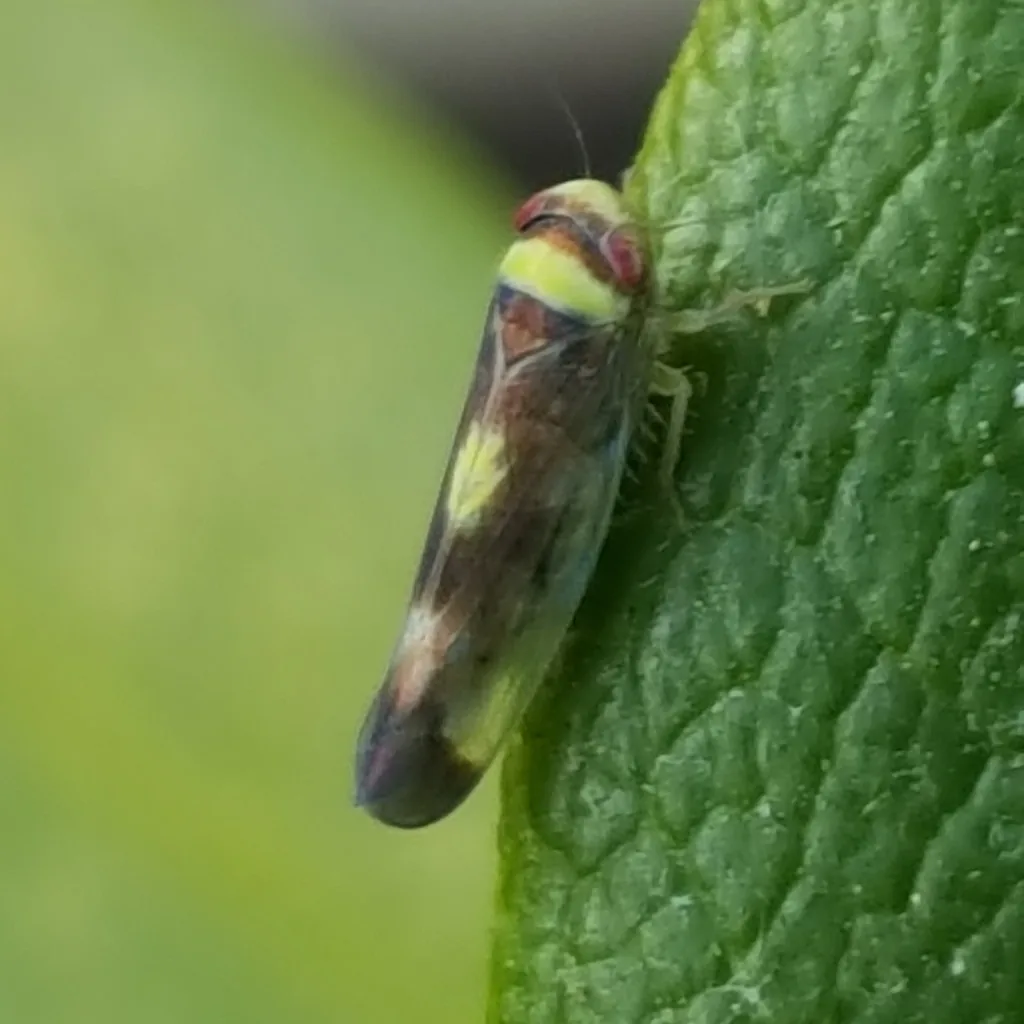
- A slender, dark brown leafhopper with red eyes, a yellow band behind the head and a yellow spot in the center of each wing.[1]
- Like other orchard leafhoppers it is about 1/8 inch long or less; adults hop or fly off when disturbed, and nymphs and adults can run sideways.[3]
- It is more active and travels farther in search of hosts than the cherry leafhopper.[2]
Look-alikes
| Look-alike | How to tell them apart |
|---|---|
| Cherry leafhopper | Also dark brown and also an X-disease carrier, but UC IPM describes it as shaped and colored like a plant bud. It prefers cherry as a host and is less active, not traveling as far.[2] |
Where it lives
UC IPM covers it in California cherry orchards, and the Pacific Northwest handbook lists it first among the leafhoppers in that region's cherries. In Washington, researchers name a form they call Colladonus montanus reductus as the main X-disease vector.[1][3][4]
Biology and life cycle
It spends the winter on herbaceous plants such as alfalfa, clovers and weedy sugarbeet fields.[1]
When those fields are cut in spring, the leafhoppers move into nearby orchards and can spread through an orchard within a few days. A second peak may show up in late July.[1]
It does not prefer cherry trees. It breeds on orchard-floor weeds such as curly dock, California burclover and sweetclovers.[1]
Leafhopper numbers in cherry orchards tend to peak after harvest, when the X-disease phytoplasma is most concentrated in infected trees.[3]
Damage and signs
- It picks up the X-disease agent by feeding on diseased cherry trees or infected weeds such as clover, and may then infect healthy cherry trees.[1]
- Trees with X-disease can bear small, misshapen, bitter fruit. There is no cure, and infected trees should be removed.[3]
- A recent X-disease outbreak has severely harmed stone fruit production in the Pacific Northwest.[4]
Health risk
The sources describe it only as a carrier of a plant disease; none mentions any risk to people or pets.[1][3][4]
Control
Prevention
Yellow sticky cards hung in the canopy during the growing season show when leafhoppers are present; no action threshold has been set.[3]
Sanitation
Control weeds and other alternative hosts in and around the orchard, such as clovers, mallow, dandelion, curly dock, bitter cherry and chokecherry.[3][1]
Remove X-disease-infected trees right after an insecticide treatment, so the leafhoppers on them are killed before the trees come out.[1][3]
Pesticides
UC IPM recommends treating right after harvest and again at 4- to 6-week intervals, depending on how long the material lasts. In Washington laboratory tests, pyrethroids and neonicotinoids were the most effective, and cherry leaves treated with kaolin clay or diatomaceous earth carried 80% to 90% fewer leafhoppers, though the repellent clays still need field testing.[1][4]
Common questions
- Does the mountain leafhopper breed on my cherry trees?
- No. It prefers clovers, alfalfa and orchard-floor weeds such as curly dock and burclover, and moves into orchards when nearby fields are cut in spring.[1]
- How does it spread X-disease?
- It picks up the X-disease agent while feeding on infected cherry trees or weeds such as clover, then can infect healthy cherry trees it feeds on later.[1]
- How is it different from the cherry leafhopper?
- The mountain leafhopper has red eyes, a yellow band behind the head and yellow wing spots, and it roams farther. The cherry leafhopper is bud-shaped and prefers cherry.[1][2]
Sources
- University of California Statewide IPM Program, “Mountain Leafhopper, UC IPM Pest Management Guidelines: Cherry.” ipm.ucanr.edu/agriculture/cherry/mountain-leafhopper (accessed 2026-11-09)
- University of California Statewide IPM Program, “Cherry Leafhopper, UC IPM Pest Management Guidelines: Cherry.” ipm.ucanr.edu/agriculture/cherry/cherry-leafhopper (accessed 2026-11-09)
- Pacific Northwest Pest Management Handbooks (Oregon State University, Washington State University and University of Idaho Extension), “Cherry-Leafhopper, Pacific Northwest Insect Management Handbook.” pnwhandbooks.org/insect/tree-fruit/cherry/cherry-leafhopper (accessed 2026-11-09)
- Entomological Society of America (Journal of Economic Entomology), “Marshall AT, Catron KA, Orpet RJ, Curtiss RT, Northfield TD, Nottingham LB. Insecticide and repellent tests on Washington leafhopper vectors of cherry X-disease. Journal of Economic Entomology 118(6):2699-2709 (2025) (abstract).” doi.org/10.1093/jee/toaf247 (accessed 2026-11-09)
- iNaturalist, “Colladonus montanus taxon page (order and family).” www.inaturalist.org/taxa/479015 (accessed 2026-11-09)