On this page
How to identify it
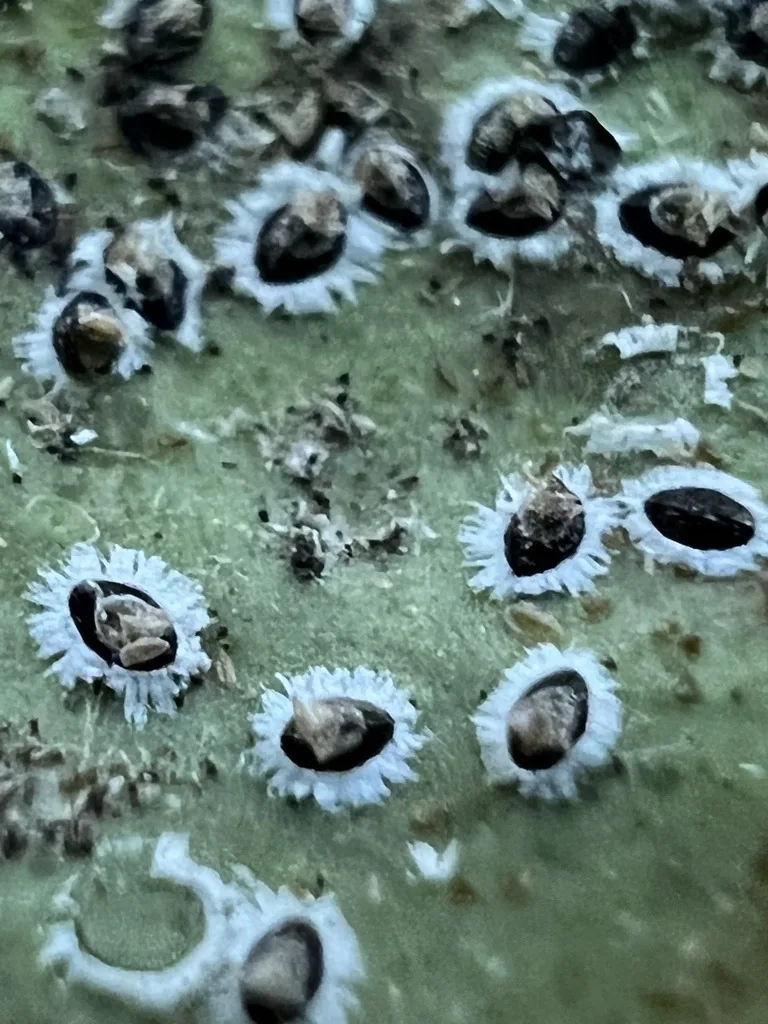
- The late-stage nymphs, called pupae, are round to oval, shiny black and ringed with a white wax fringe that lies out flat rather than curling over the body; they are often mistaken for scale insects.[1][2][3]
- Adults are tiny and pale gray with darker gray or reddish spots and jagged lines on the forewings, including a blotch at the base and tip of each wing.[1][3]
- Young crawlers are tiny and yellow; once they settle they stay in one spot until the adult emerges.[1]
Look-alikes
| Look-alike | How to tell them apart |
|---|---|
| Armored and soft scales | Scales can look similar from a distance, but mulberry whitefly pupae have the distinctive white fringe and give rise to tiny winged adults.[2][1] |
| Redbanded whitefly | On avocado in California, the redbanded whitefly's pupal fringe curls over the body, while the mulberry whitefly's extends out flat.[3] |
Where it lives
It turns up on shrubs and trees in North Carolina and Ohio landscapes and on avocado in California.[1][2][3]
Biology and life cycle
Females insert just the tip of each egg into the underside of a leaf, and crawlers hatch about two weeks later.[1]
Nymphs feed in one spot, growing larger and darker with each molt, and the new adult emerges a month or more after the crawler settles.[1]
It has multiple, sometimes overlapping, generations a year.[2]
Hosts include American holly, avocado, boxelder, citrus, flowering dogwood, mountain laurel, mulberry, Norway and red maple, Virginia sweetspire and wax myrtle.[1]
Damage and signs
Health risk
It feeds only on plant sap; NC State, Ohio State and UC IPM mention no risk to people.[1][2][3]
Control
Biological control
Whiteflies have many predators, parasites and diseases, and treatment is probably unnecessary unless they become tremendously abundant.[1]
Pesticides
If treatment is needed, insecticidal soaps work well on the adults and horticultural oils give some control of the nymphs; the mulberry whitefly is not particularly resistant to pesticides.[1]
Common questions
- What are the black spots with white fringes under my holly leaves?
- Most likely mulberry whitefly pupae, the late nymph stage, which are often mistaken for scale insects.[2][1]
- Do I need to spray for mulberry whitefly?
- Usually not. NC State calls it more a curiosity than a pest and suggests treating only if it becomes tremendously abundant.[1]
Sources
- NC State Extension, “Mulberry Whitefly (PDIC Factsheet).” content.ces.ncsu.edu/mulberry-whitefly (accessed 2026-10-19)
- Ohio State University Extension, “Mulberry Whitefly "Pupae" Can Present an ID Challenge (Buckeye Yard & Garden onLine).” bygl.osu.edu/index.php/node/763 (accessed 2026-10-19)
- University of California Statewide IPM Program, “Whitefly species that occur on avocado in California (identification figure).” ipm.ucanr.edu/PMG/FIG/avo-whiteflies.html (accessed 2026-10-19)
- iNaturalist, “Tetraleurodes mori taxon page (order and family).” www.inaturalist.org/taxa/493763 (accessed 2026-10-06)