On this page
How to identify it
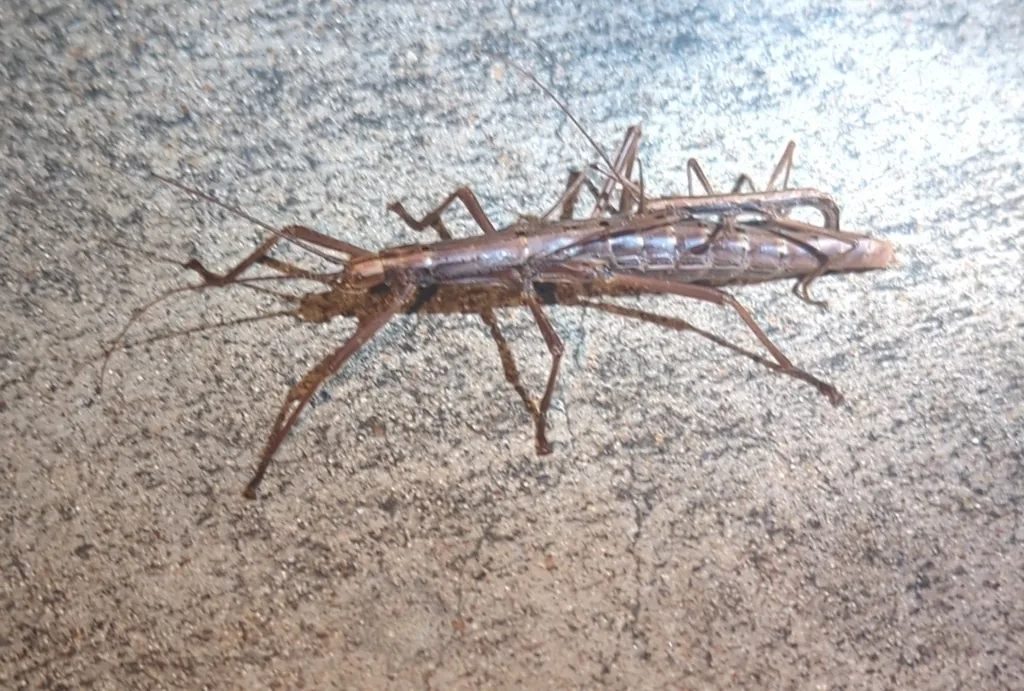
- It is tan to brownish yellow and chunkier than other stick insects, with a stripe down the middle of the back and fainter side stripes.[2]
- Females are much larger than males: MDC gives 2 to 2 1/4 inches for females and 1 to 1 1/2 inches for males, while NC State gives about 4 inches for females.[1][2]
- It is usually seen as a pair, with the small male riding on the larger female's back.[1][2]
Look-alikes
| Look-alike | How to tell them apart |
|---|---|
| Southern two-striped walkingstick | A Gulf Coast species that is larger and darker, with three sharp black stripes and a head longer than wide.[2] |
| Northern walkingstick | Thinner stick insects; two-striped walkingsticks are chunkier.[2] |
Where it lives
Ranges from Texas and Kansas to Georgia and Virginia but is absent from Florida; in Missouri most common in the south.[2]
Biology and life cycle
It feeds and grows unseen in trees and shrubs in summer, then gathers in open areas to mate in late summer and fall.[1][2]
NC State says eggs are laid in a dense mass on bark and other objects; MDC says females apparently lay them in the soil.[1][2]
Damage and signs
Health risk
When pinched, poked or handled it squirts a milky, irritating fluid aimed at the eyes that causes intense pain; flush the eye with water at once, and get medical care for blurred vision, light sensitivity or other severe symptoms.[1][2]
Control
Prevention
Leave musk mares alone and do not handle or examine them closely.[1][2]
Pesticides
Control is rarely needed; NC State notes late-fall adults are hard to kill because cool weather slows insecticides.[1][2]
Common questions
- Can a walkingstick hurt my eyes?
- Yes; musk mares aim an irritating spray at the eyes when threatened, causing intense pain.[1][2]
- Why are two stick bugs stuck together?
- Musk mares are usually seen as mating pairs, with the small male riding the female, and mating can take several days.[2]
- What if my dog is sprayed?
- MDC cites a report of a dog with an ulcerated cornea after exposure, though the injury may have been self-inflicted from the pain.[2]
Sources
- NC State Extension, “Northern Twostriped Walkingstick (PDIC Factsheet).” content.ces.ncsu.edu/northern-two-striped-walkingstick (accessed 2026-10-16)
- Missouri Department of Conservation, “Northern Two-Striped Walkingstick (Musk Mare) (Field Guide).” mdc.mo.gov/discover-nature/field-guide/northern-two-striped-walkingstick-musk-mare (accessed 2026-10-16)
- iNaturalist, “Anisomorpha ferruginea taxon page (order and family).” www.inaturalist.org/taxa/416291 (accessed 2026-10-06)