On this page
How to identify it
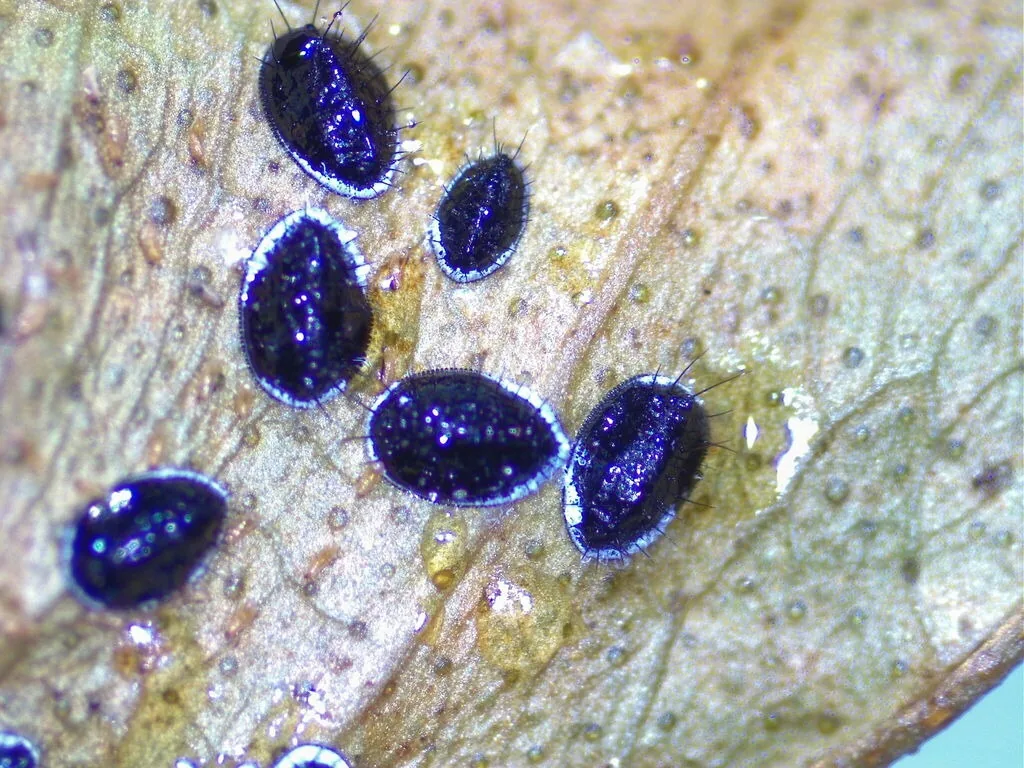
- The pupa (last nymphal stage) is oval, jet black and convex, with strong, dark spines on its back and a short, compact fringe of white, cottony wax around the edge.[1]
- Younger nymphs are oval and brown to black with a short wax fringe; in the second and third stages each side of the back carries a row of strong, heavy spines.[1]
- Eggs are tiny (0.2 by 0.1 mm), yellow and curved, and stand upright on short stalks on the leaf.[1]
- Adults are slate blue and can't be told apart from citrus blackfly adults.[1]
Look-alikes
| Look-alike | How to tell them apart |
|---|---|
| Citrus blackfly | The pupae are very similar, and the adults are indistinguishable. In the field, the white wax fringe around an orange spiny whitefly pupa is generally about twice as large as citrus blackfly's. Whitefly species are identified mainly from features of the pupa.[1] |
Where it lives
Native to tropical Asia, it has spread to Africa, Australia, the Caribbean and the Pacific islands, and in Europe to restricted areas of Italy and Greece. It was found on Oahu in 1974, and surveys in 2022 found citrus whitefly infestations in Hawaii very low. UF's 2005 fact sheet reported no established populations in the continental United States.[1][2][3]
Biology and life cycle
Like other whiteflies it develops through egg, a mobile crawler, two settled nymphal stages, a pupa and the winged adult. Mild temperatures and high humidity suit it best.[1]
Generations per year depend on climate: about four in Japan, five or six on Guam, and up to seven under ideal lab conditions.[1]
It feeds on plants in 38 families. Citrus is its best-known host, and it has also been found on rose, grape, peach, pear and guava; in Hawaii it was first detected on rose foliage in Honolulu and later on orange, lime, tangerine and pear.[2][1]
It moves between regions on nursery stock, infested fruit and cut branches or flowers.[1][2]
Damage and signs
- It sucks sap from the leaves, and the honeydew it excretes grows sooty mold that can cover leaves, fruit and branches and cut photosynthesis. Heavy infestations weaken the tree.[1]
- UF warned that citrus fruit quality and yield could suffer if it reached Florida, and that it also threatens ornamental plants there.[1]
Health risk
The sources treat it only as a plant pest; none mentions bites or other risk to people or pets.[1][2]
Control
Prevention
Infested nursery stock, fruit and cut plant material are the main ways it spreads, and sourcing host plants from pest-free areas is one of the main ways to keep it out.[1][2]
Biological control
Imported parasitic wasps have controlled outbreaks in Japan, Guam and southern Africa. In Hawaii two Amitus and three Encarsia species were released between 1974 and 1999, and in 2022 the dominant parasite was Encarsia perplexa, with parasitism rates of 11 to 65% on Oahu.[1][3]
Encarsia opulenta and Amitus hesperidum, the wasps that keep citrus blackfly in check in Florida, might also control orange spiny whitefly if it arrived.[1]
Pesticides
Low-concentration petroleum oil sprays gave acceptable control on sweet orange and pummelo in China, but UF notes that chemical control in general hasn't proven effective against this or other whiteflies in crops.[1]
Common questions
- Is orange spiny whitefly in the mainland United States?
- As of UF's 2005 fact sheet, no established populations were known in the continental United States. It has been in Hawaii since 1974.[1]
- How can I tell it from citrus blackfly?
- Only with difficulty. The adults look the same; on pupae, orange spiny whitefly's white wax fringe is generally about twice as large.[1]
- Does spraying control it?
- Natural enemies have done far better than insecticides: introduced parasitic wasps brought it under control in several countries, while chemical control of whiteflies in crops has generally not worked well.[1][3]
Sources
- University of Florida IFAS Extension (EDIS Featured Creatures), “Orange Spiny Whitefly, Aleurocanthus spiniferus Quaintance (EENY341, 2005).” journals.flvc.org/edis/article/view/114920 (accessed 2026-11-09)
- European Food Safety Authority (EFSA Journal), “Pest categorisation of Aleurocanthus spp. (EFSA Panel on Plant Health 2018, EFSA Journal 16: e05436; PubMed abstract).” doi.org/10.2903/j.efsa.2018.5436 (accessed 2026-11-09)
- MDPI (Insects), “A survey in Hawaii for parasitoids of citrus whiteflies, for introduction into Greece (Giakoumaki et al. 2023, Insects 14: 858; PubMed abstract).” doi.org/10.3390/insects14110858 (accessed 2026-11-09)
- iNaturalist, “Aleurocanthus spiniferus taxon page (order and family).” www.inaturalist.org/taxa/514346 (accessed 2026-11-09)