On this page
How to identify it
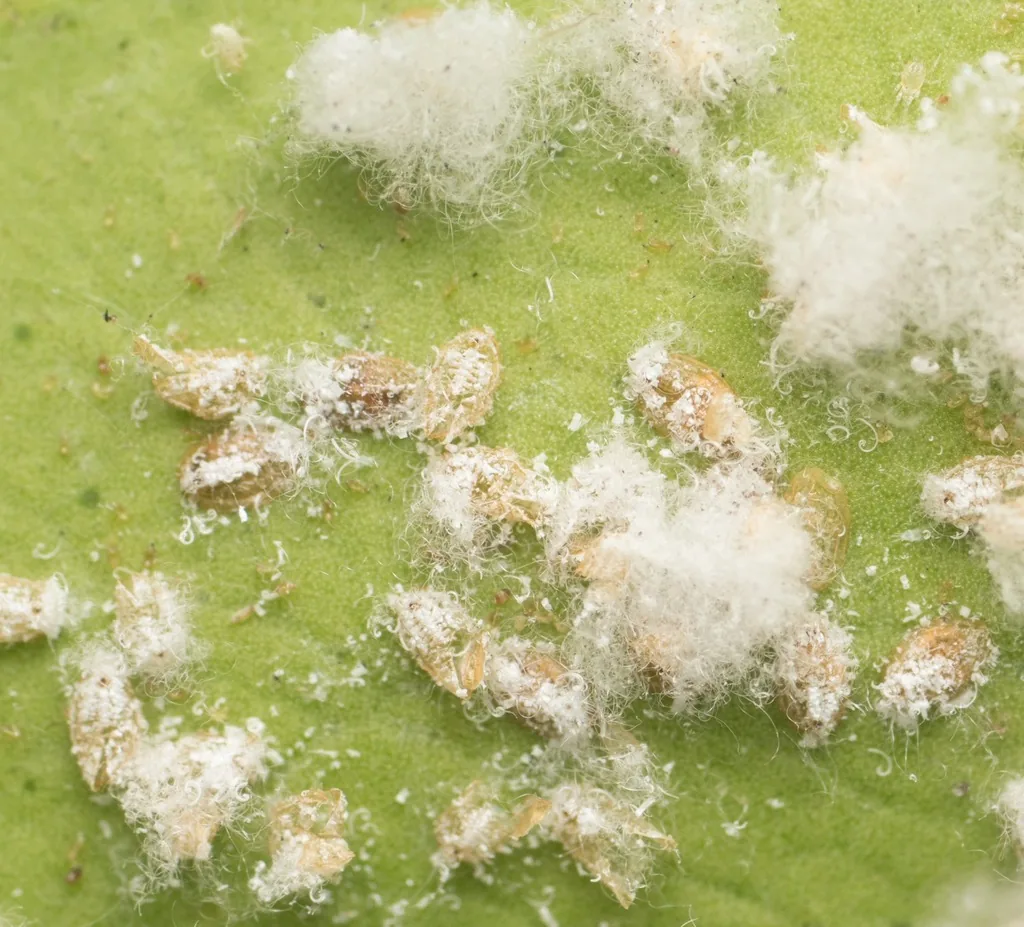
- The nymphs, which sit fixed on the undersides of leaves, are covered with fluffy, waxy filaments. That woolly wax is the easiest way to recognize this whitefly.[2][4]
- Adults are tiny and white, like other whiteflies, and fly up when the plant is disturbed.[2]
- Look for sticky honeydew on leaves and fruit or black sooty mold growing on it.[2][3][4]
- Parasitized pupae turn blackish to orangish as the wasp larva inside grows, and the adult wasp leaves a round exit hole in the empty whitefly case.[1]
Look-alikes
| Look-alike | How to tell them apart |
|---|---|
| Citrus whitefly | Citrus whitefly is another of Florida's main citrus whiteflies; the woolly whitefly is the one whose nymphs wear fluffy wax filaments.[3][2] |
| Other whiteflies | UC IPM's table of common whiteflies sorts the species mostly by their last-stage nymphs; on citrus and eugenia, nymphs covered in fluffy wax point to woolly whitefly.[2] |
Where it lives
Probably of Neotropical origin, it has spread around the world. It invaded California from Mexico in the 1960s, is among the most important whiteflies in Florida citrus, and has also been introduced to southern Europe and Ethiopia.[4][1][3][5]
Biology and life cycle
UC IPM lists citrus and eugenia as hosts and says it infests a wide range of crops and ornamentals, though citrus is where it has mattered most. In Ethiopia it infests all types of citrus.[2][1][5]
Like other whiteflies, females lay eggs on leaf undersides. The young pass through four nymphal stages: the first (the crawler) moves around for a few hours, and the later ones stay put like tiny scales until the winged adult emerges.[2]
Whiteflies in citrus depend on new growth and are active only while the trees are flushing. In Ethiopian groves, adults and eggs were much more numerous on newly grown leaves than on older ones.[3][5]
Damage and signs
- Nymphs and adults suck sap and drip honeydew, and large populations coat leaves and fruit with honeydew and sooty mold. Heavy whitefly feeding can make leaves yellow, look dry or drop.[3][2][4]
- The honeydew draws ants, which protect whiteflies from their natural enemies.[2][5]
- In Florida groves it is usually present only in very low numbers, and populations rarely need treatment unless biological control has been disrupted.[3]
Health risk
The sources treat it only as a plant pest; none mentions bites, stings or other risk to people or pets.[2][1][3]
Control
Prevention
Keep ants out of infested plants, since they shield whiteflies from natural enemies, and don't use pesticides while natural enemies are active. Florida's citrus guide says a serious whitefly infestation is a sign that management practices should be reviewed.[2][3]
Traps and physical control
For garden plants, UC IPM suggests hosing adult whiteflies off with a strong stream of water.[2]
Biological control
Two parasitic wasps brought in during the late 1960s and 1970, Amitus spiniferus from Mexico and Cales noacki from Chile, keep woolly whitefly under complete biological control in California, except when very cold or hot weather or broad-spectrum, persistent insecticides disrupt them. In Florida, parasitoids, general predators and the fungus Aschersonia aleyrodis normally keep whiteflies at low levels.[1][3]
Pesticides
Sprays work poorly on this species: the nymphs' wax filaments and honeydew keep insecticides from reaching them. If you do treat, UC IPM recommends products least harmful to natural enemies, such as insecticidal soaps and oils, with good coverage of leaf undersides and repeat applications as needed.[4][2]
Common questions
- What is the fluffy white stuff under my citrus leaves?
- If it is made of small, fixed nymphs wrapped in fluffy wax filaments, with honeydew or sooty mold nearby, it is likely woolly whitefly.[2][3]
- Do I need to spray woolly whitefly?
- Usually not. Parasitic wasps keep it under complete biological control in California and normally keep it low in Florida citrus. Outbreaks generally follow disruption by broad-spectrum insecticides, ants or extreme heat or cold.[1][3][2]
- How can I tell if parasitic wasps are already working?
- Check the older, pupal-stage nymphs. Parasitized ones look blackish to orangish, and empty cases with round exit holes mean wasps have already emerged.[1]
Sources
- University of California Statewide IPM Program, “Natural Enemies Gallery: Woolly Whitefly Amitus Parasitoid.” ipm.ucanr.edu/natural-enemies/woolly-whitefly-amitus-parasitoid/ (accessed 2026-11-09)
- University of California Statewide IPM Program, “Pest Notes: Whiteflies (UC ANR Publication 7401).” ipm.ucanr.edu/home-and-landscape/whiteflies/ (accessed 2026-11-09)
- University of Florida IFAS Extension (EDIS), “2026-2029 Florida Citrus Production Guide: Soft-Bodied Insects Attacking Foliage and Fruit (CPG vol. 1 ch. 24).” journals.flvc.org/edis/article/view/133504 (accessed 2026-11-09)
- MDPI (Insects), “Melone G et al. The parasitoid complex of Aleurothrixus floccosus (Hemiptera: Aleyrodidae) in the citrus groves of central-southern Italy. Insects 16(10):1037 (2025) (abstract).” doi.org/10.3390/insects16101037 (accessed 2026-11-09)
- Entomological Society of America (Journal of Economic Entomology), “Belay DK, Zewdu A, Foster JE. Ecology and management of the woolly whitefly (Hemiptera: Aleyrodidae), a new invasive citrus pest in Ethiopia. Journal of Economic Entomology 104(4):1329-1338 (2011) (abstract).” doi.org/10.1603/ec11017 (accessed 2026-11-09)
- iNaturalist, “Aleurothrixus floccosus taxon page (order and family).” www.inaturalist.org/taxa/330176 (accessed 2026-11-09)