On this page
How to identify it
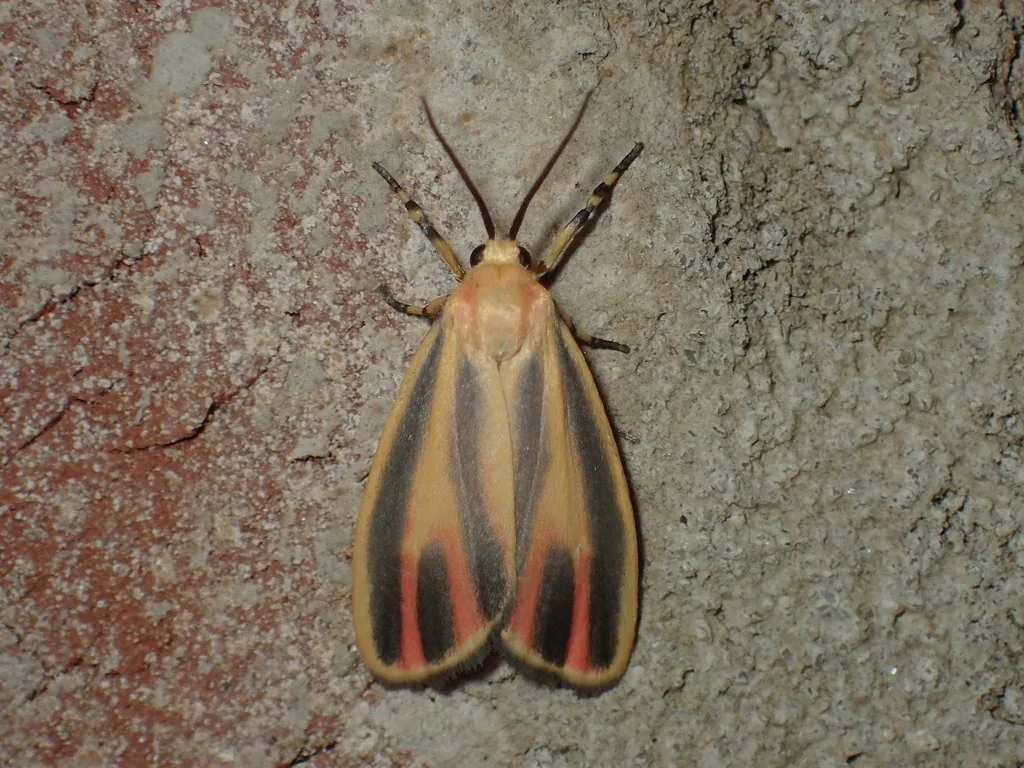
- The forewings are red-orange, more yellowish toward the head, with three dark gray stripes: a broad one along the leading edge, another broad one along the inner edge, and a thinner one between them where the two spread apart toward the outer edge.[1]
- The hindwings are pinkish with a wide dark band along the outer edge. Missouri gives the wingspan as 1 to 1 1/2 inches; Ohio gives 1.0 to 1.2 inches. Ohio adds that at first glance the moth might suggest a brightly colored beetle.[1][4]
- Caterpillars are brown with yellow markings and carry many black warts with spinelike hairs.[1]
- Tiger moth caterpillars that feed on lichens and algae, like this one, may lack the dense hair of their relatives; instead they have stout, barbed spines and a comb at the rear end used to flick droppings away from the feeding site.[2]
Look-alikes
| Look-alike | How to tell them apart |
|---|---|
| Scarlet-winged lichen moth | Ohio has only these two Hypoprepia lichen moths. The scarlet-winged has much more prominent red veins on the wings and an entirely red head and thorax. Its caterpillar is the closest match: the painted lichen moth's caterpillar is smaller, with less yellow and a fainter line down the middle of the back.[4][2] |
Where it lives
A 2018 paper on the genus places it in eastern and central North America. Missouri reports it statewide, in woods and places near forests, and Ohio in wooded areas with plenty of large trees and lots of lichens. GBIF's public U.S. records since 1990 (about 14,200) come from 37 states on the map, most from Texas, New York and North Carolina.[5][1][4][7]
Biology and life cycle
The moths are active at night and come to lights. In Missouri they probably fly from May through September.[1]
The caterpillars graze lichens on trees and rocks, along with mosses and algae on trees; the USDA Forest Service lists terrestrial algae and lichens on tree trunks as lichen moth caterpillar food. Ohio notes that no one seems to have studied whether the larvae favor particular lichen species.[1][2][4]
It spends the winter as a caterpillar, and the caterpillars that survive the winter pupate the following spring.[1]
Lichen moth caterpillars have an enlarged grinding region on the jaw that is thought to be linked to their lichen diet.[5]
Many moths in its family wear bright colors that advertise distasteful chemicals; after sampling a few, predators learn to avoid those colors. Lichen moths can carry lichen chemicals: a 1995 survey found lichen compounds in 24 of 103 wild-caught tiger moths, from 11 of 16 species, though the authors say their role is unknown, while the 2018 paper suggests they give some chemical protection.[1][6][5]
Damage and signs
Health risk
The caterpillars are spiny, and the Missouri Department of Conservation cautions that the spines and hairs of many moth caterpillars can irritate skin, so handle them carefully.[1]
Control
Prevention
None of the sources recommends any control. Missouri lists it as a breeding resident of woodlands whose caterpillars feed on lichens, mosses and algae.[1][2][4]
Common questions
- What is the orange moth with gray stripes by my porch light?
- If it has red-orange forewings with three dark gray stripes and pinkish hindwings, it is likely a painted lichen moth, a night-flying woodland moth that is attracted to lights.[1]
- What do painted lichen moth caterpillars eat?
- Lichens growing on trees and rocks, plus mosses and algae on trees.[1][2]
- How can I find the caterpillars?
- The USDA Forest Service notes that lichen moth caterpillars can be collected using burlap bands. They feed on algae and lichens, especially on tree trunks.[2]
- Are painted lichen moths common?
- Ohio says lichen moths are not commonly encountered; painted lichen moths turn up at night-lights now and then, which is where most people notice them.[4]
Sources
- Missouri Department of Conservation, “Painted Lichen Moth (Field Guide).” mdc.mo.gov/discover-nature/field-guide/painted-lichen-moth (accessed 2026-11-11)
- USDA Forest Service, Forest Health Technology Enterprise Team, “Caterpillars of Eastern Forests, FHTET-96-34 (D. L. Wagner, V. Giles, R. C. Reardon and M. L. McManus, November 1997; scanned copy).” archive.org/details/caterpillarsofea001997 (accessed 2026-11-11)
- iNaturalist, “Hypoprepia fucosa taxon page (order and family).” www.inaturalist.org/taxa/119953 (accessed 2026-11-11)
- Ohio Department of Natural Resources, Division of Wildlife, “Moths of Ohio Field Guide (Publication 5467).” dam.assets.ohio.gov/image/upload/ohiodnr.gov/documents/wildlife/backyard-wildlife/Moths%20of%20Ohio%20Field%20Guide%20pub5467.pdf (accessed 2026-11-11)
- ZooKeys, via PubMed Central, “A new species of Hypoprepia from the mountains of central Arizona (Palting, Ferguson and Moore 2018).” pmc.ncbi.nlm.nih.gov/articles/PMC6189220/ (accessed 2026-11-11). Cited from the open-access full text.
- Journal of Chemical Ecology, via PubMed, “Sequestration of lichen compounds by lichen-feeding members of the Arctiidae (Hesbacher et al. 1995).” pubmed.ncbi.nlm.nih.gov/24233908/ (accessed 2026-11-11). Cited from the PubMed abstract.
- Global Biodiversity Information Facility (GBIF), “Hypoprepia fucosa: occurrence records in the U.S., 1990-2026 (GBIF occurrence search).” api.gbif.org/v1/occurrence/search?taxonKey=1806737&country=US&hasGeospatialIssue=false&occurrenceStatus=PRESENT&year=1990%2C2026&facet=stateProvince&facetLimit=400&limit=0 (accessed 2026-11-11). State counts are records reported (iNaturalist research-grade, museum specimens, surveys), not abundance.