On this page
How to identify it
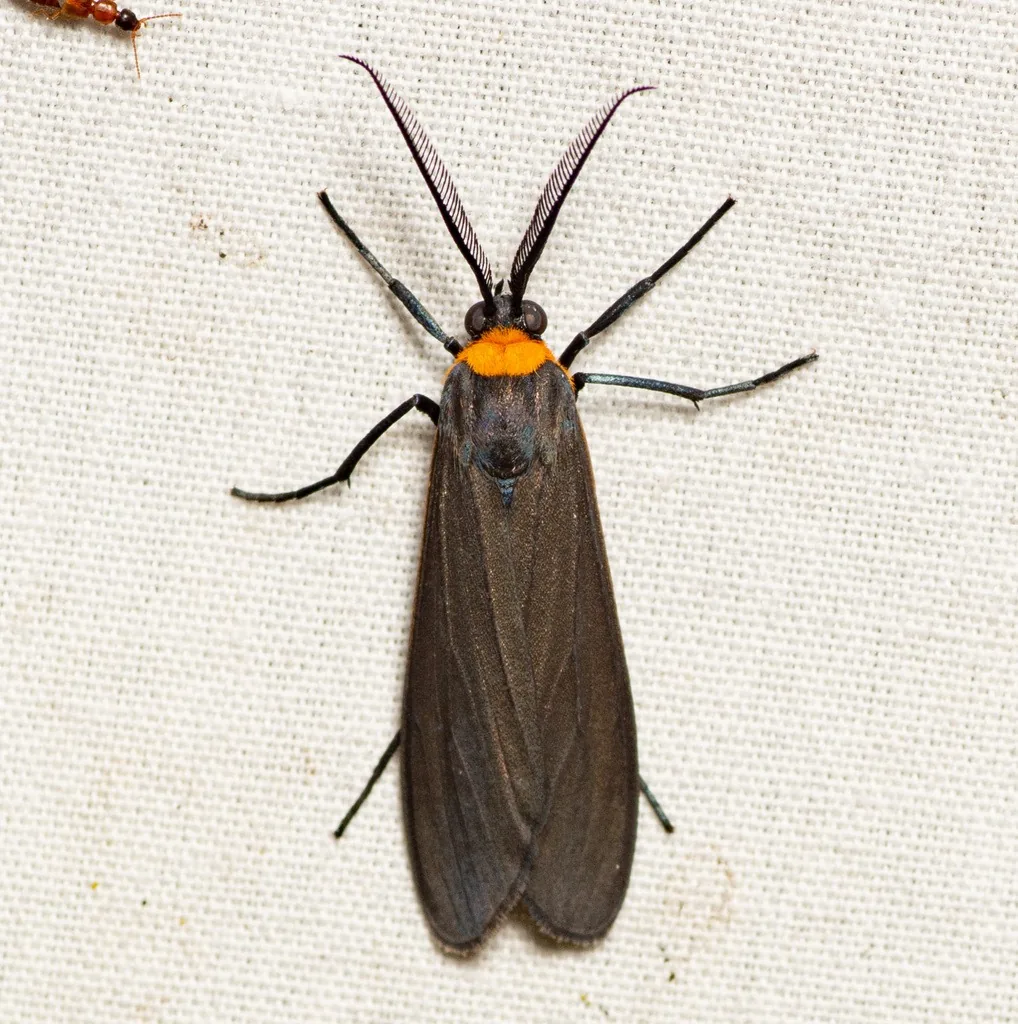
- Adults have black forewings and a black or bluish-black body, set off by a bright orange or yellow collar behind the head. The head itself is black. The University of Arkansas notes a yellow streak along the outer basal half of the forewing and says the collar is more yellow in the Midwest.[1][2]
- The wingspan is 1 to 1 1/2 inches (MDC; Ohio DNR gives 1.1 to 1.5), and the body is about 3/4 inch long.[1][3][2]
- The hindwings, usually hidden under the forewings, are translucent with black edges and veins; Ohio DNR describes a clear, scale-free patch in the center.[2][1][3]
- It is one of the few moths that fly in daylight, and it is often seen on flowers, especially goldenrod. It also comes to lights at night.[2][1][3]
- Caterpillars are hairy, with tufts of pale hair and an orange head. Descriptions differ: the University of Arkansas says yellow to brown to nearly black with a reddish-orange stripe down the back and broad black side stripes, while MDC describes a brownish body with a dark line down the back and a broken orange and yellow line on each side of it.[2][1]
Look-alikes
| Look-alike | How to tell them apart |
|---|---|
| Grapeleaf skeletonizer moth | The grapeleaf skeletonizer moth is considerably smaller and usually holds its abdomen curled upward, ending in a fan-shaped tuft.[2] |
| Virginia ctenucha | A slightly larger relative with an orange or yellow head; the scape moth's head is black. Ohio DNR calls it the closest look-alike.[2][3] |
Where it lives
It ranges from southern Canada south to the Gulf States and west to the Rocky Mountains and Chihuahua, Mexico. In Missouri it occurs statewide in almost any habitat, and Ohio DNR calls it the most common wasp moth in Ohio. GBIF holds about 21,300 U.S. records since 1990, most from Texas, Ohio, Pennsylvania, Maryland and New York, with a smaller number from Pacific states.[2][1][3][4]
Biology and life cycle
MDC says adults fly from late April until freezing weather in Missouri; the University of Arkansas says adults are seen in summer and fall, and Ohio DNR notes they may stay active late into fall while goldenrods are still blooming.[1][2][3]
Adults drink nectar from many flowers, especially asters, goldenrods and other plants in the sunflower family, and from milkweeds.[1][2]
They are also drawn by scent to plants containing pyrrolizidine alkaloids, and feed on the leaves, flowers and roots of those plants with the proboscis. Males have scent organs, displayed during courtship, that contain a chemical made from those alkaloids.[5]
The caterpillars feed at night near the ground on grasses, sedges and lichens. Ohio DNR lists weedy fields, woodlot edges and vacant lots as habitat.[2][1][3]
It spends the winter as a half-grown caterpillar.[2]
North America has about three species of scape moths. The name probably comes from the long, stalklike segment, or scape, at the base of each antenna.[1][2]
Damage and signs
Health risk
None of the sources (Missouri Department of Conservation, Ohio DNR and the University of Arkansas Arthropod Museum) mention any bite, sting or other risk to people.[1][2][3]
Control
Prevention
None of the sources recommend any control. The adults are flower visitors that play a role in pollination.[1][2]
Why the bright colors?
A day-flying moth is exposed to birds and other predators that hunt by sight. The black and orange pattern looks like warning coloration, and the moth may pass for a wasp or a bad-tasting beetle.[2][1][3]
It may also be truly distasteful: MDC and the University of Arkansas suggest it picks up toxins from the plants it feeds on, and a 1989 study found the adults seek out and feed on plants that contain pyrrolizidine alkaloids.[1][2][5]
Family name
The scape moth is a tiger moth. The University of Arkansas still files it under the old family Arctiidae; MDC and Ohio DNR place it in Erebidae.[2][1][3]
Common questions
- What is the black moth with an orange collar on my goldenrod?
- It is likely a yellow-collared scape moth, a day-flying moth that sips nectar from goldenrods, asters and milkweeds from spring into fall.[1][2][3]
- Is it a wasp or a firefly?
- Neither. It is a moth, though its colors may help it pass for a wasp or a bad-tasting beetle.[1][2][3]
Sources
- Missouri Department of Conservation, “Yellow-Collared Scape Moth (Field Guide).” mdc.mo.gov/discover-nature/field-guide/yellow-collared-scape-moth (accessed 2026-11-11)
- University of Arkansas Arthropod Museum, “Yellow-collared scape moth.” arthropod.uark.edu/?p=27722 (accessed 2026-11-11)
- Ohio Department of Natural Resources, Division of Wildlife, “Moths of Ohio Field Guide (Publication 5467).” dam.assets.ohio.gov/image/upload/ohiodnr.gov/documents/wildlife/backyard-wildlife/Moths%20of%20Ohio%20Field%20Guide%20pub5467.pdf (accessed 2026-11-11)
- Global Biodiversity Information Facility (GBIF), “Cisseps fulvicollis: U.S. occurrence records since 1990 by state (GBIF occurrence search).” api.gbif.org/v1/occurrence/search?taxonKey=1810469&country=US&hasGeospatialIssue=false&occurrenceStatus=PRESENT&year=1990%2C2026&facet=stateProvince&facetLimit=400&limit=0 (accessed 2026-11-11)
- Journal of Chemical Ecology, via PubMed, “Dihydropyrrolizine attractants for arctiid moths that visit plants containing pyrrolizidine alkaloids (Krasnoff and Dussourd 1989).” pubmed.ncbi.nlm.nih.gov/24271426/ (accessed 2026-11-11)
- iNaturalist, “Cisseps fulvicollis taxon page (order and family).” www.inaturalist.org/taxa/119789 (accessed 2026-11-08)