On this page
How to identify it
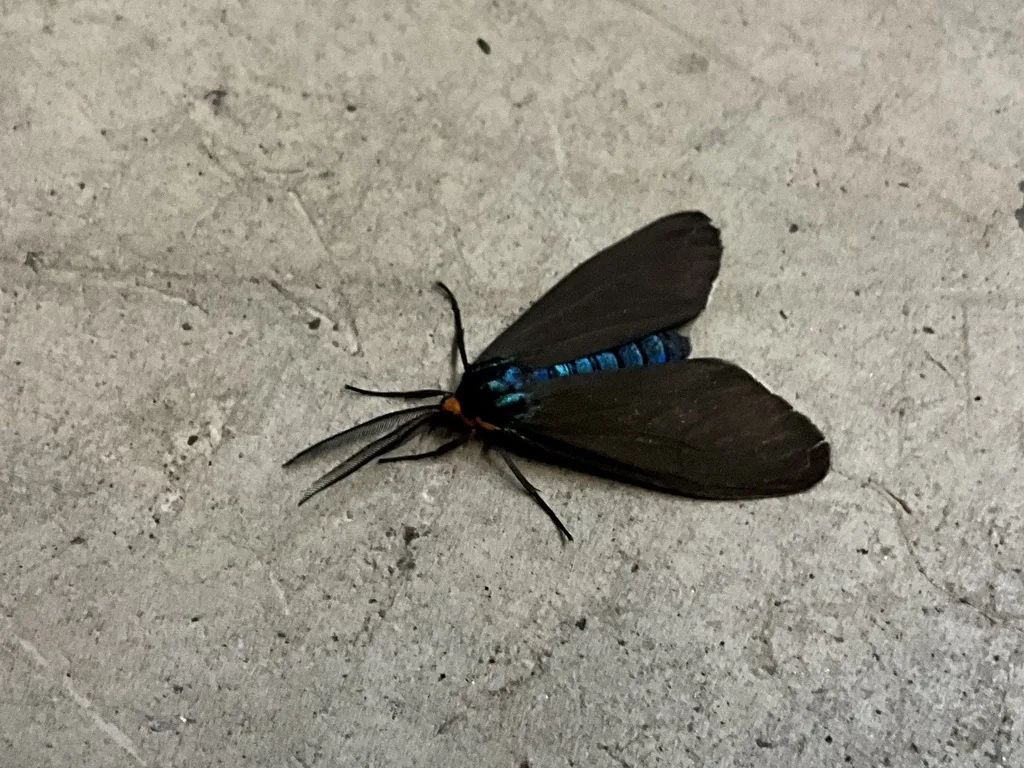
- A large wasp moth, the biggest in Ohio, with a wingspan of about 1.6 to 2 inches. The overall look is metallic blue-black, almost tropical.[1]
- The bluish metallic thorax stays visible even when the wings are folded, which separates it from similar wasp-mimic moths.[1]
- In flight it flutters like a butterfly, then ducks under a leaf and folds its wings when alarmed.[2][3]
Look-alikes
| Look-alike | How to tell them apart |
|---|---|
| Yellow-collared scape moth (Cisseps fulvicollis) | A smaller wasp moth that the Ohio guide lists right after the ctenucha; the ctenucha is the larger of the two and shows a metallic blue thorax at rest.[1] |
Where it lives
Mostly a northeastern species. It lives in weedy fields, wet meadows and other grassland where adults visit flowers.[2][1]
Biology and life cycle
Adults fly by day in the first half of summer and feed at flowers, particularly goldenrods.[1][2]
Caterpillars feed mainly on grasses, and also on sedges and iris.[1][2]
The species overwinters as a caterpillar. Larvae are active early in the year and are seen walking on warm roads in late winter and early spring.[2][3]
Some Ctenucha species mimic wasps or distasteful beetles, which may help them go unbothered on flowers.[2]
Damage and signs
Health risk
The sources describe no stings, bites or other effects on people; its wasp look is mimicry.[1][2]
Control
Prevention
No control is needed. The sources describe it as a showy native moth of weedy fields and wet meadows, not a pest.[1][2]
Common questions
- What is the black moth with a shiny blue body on my goldenrod?
- Very likely a Virginia ctenucha. It flies by day and keeps its metallic blue thorax visible even with the wings folded.[1]
- Why are caterpillars crawling around in winter?
- Virginia ctenucha caterpillars overwinter and are often seen walking on warm days in late winter and early spring.[2][3]
Sources
- Ohio Department of Natural Resources, Division of Wildlife, “Moths of Ohio Field Guide (Publication 5467).” dam.assets.ohio.gov/image/upload/ohiodnr.gov/documents/wildlife/backyard-wildlife/Moths%20of%20Ohio%20Field%20Guide%20pub5467.pdf (accessed 2026-11-10)
- University of Wisconsin-Milwaukee Field Station, “It's National Moth Week (soon), Bug of the Week (K. Redmond, 'the BugLady').” uwm.edu/field-station/bug-of-the-week/its-national-moth-week-soon/ (accessed 2026-11-10). University field station's natural-history column
- University of Wisconsin-Milwaukee Field Station, “Summer Sights - and Sounds, Bug of the Week (K. Redmond, 'the BugLady').” uwm.edu/field-station/bug-of-the-week/summer-sights-and-sounds/ (accessed 2026-11-10). University field station's natural-history column
- iNaturalist, “Ctenucha virginica taxon page (order and family).” www.inaturalist.org/taxa/119013 (accessed 2026-11-10)